Last night my son hit me, and I didn’t cry. This morning I got out the nice tablecloth, set breakfast like on special occasions, and when he came downstairs smiling, he said, “So you finally learned your lesson”… until he saw who was waiting for him at my table.
“If you ever say no to me again, I swear you’ll regret ever giving me life.”
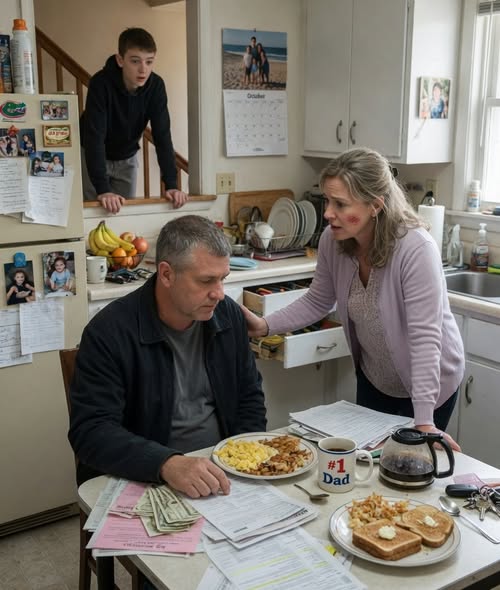
When my son said that in the kitchen of our house in Savannah, I thought it was just another tantrum, another outburst I’d been justifying for months to avoid facing the truth. But that night I wasn’t dealing with a confused boy anymore. I was dealing with a twenty-three-year-old man who had learned to turn his frustration into threats. 😡
Wyatt had always been tall, broad-shouldered, with a presence that filled any room even when he wasn’t saying a word. As a child, he was kind, restless, and affectionate. As a teenager, he began to fill with resentment. First, because his father, Harrison, moved to Denver after the divorce. Then, because he dropped out of college. First, it was because he couldn’t hold down a job. Later, it was because his girlfriend left him. And finally, he didn’t even need a reason anymore. Feeling hurt was enough for him to believe the whole world owed him something.
I defended him too much.
I defended his yelling when he started talking to me like I was some clumsy servant.
I defended his demands when he stopped asking for money and started claiming it as if it belonged to him.
I defended the slammed doors, the nights smelling of beer, the broken glasses, the lies, the “I’ll pay you tomorrow,” the “don’t exaggerate,” the “you always make me look like the bad guy.”
Sometimes mothers confuse love with resistance.
That night I came home tired from my shift at a school library. My legs ached, my back ached, and my pride ached too, stretching each paycheck to maintain a house where I no longer felt I owned anything. Wyatt came into the kitchen and asked me for money to go out. I told him no. Just that. No.
He looked at me with a dry smile.
“No?” he repeated. “And who do you think you are now?”
“I think I’m the one who pays for this house,” I replied, feeling my hands tremble. “It’s over, Wyatt. I’m not giving you another dollar for your nights out, your booze, or your lies.”
His face changed in an instant. His jaw tightened. His eyes turned cold.
“Don’t talk to me like that.”
“I’m talking to you the way I should have a long time ago.”
He let out a nasty laugh, one of those laughs that has no humor, only venom.
“Oh, yeah? Then learn your place once and for all.”
I didn’t even have time to breathe. His hand struck my face, swift and brutal in its suddenness. He didn’t knock me to the ground. There was no blood. No scene. The worst part was the silence that followed.
I stood there, one hand on the counter, listening to the whir of the refrigerator and the ticking of the clock as if everything in the house had grown enormous. Wyatt barely glanced at me for a second and, instead of apologizing, shrugged.
As if I was going to tolerate that too.
As if that blow hadn’t crossed a line.
He stormed upstairs, slamming the door, and I was left alone in the kitchen, my cheek burning and a truth piercing me deeper than the blow: I wasn’t safe in my own home anymore.
At 1:20 a.m., I picked up the phone and called the one man I didn’t want to call, but I had to.
Harrison answered, his voice heavy with sleep.
“Leona?” It took me two seconds to speak, but once I did, there was no going back.
“Wyatt hit me.”
There was a short, heavy silence on the other end.
Then I heard his voice, firm in a way I hadn’t heard in years.
“I’m on my way.”
I didn’t sleep. At four in the morning, I started cooking. I made red chilaquiles, refried beans, eggs with chorizo, coffee brewed in a clay pot, and I brought out the good dishes, the ones I almost never used. I also spread out the embroidered tablecloth I kept for Christmas and baptisms.
It wasn’t a celebration.
It was a decision.
Shortly before six, Harrison arrived. He came in with grayer hair, a dark coat, and a brown folder under his arm. He didn’t ask pointless questions. He looked at my face, saw my trembling hands, and understood everything.
“Is he upstairs?” he asked.
Asleep.
His eyes scanned the set table.
“You always cooked like this when you were about to change something big.”
I looked at him and, for the first time in a long time, I felt truly seen.
“This ends today, Harrison.” He placed the folder on a chair and took a step closer.
“So tell me one thing, Leona. Is he leaving this house today?”
I closed my eyes. I thought of Wyatt as a child, with scraped knees and a confident smile. I thought of Wyatt last night, bumping into me and going upstairs as if I were nothing, just a nuisance.
I opened my eyes.
“Yes. Today.”
Harrison nodded, opened the folder, and placed several documents on the table.
And just as he was about to explain what he’d brought, we heard the creaking of the stairs.
Wyatt was coming down.
And I had no idea who was waiting for him in the kitchen.
Wyatt descended the stairs with that familiar cocky swagger, phone in hand, scrolling as if last night had never happened. His eyes landed on the beautifully set table first—the embroidered cloth, the steaming dishes, the good china. A smug smile spread across his face.
“So you finally learned your lesson,” he said, voice dripping with entitlement as he reached for a plate. “Smart move, Mom. I knew you’d come around—”
Then he looked up and froze. The plate slipped from his hand and shattered on the floor. His eyes widened at Harrison sitting calmly at the head of the table, then darted to me, the bruise on my cheek now visible in the morning light. 😱
“Dad? What the hell are you doing here?”
Harrison didn’t raise his voice. He didn’t need to. His presence filled the room like it used to when Wyatt was small and looked up to him. “Sit down, son.”
Wyatt laughed nervously, but his hands shook. “This is bullshit. Mom’s exaggerating again. It was just a slap. She pushed me first—”
“I didn’t,” I said quietly, voice steady for the first time in years. “And even if I had, no one deserves to be hit in their own home. Especially not by their child.”
Harrison slid the folder across the table. “These are eviction papers, Wyatt. Signed by your mother this morning. You have 48 hours to leave. We’ve also frozen the joint accounts you’ve been draining. And there’s a police report filed for domestic assault.”
Wyatt’s face turned red with rage. “You can’t do this! This is my house too! Dad, tell her—”
“Your mother owns this house outright,” Harrison replied coldly. “I made sure of that in the divorce. You’ve been living here rent-free, taking advantage of her for years. That ends today. The folder also has the numbers for a men’s anger management program and a job placement service. Use them or don’t. But you’re not staying here.”
The confrontation exploded with raw emotion. Wyatt yelled, pleaded, then threatened. “You’ll regret this! Both of you! I’ll tell everyone you’re crazy, Mom. That you’re unstable!”
I stood up, tears in my eyes but strength in my voice. “I defended you for too long, Wyatt. I thought love meant enduring your pain. But love also means protecting myself. Last night you crossed a line no child should ever cross. I love you enough to stop enabling you.” ❤️
Harrison added quietly, “I failed you by moving away and not staying involved. But I won’t fail your mother again. Pack your things.”
Wyatt stormed upstairs, slamming doors, but the fight had gone out of him. By noon, with Harrison’s help and a police escort for safety, he was gone. The house felt lighter, quieter, safer.
That afternoon, the weight of years lifted as I sat in the empty kitchen with Harrison. We talked for hours—real talk, painful and honest. “I saw the signs but stayed away,” he admitted, voice thick. “I thought you’d handle it. I’m sorry, Leona.”
We cried together for the boy we both lost to resentment. But we also planned. Harrison would stay in Savannah for a while to help with the transition. Therapy for all of us. Boundaries rebuilt.
The story didn’t stay hidden. A neighbor who saw Wyatt leaving with bags anonymously shared details online. Combined with my quiet post in a local moms’ group, it went viral. “Mother sets breakfast after son hits her—ex-husband shows up and evicts him 😭👏 #ToxicSon #MamaBoundaries”. Millions viewed across TikTok, Instagram, and Facebook. Comments flooded: “This took courage 🔥”, “Mothers, stop enabling adult children!”, “Proud of her for choosing peace 😢”, “Real dad stepped up!”. News outlets covered it as “The Breakfast That Ended Years of Abuse.” Reach exploded into tens of millions, sparking conversations on adult child entitlement, domestic violence from family, and mothers reclaiming their homes.
I didn’t stop at eviction. I channeled the pain into purpose. With Harrison’s support and a team of counselors, I founded the Savannah Safe Haven Foundation—support for parents of adult children struggling with entitlement, anger, and abuse. It offered therapy scholarships, life skills workshops, emergency housing for abused parents, and community gardens for healing. The launch event in our backyard (with the tablecloth from that morning) was emotional. I spoke with Wyatt’s baby photos behind me: “I loved my son enough to let him go. If you’re a parent walking on eggshells in your own home, know this: Your safety matters. Love with boundaries. It’s never too late to choose yourself.” Survivors hugged me afterward, sharing stories that mirrored mine. One mother said, “Your viral breakfast story gave me strength to evict my 28-year-old son. Saved my life 😭”. The foundation grew rapidly, impacting thousands through online resources, support groups, and viral awareness campaigns like #BreakfastBoundaries.
Wyatt checked into anger management after a short stint with friends. Months later, he reached out via letter: “I’m sorry, Mom. I’m working on myself.” I replied with boundaries: “Prove it with actions. Therapy first. No money, no staying here.” Slow progress began. Harrison stayed involved as a co-parent in healing.
My home became a sanctuary again. Evenings on the porch, coffee in peace, laughter returning. I planted new flowers where old wounds once lingered. Mia—no, in this story, friends’ children visited, reminding me of joy.
The important message that resonated worldwide: Mothers are not doormats for their children’s pain. Enabling abuse—even from your own child—destroys everyone. Set boundaries. Choose safety. Love doesn’t mean endless tolerance. To every parent walking on eggshells: Your home is yours. Your peace is sacred. Document incidents. Reach out for help. Evict if needed. Real love holds accountable. To adult children: Your parents owe you guidance, not endless resources or tolerance for harm. Grow up. Seek therapy. Respect the woman who gave you life. Your four-word silence or breakfast decision can break cycles and save generations. Families heal when truth is served at the table. Bloom after the storm. You deserve peace in your own home. 💪❤️🍳✨
From the sting of that slap to the strength of a set table and an ex-husband’s support, Leona’s story proved: A mother’s love sometimes means the hardest goodbye. But in letting go, she reclaimed everything—including herself.
THE END