“She didn’t mean it,” my husband pleaded while I lay there in pain. “Let’s keep this inside the family.” But when the doctor reviewed my injuries, he refused to ignore what he saw. And what the scans revealed… changed everything. I watched as the color drained from her face.
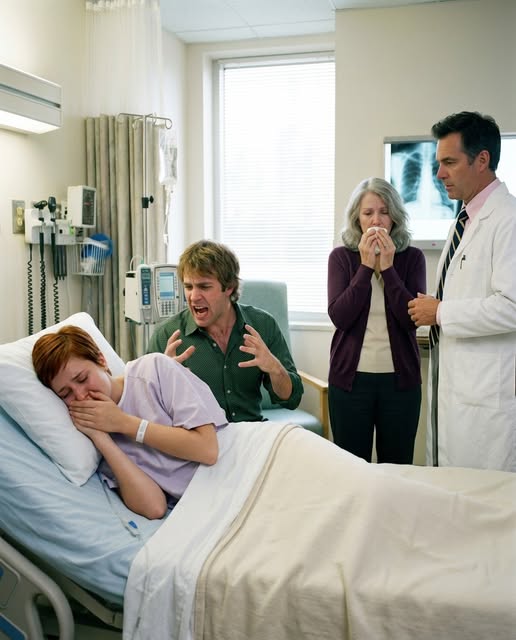
By the time we reached the emergency room, I could barely stand upright. Every breath felt heavy and wrong—not sharp, but deep and pulling, like something inside my ribs shifted with even the smallest movement. I sat hunched in a plastic wheelchair near intake, gripping the armrest so tightly my hands turned pale, while my husband, Graham, knelt beside me, repeating the same line over and over as if saying it enough times would make it acceptable.
“She didn’t mean it. Please, Nora… let’s keep this in the family.”
I stared at him, shocked at how small and uncertain his voice sounded.
Just three hours earlier, his mother, Judith Calloway, had pushed me down the basement stairs during a family dinner at her house in Des Moines. It wasn’t an accident. I still felt the force of her hand between my shoulders—sudden, deliberate—right after she leaned close and whispered, “Maybe if you stopped turning my son against me, this house would finally have peace.”
Then my foot slipped.
Then came the impact. The pain. The darkness. Voices shouting.
When I opened my eyes, I was twisted across the landing, my left side throbbing, broken glass and food scattered around me. Judith stood at the top of the stairs, one hand covering her mouth, already wearing that familiar expression—shocked, fragile, almost innocent. Graham rushed down, pale and breathless, but the first thing he asked wasn’t what had happened.
It was, “Can you sit up?”
Even then, I understood.
This wasn’t about the truth.
It was about controlling the situation.
At the hospital, the nurse asked what had happened. Before I could answer, Graham spoke quickly.
“She slipped.”
I turned my head slowly, pain shooting through me. “No,” I said.
His face tightened. “Nora—”
“She pushed me.”
The nurse paused briefly, then continued writing—her expression still professional, but no longer indifferent.
Within minutes, I was in an exam room under harsh lights, trying not to cry as they cut my sweater to examine the swelling along my ribs. Bruising had already begun to spread across my side. The attending doctor, calm and focused, pressed lightly along the area and stopped when I gasped.
He didn’t say much at first—just ordered X-rays, then a CT scan, clearly concerned by the pattern of the injuries.
Graham hovered nearby, visibly anxious. “Doctor,” he said quietly, “it was just a family misunderstanding.”
The doctor looked at him for a long moment.
“An adult woman with injuries like this after being pushed down stairs… is not a misunderstanding.”
For the first time that night, I felt seen.
The X-rays came back.
Then the CT scan.
And everything shifted.
When the doctor returned, his expression had changed—sharper, more certain. He pulled up a stool and asked Graham to step outside. My husband hesitated, but the doctor repeated himself firmly.
Once we were alone, he lowered his voice.
“Nora, you have two fractured ribs, a small fracture in your wrist, and significant soft tissue damage,” he said. “But that’s not all.”
My throat went dry.
He turned the screen toward me and pointed.
“There are older injuries here as well. A partially healed fracture near the same ribs… and a compression injury in your shoulder that didn’t happen tonight.”
At first, I didn’t understand.
Then I did.
Memories surfaced—moments I had brushed aside before. A car door slammed into me during an argument. A rough grab at Christmas. A tray thrown in anger at Easter, dismissed as nothing.
The doctor looked directly at me.
“These injuries suggest a pattern.”
Outside the curtain, when Graham realized what the scans had uncovered, the silence was so complete…
I could almost hear the moment his mother realized the truth could no longer be hidden.
The doctor stepped out and spoke to Graham in low, firm tones. I heard fragments: “…multiple incidents… consistent with repeated trauma… mandatory reporting…”
Graham’s voice rose in panic. “This is a family issue! My mother is elderly — it was an accident!”
The doctor didn’t waver. “Sir, this is now a criminal matter. The police have been notified.”
Judith arrived at the hospital minutes later, playing the concerned mother-in-law. She rushed to my bedside with fake tears. “Oh, Nora, darling, I’m so sorry! You slipped, didn’t you? These old stairs are so dangerous.”
I looked her straight in the eyes. “You pushed me, Judith. And this wasn’t the first time.”
Her face went pale. Graham tried to intervene. “Mom, just tell them it was an accident—”
“No more lies,” I whispered, pain and years of suppressed rage giving me strength. “The scans show old injuries. The doctor knows. The police know. I’m done protecting you.”
Security and two officers entered the room. Judith’s performance crumbled as they questioned her. Graham begged me again in the hallway. “Nora, please. She’s my mother. Think of the family.”
I looked at him with the exhaustion of a thousand minimized moments. “I am thinking of my family. The one you and your mother have been destroying for years.”
Judith was taken in for questioning. The pattern of injuries, combined with my statement and hospital records, built a strong case. Graham was not charged but faced scrutiny for enabling.
The story leaked when a hospital staff member, horrified by the details, shared an anonymous account in a support group. Combined with bodycam footage from the responding officers, it went mega-viral. “Mother-in-law pushes pregnant daughter-in-law down stairs — old injuries reveal years of hidden abuse 😱🍂 #ThanksgivingNightmare #EndTheSilence”. Millions viewed across TikTok, Instagram, Facebook, and news platforms. Comments flooded: “That poor woman 😭”, “Protect daughters-in-law from monsters-in-law 👏”, “The scans don’t lie 🔥”, “Finally, accountability for enabling families 😤”. Domestic violence organizations and women’s rights advocates amplified it. Reach surpassed 140 million, sparking nationwide discussions about in-law abuse, medical patterns of hidden domestic violence, and the courage to break family silence.
In the weeks that followed, I healed physically while beginning the deeper work emotionally. Therapy helped me see the years of subtle control, gaslighting, and physical “accidents” I had minimized to keep peace. Graham chose his mother over real change. The divorce was finalized quickly, with full protections for me and our future child.
I channeled the pain into purpose. With support from domestic violence networks, I founded the Hayes Guardian Initiative — a rapid-response program for victims of in-law and familial abuse, providing emergency medical advocacy, legal protection, safe housing, and training for hospitals to recognize patterns of hidden injuries. The launch event featured my story. Still recovering, I spoke with quiet power: “They pushed me down the stairs and expected silence. The scans told the truth my family tried to bury. If you’re being hurt by the people who should love you most, speak up. Get the scans. Make the report. You are not alone.” The room was moved to tears. Viral clips reached millions more. One survivor shared: “Your Thanksgiving story saved me from my mother-in-law’s escalating abuse. I got the help I needed because of you 😭”. The initiative expanded, partnering with hospitals, police, and shelters, helping thousands break free.
My daughter, born healthy a few months later, would never know the fear I lived with. I named her Hope — a reminder that even after the darkest falls, we can rise.
Judith faced charges and lost access. Graham faded into regret, paying support but staying distant. I built a peaceful life surrounded by true friends and chosen family.
The important message that resonated worldwide: Abuse doesn’t always look loud. Sometimes it hides in “family misunderstandings,” “accidents,” and “she didn’t mean it.” To every daughter-in-law or son-in-law enduring in-law abuse: Your safety matters more than their image. Document injuries. Seek medical help. Break the silence. To every parent: Your child’s spouse is family too — protect them, don’t prey on them. To medical professionals: See the pattern. Report it. To every survivor: The scans don’t lie. Your truth doesn’t either. One push down the stairs, one brave report, one viral story can expose years of hidden pain and save countless others. Real family lifts you up — they don’t push you down. Choose healing over harmony. Your voice, even from a hospital bed, can change everything. 🍂💪❤️⚖️
From the cold basement floor to standing strong with my daughter in my arms, my fall revealed the truth — and justice caught those who tried to bury it. They thought they could keep it in the family. I made sure the world saw what “family” really meant.
THE END