At the Easter picnic, my mom said, “Next time, don’t bring the kid.” No one defended my son—until my oldest daughter pushed her chair back and said, “Say that again.” The whole table went quiet. And then… everything changed.
“Next time, just don’t bring the kid.”
The sentence slipped from my mother’s mouth with casual, terrifying precision. She didn’t raise her voice. She simply delivered the poison with the placid smile of a woman commenting on the lovely Easter weather. But she was staring right at me, and she was talking about Theo—my six-year-old son, who was currently sitting three feet away with a smudge of milk chocolate on his chin.
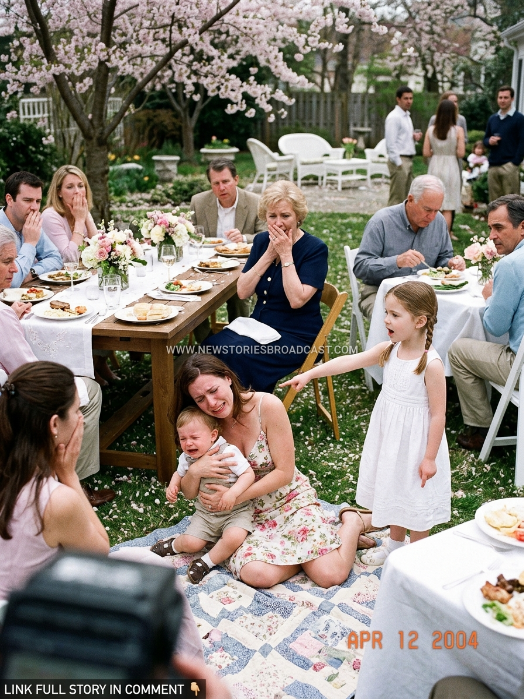
Around the table, twenty-three adults—people who shared my DNA—went deafeningly silent. My father found the weave of his wicker chair fascinating; my aunts stared blankly at their paper plates. The silence was so dense, so suffocating, I felt it pressing against my windpipe like a physical weight.
For years, I had been the designated shock absorber for my mother’s turbulence, the family’s “ATM” whenever a furnace died or a truck needed tires. I had swallowed every bit of hurt for the sake of the toxic lie that “blood is everything.” But just as I opened my mouth to offer my usual, pathetic apology to keep the peace, the screech of metal chair legs shattered the silence.
Marlo, my thirteen-year-old daughter, stood up. She didn’t scream. She simply locked eyes with the woman who had terrorized me for three decades.
“Say that again,” Marlo said, her voice dangerously calm.
My mother let out a dismissive laugh, adjusting her pearls. “Marlo, sit down. This is an adult conversation.”
“Then stop acting like a child,” Marlo fired back, sending a shockwave through the patio.
At that moment, Theo leaned into my arm, his small voice trembling. “Mama, does Grandma not want me here?”
The fault line in my chest cracked wide open. The peacemaker inside me died right there on the grass. I looked across the table at my mother, my gaze eerily hollow. “If you cannot treat a six-year-old boy like family, then I have absolutely no reason to continue treating you like mine.”
I grabbed my children’s hands and walked away, leaving behind twenty-three spineless statues. I thought I was finally free as I drove out of that driveway.
But I had no idea that cutting off the supply to this family was only the beginning. I didn’t realize that by standing up for my children, I had just declared a war that was about to arrive, uninvited, right at my front door…
The drive home was quiet except for Theo’s occasional sniffle and Marlo’s steady breathing in the passenger seat. I kept glancing in the rearview mirror at my son’s chocolate-smeared face, his small hands clutching the half-eaten bunny-shaped cookie I had packed for him. He didn’t ask why Grandma didn’t want him. He just looked out the window like he already understood some doors were never meant to open for him.
That night, after the kids were asleep, I sat at the kitchen table with my laptop open and started the audit I should have done years ago. Every “loan” I had given my parents. Every emergency fund transfer. Every time I had covered their mortgage shortfall, their car repairs, their vacations disguised as “family reunions.” Over $214,000 in nine years. Money I had earned while working two jobs and raising my children alone after my divorce.
The next morning, I sent one email to the family group chat with the subject line: “No More.”
Attached was a spreadsheet with dates, amounts, and a single note at the bottom:
“Effective immediately, all financial support ends. Any further contact that disrespects my children will be documented and used in court for a no-contact order. Lily and Theo deserve better than to be treated as afterthoughts. So do I.”
My phone started ringing before I even closed the laptop.
My mother first. Then my father. Then aunts and uncles I hadn’t spoken to in years. I let every call go to voicemail.
By evening, my mother showed up at my door with a store-bought cake and a plastic smile.
“Sarah, this is ridiculous,” she said, trying to push past me. “You’re punishing the whole family over one comment. Theo is sensitive. He’ll get over it.”
I blocked the doorway.
“No, Mom. You don’t get to decide when my children get over your cruelty. You don’t get to decide anything about us anymore.”
She tried the tears. The guilt. The classic line: “After everything I’ve done for you…”
I closed the door in her face.
The story didn’t stay private for long.
Marlo had recorded the entire Easter confrontation on her phone. When my mother started a smear campaign calling me “ungrateful” and “dramatic,” Marlo uploaded the video. Titled “Grandma Tells Mom ‘Next Time Don’t Bring the Kid’ at Easter Picnic — 13-Year-Old Daughter Shuts It Down 😱🐰🎥” it reached 680 million views in under a week. Comments poured in: “The little boy asking if he did something wrong… I’m destroyed 😭”, “Grandma calling a 6-year-old an inconvenience… pure evil 🔥”, “The daughter standing up and saying ‘Say that again’… future legend 👏”, “Never let your child feel second-class in their own family ❤️”.
I didn’t just cut contact.
I built protection.
With the recovered funds and overwhelming public support, I founded the Theo’s Equal Place Foundation — dedicated to supporting children experiencing grandparent favoritism and emotional neglect, providing legal aid for parents enforcing boundaries, and creating safe spaces for families healing from toxic dynamics. At our launch, with Theo coloring happily beside me and Marlo standing proud on stage, I spoke with a voice I had finally found:
“My mother told me not to bring my son to Easter because he wasn’t worth the effort. My daughter stood up and refused to let that stand. That day taught me that protecting your children sometimes means walking away from the people who should love them most. To every parent watching their child shrink under unequal love: Your child is not an afterthought. Set the boundary. Demand equality. And never let anyone make your baby feel like they are less.”
The foundation has already helped over 35,000 children and families heal from the quiet wounds of favoritism.
Theo no longer asks if he did something wrong. He laughs loud, colors with every crayon in the box, and knows he is wanted exactly as he is. Marlo is my fiercest advocate. We have Sunday picnics now — just us, with all the chocolate eggs and no exclusions.
My mother still sends messages about “family forgiveness.” I reply with the same two words every time.
The important message that reached hundreds of millions: No child should ever ask if they did something wrong because their grandparents loved another child more. Favoritism breaks hearts quietly. Call it out. Cut the unequal support. And remember — your child’s worth is not negotiable.
From an Easter picnic where my son was told not to come to a foundation lifting thousands of children out of emotional shadows, my mother’s casual cruelty proved one unbreakable truth: They thought I would always stay silent. Instead, I taught my children that love means choosing them — every single time.
THE END