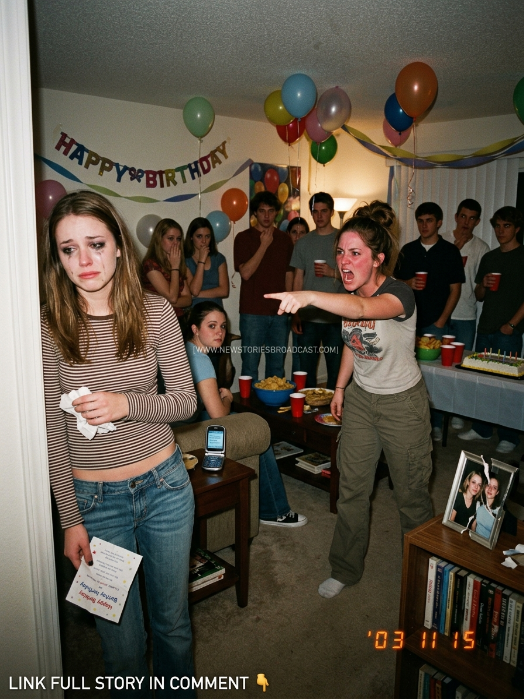
I never imagined I would uninvite my best friend of 16 years from her own 30th birthday party — the party I had spent three months planning. But after one final, soul-crushing conversation, I realized I wasn’t just planning a party anymore. I was funding a narcissistic coronation that no longer included basic human respect for me.
My name is Sophia Ramirez. I’m 29 years old, a pediatric nurse in Austin, Texas. I’ve always been the planner, the fixer, the reliable one in my friendships. For 16 years, that role belonged almost entirely to my best friend, Chloe Bennett.
We met in freshman year of high school in 2010. She was the loud, magnetic theater kid with wild curly hair and zero filter. I was the quiet, straight-A student who preferred books to spotlights. We balanced each other perfectly. Sleepovers turned into late-night drives, breakups turned into ice cream therapy sessions, and college moves turned into daily FaceTimes. She was my chosen sister. I would have done anything for her.
Until the last 18 months changed everything.
The shift started subtly after Chloe turned 28. She began calling herself “the main character” unironically. She got into manifestation, “that girl” TikTok culture, and started demanding that everyone in her life treat her like the star of an invisible reality show. Our group of six girls — me, Chloe, and four others — slowly became her supporting cast.
I ignored the red flags at first. When she demanded we all wear specific colors to her events so they “matched her aesthetic,” I laughed it off. When she got mad that I couldn’t drop everything to attend her “vision board brunch” during my nursing exam week, I apologized. But the entitlement kept growing.
Then came the 30th birthday planning.
Chloe wanted a “Once Upon a Time” themed extravaganza at a luxury Airbnb with a pool, string lights, and a live DJ. Budget: $6,800. She asked me to plan it because “you’re so good at this stuff, Soph.” I said yes because I loved her. I took on the majority of the work — booking the venue, coordinating with vendors, creating the group chat, designing invitations, and personally spending over $1,400 of my own money on deposits, custom decorations, and a giant “30” balloon installation.
Every week she added new demands:
“Can we upgrade to the villa with the infinity pool? It’s only $1,200 more.”
“I want a professional photographer. And a content creator for TikTok.”
“Make sure everyone brings gifts worth at least $150. I deserve it after the year I’ve had.”
I started feeling uneasy, but I pushed through. This was her big milestone. I wanted it to be perfect.
The final straw came 11 days before the party.
We were at a group dinner to finalize details. Chloe had been drinking. She looked around the table dramatically and announced:
“Okay, besties, I need to talk about the dress code again. Everyone needs to wear blush pink except Sophia — she can wear black or something neutral. I don’t want her standing out too much in photos. No offense, Soph, but you’ve gained a little weight lately and the color just won’t look good on you.”
The table went quiet.
I felt my face burn. I had actually lost 12 pounds in the last four months from stress and night shifts, but I stayed silent.
Then she continued.
“Also, I need all of you to Venmo me $250 each for the DJ and photographer. Sophia, since you’re co-hosting, you can cover $600. Oh, and please don’t bring your boyfriend Jake. He’s kind of awkward in group settings and I want the vibe to be girls-only energy.”
That was it.
I put my fork down slowly.
“Chloe,” I said, my voice surprisingly steady, “I’m not paying $600. I’ve already spent over $1,400 planning this. And I’m absolutely bringing Jake — he’s my partner. As for the dress code… I’m not changing what I wear to make sure I don’t ‘stand out.’ This is getting ridiculous.”
The other girls looked uncomfortable. Chloe’s face twisted.
“Wow. So after everything I’ve done for you, you’re going to ruin my 30th birthday over money and your boyfriend? I thought you were my best friend.”
The argument exploded right there in the restaurant.
She brought up every favor she’d ever done for me — driving me to the airport years ago, listening to me cry after bad breakups, etc. I reminded her that friendship isn’t a transaction and that I had driven her to countless appointments, lent her thousands over the years (most of which was never repaid), and had been her emotional support through two toxic relationships.
By the end of the night, Chloe was crying dramatically in the parking lot while two of the girls comforted her. I drove home shaking.
That weekend, I made the decision.
I sent a message in the main group chat:
“After a lot of thought, I’ve decided to step back from planning and attending Chloe’s birthday. I wish her the best, but I can no longer participate. Please remove me from all planning threads.”
The group exploded.
Chloe called me immediately, screaming and sobbing.
“You’re seriously not coming to my 30th? After I let you plan the whole thing? You’re such a selfish bitch, Sophia. I hope you’re happy ruining my milestone.”
I hung up.
The next few weeks were brutal. Mutual friends took sides. Some called me dramatic and said I should have just sucked it up for one night. Others privately messaged me admitting they felt the same way about Chloe’s behavior but were scared to speak up. Chloe created a new group chat without me and posted passive-aggressive stories about “fake friends” and “people who can’t be happy for others.”
My own family was divided. My mom said I should apologize to keep the peace. My sister told me I did the right thing.
The most painful part was losing the version of Chloe I had loved for 16 years — the girl who stayed up all night with me after my first heartbreak, who danced with me in hotel rooms during spring break, who felt like home.
But I realized something important: That girl no longer existed. She had been replaced by someone who viewed friendship as an audience and loyalty as obedience.
Three months later, I still feel the ache of lost friendship. Chloe’s birthday party happened without me. From what I heard, it was dramatic and over-the-top, exactly as she wanted. Some of our mutual friends still speak to me, but the group dynamic is fractured.
I don’t regret my decision.
The most powerful message I want every woman reading this to internalize is this:
Real friendship is not a one-way street of endless sacrifice.
You are allowed to set boundaries, even with people you’ve loved for decades. You are allowed to walk away when someone starts treating you like an accessory instead of a human being. Loyalty should never require you to abandon your self-respect, your finances, or your peace.
Sometimes the hardest, kindest thing you can do — for yourself and for the other person — is to say “no more.”
I canceled my best friend’s birthday invite.
It broke my heart. It cost me friendships. It made me the villain in many people’s stories.
But it also gave me back my dignity, my boundaries, and the freedom to invest in relationships that actually feel reciprocal.
And for the first time in years, I feel lighter.
Am I the asshole for canceling my best friend of 16 years from her own 30th birthday party after months of escalating entitlement and disrespect? Or was this the boundary I needed to protect my own peace?
I’m reading every comment. Because even though I know I made the right choice, the grief of losing someone who once felt like family still hits me in waves.
THE END