PART 3 — FULL STORY / COMPLETE ENDING
FULL STORY — PAGE 1
The Patient in Trauma Room 2
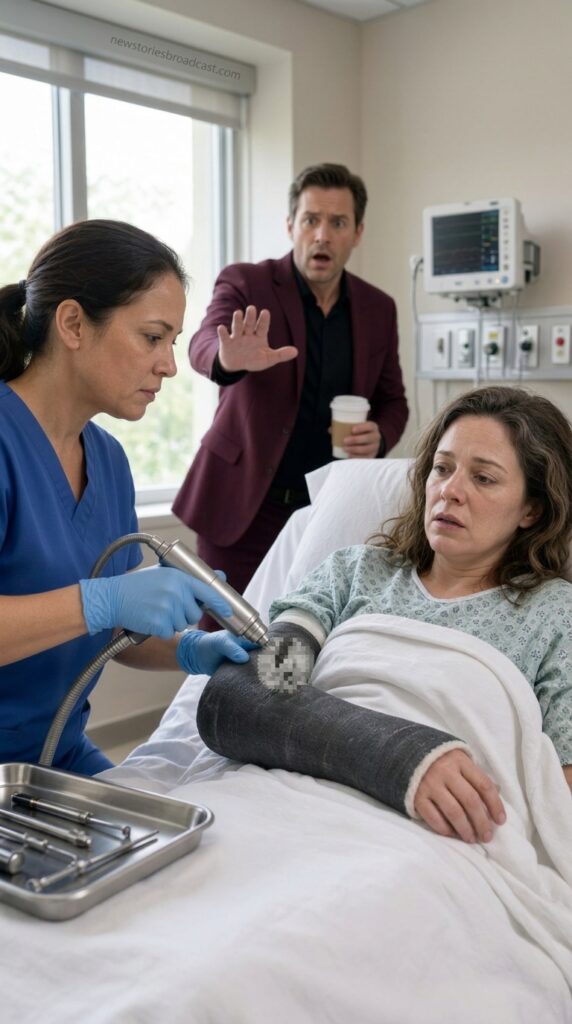
The smell reached me before the stretcher did.
Sickly sweet.
Metallic.
Rotten.
Sharp enough to cut through the clean hospital air.
Even the nurses at the station reacted.
After eight years in emergency medicine, I knew that smell did not belong anywhere near a routine case of the flu.
I’m Dr. Sarah Jenkins.
I’ve learned that the most dangerous patients don’t always arrive surrounded by shouting relatives and frantic explanations.
Sometimes the room is strangely controlled because one person is working very hard to make everyone believe nothing serious is happening.
Marcus, one of our nurses, hurried toward me.
“Thirty-two-year-old female. Fever 103.8. Heart rate almost 140. Blood pressure dropping. She can barely respond.”
Then he glanced toward Trauma Room 2.
“Her husband keeps saying it’s the flu,” he said quietly. “But Sarah, look at her arm.”
I did.
Emily Harris looked painfully fragile against the bed.
Her lips were cracked.
Her face was hollow.
Her skin had the washed-out pallor I had seen in patients whose bodies were burning through every reserve they had left.
Her right arm was trapped inside a fiberglass cast running from her fingers to above her elbow.
It was stained and filthy, and the skin around its edges had swollen far beyond anything I considered normal.
Then I saw her fingers.
Purple.
The tips were already turning blue.
I pressed gently against one fingertip and waited for the color to return.
I watched the skin.
Counted the seconds.
Checked again.
Nothing.
“How long has she had this cast?” I asked.
A man in the corner slowly looked up from a Starbucks cup.
Daniel Harris, Emily’s husband, looked completely disconnected from the emergency unfolding a few feet away.
Expensive jacket.
Perfect hair.
Polished shoes.
He looked like someone waiting through an inconvenient appointment.
“About a month,” he said. “Emily is clumsy. She fell down the stairs.”
He took another sip of coffee.
“She felt warm this morning. Probably some seasonal virus.”
I looked at Daniel.
Then Emily.
Then back at the swollen hand extending from that dirty cast.
This was not a mild fever.
Not normal swelling.
Not circulation I was willing to ignore.
“Mr. Harris, your wife is critically ill,” I said. “Her body is showing signs of severe infection. I need to remove this cast immediately. Her hand is at risk, and if the infection has spread, she could die.”
I expected him to look frightened.
Instead, his expression hardened.
“No,” he snapped. “Her orthopedic surgeon said it stays on for another two weeks. Give her antibiotics and we’ll go home.”
There it was.
The casual husband with the coffee was gone.
His voice had changed.
So had the entire feeling of the room.
He wasn’t asking what Emily needed.
He was telling me what I was allowed to do.
I looked at Emily again.
She could barely respond.
Her fever was 103.8.
Her blood pressure was falling.
Her fingers were turning blue while her husband argued about taking her home.
Whatever explanation Daniel wanted me to accept, Emily’s body was contradicting it in front of us.
“I’m removing the cast,” I said.
For the first time, real panic flashed across his face.
I turned toward the equipment cabinet and reached for the cast-removal kit.
The moment my hand closed around it, Daniel stopped pretending this was a routine disagreement.
“You’re not listening to me,” he said. “Her doctor already told us what to do.”
I kept my attention on Emily.
Her fingertips were still discolored, and the swelling above the edge of the cast looked even worse from this angle.
The odor was strongest near her arm.
“Her condition has changed,” I told him. “I’m treating the patient I have in front of me right now.”
Marcus stayed beside the bed, watching Emily’s vital signs.
Daniel tightened his grip around the paper coffee cup.
“Give her antibiotics,” he repeated. “We’re leaving.”
“No.”
It was the first word I gave him without an explanation attached.
Emily needed treatment.
Whatever argument Daniel wanted to have could come later.
I brought the cast-removal kit to the bedside.
Then Daniel moved away from the wall and came toward the end of Emily’s bed.
Marcus noticed it too.
He shifted closer to Emily, not Daniel, and kept one hand near the bed rail while watching the monitor.
I had spent enough years in emergency medicine to recognize the difference between a frightened spouse and someone frightened of losing control of the room.
Daniel was watching my hands.
Not Emily’s face.
Not the blood pressure cycling lower on the monitor.
My hands.
Specifically, the cast-removal kit in them.
“Don’t do that,” he said.
His voice was quieter now.
Somehow, that made it more concerning.
“Your wife’s circulation is compromised, and she is critically ill,” I told him. “I’m removing it.”
“You’re making this into something it isn’t.”
Emily made a faint sound from the bed.
That ended the conversation for me.