It was pale blue, the same color as the hospital walls, and for a few seconds it was just another detail in a room full of machines, paperwork, and exhausted people.
Then I saw where she looked first.
Image
Not at Emma.
Not at the monitor.
Not at the surgeon’s notes beside the bed.
She looked at the paper cups on the counter and asked why the payment had not been handled yet.
Emma was four years old.
She had fallen from our treehouse at 4:18 on Thursday afternoon after a railing board snapped. By 5:41, I was under the harsh hospital lights listening to a surgeon explain a skull fracture, swelling, bleeding, and the emergency procedure they needed to perform.
I signed every form they placed in front of me.
I followed Emma’s bed until the doors closed between us.
After that, I sat outside the operating area holding the edge of her white hospital band because it was the only thing my hands could find when they started shaking.
Marcus sat beside me with a coffee he never drank. Josh showed up later carrying chargers, hoodies, and snacks he hoped I could eat.
I called my parents three times before I remembered that some patterns do not disappear just because they hurt you.
When my father answered, I told him Emma might not survive the night.
His first question was about money.
He asked why I had not sent Charlotte $2,300 for Madison’s birthday party.
I said no.
I ended the call.
Fifteen minutes later, my mother sent an invoice with a Friday deadline. Under the total was one sentence: Madison is counting on you.
I looked at that message while my daughter was in surgery.
The next morning, I ate two crackers from a vending machine bag because I had forgotten what hunger felt like until it became impossible to ignore. The rest of the bag stayed crushed beside my chair.
My father called again the next afternoon.
He asked what was holding up the payment.
I told him that if he asked for another cent while Emma was in intensive care, he would never speak to me again.
For about an hour, there was silence.
Then my mother’s voice came from the nurses’ station.
She entered the ICU wearing a visitor band and speaking softly.
She said they were worried about everyone.
She said Charlotte was overwhelmed.
She said Madison was hurt.
She said I was turning one family emergency into five.
I pointed toward the exit.
They did not leave.
My father folded his arms.
My mother stepped closer to Emma’s bed and told me I was too emotional to understand what I was doing.
I reached for the call button.
She reached first.
Her purse hit the rail.
Marcus stood up.
The room changed.
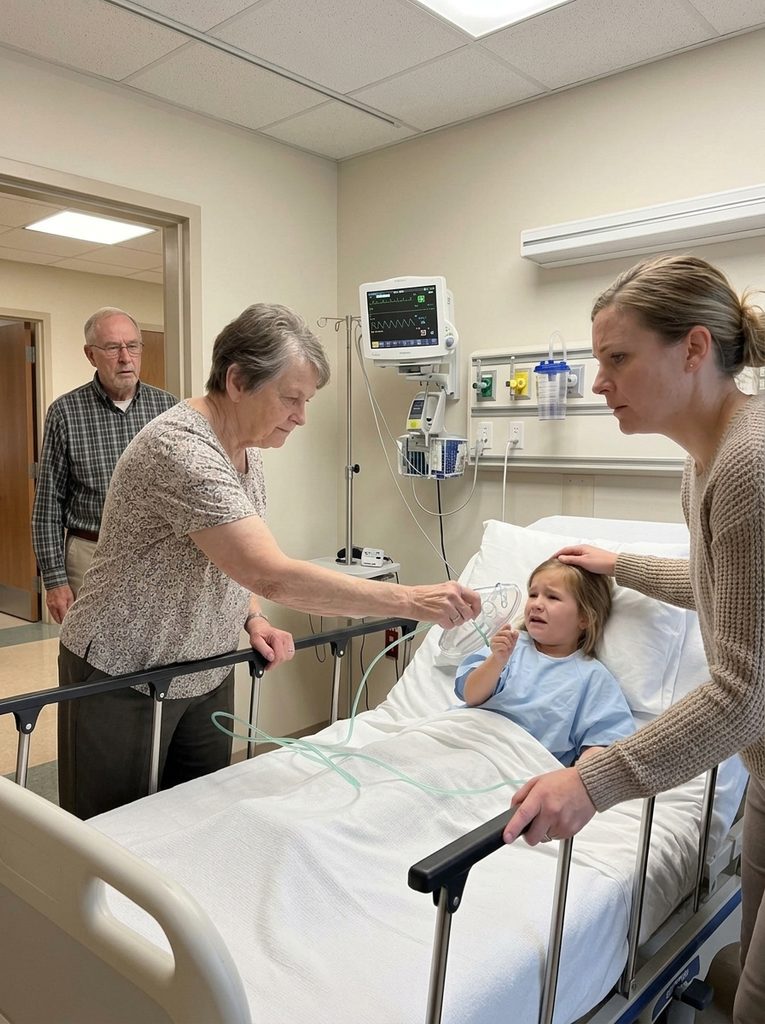
My mother pulled Emma’s oxygen mask away before the nurse could get between them.
Emma made one small sound.
The alarms sharpened.
The nurse replaced the mask.
I stood between my mother and my daughter’s bed while my father repeated that she was only trying to calm things down.
Security arrived within minutes.
My mother changed her voice immediately.
She said she was only adjusting the mask because Emma looked uncomfortable.
I told the nurse exactly what happened.
Every word.
Even when my father warned me that accusing my own mother would make Charlotte’s children afraid of me.
Josh whispered that they could never get past the lobby again.
I did not answer him.
I fixed one corner of Emma’s blanket after it slipped loose.
It fell again the second I let go.
The charge nurse asked if there was any record of the money demands.
I opened my phone.
I showed her the messages.
The invoice.
The deadline.
The repeated requests.
The accusations.
She took the phone from my hand and documented the timeline.
At that point, the situation was no longer treated as a family argument happening inside a hospital room.
It became a patient safety issue.
The staff reviewed what Marcus, Josh, and the nurse had witnessed.
My parents stood outside the unit insisting they had been misunderstood.
My father asked for a supervisor.
I asked for one too.
He tried to return to the birthday party money.
He explained that Charlotte had already promised the funds and that I was hurting a child over a misunderstanding.
Nobody argued with him.
Nobody followed him back into that conversation.
The printer behind the nurses’ station started running later that evening.
At 9:23, the unit clerk walked across the lobby holding paperwork.
She handed the visitor restriction notice to my father.
The same family members who had walked in believing they could demand something from me were now being told they could not enter that room without permission.
The white hospital band on Emma’s wrist stayed where it had been all along.
But the meaning of the other band had changed.
It was no longer just proof that someone belonged near her.
It became part of the record of who was allowed close enough to protect her.