I never told my sister-in-law that I was a Colonel in Army Intelligence.
To her, I was simply the man in the faded gray hoodie who spent his afternoons repairing an old truck.
She saw grease under my fingernails and assumed she understood my life.
She saw my 2004 Ford F-150 and decided it was proof that I had failed.
She saw a veteran who kept quiet and mistook that quiet for weakness.
What she never saw was everything I had deliberately left outside her field of vision.
That was how Sarah liked things.
Simple.
She needed people to fit into categories because categories made them easy to judge.
Three months earlier, Sarah had arrived at our home after a breakup and what she described as a toxic work situation.
Claire, her younger sister, felt sorry for her.
We both did.
Claire offered Sarah our guest room for a few weeks while she figured out what she wanted to do next.
A few weeks became months.
The guest room filled with Sarah’s clothes.
Her toiletries appeared in the bathroom.
Her food began occupying space in the refrigerator.
Then her opinions started occupying the entire house.
Sarah began acting as though temporary hospitality had somehow transformed into ownership.
She questioned what I bought.
She commented on the truck.
She criticized the way I spent my time.
And whenever Claire was away, Sarah became even more comfortable treating me as though I were an unwanted employee rather than the man who owned the house.
I could have corrected her.
I didn’t.
Claire and I had been together long enough to understand that some conflicts are not worth feeding.
My daughter Sophia was five years old.
Her birthday was approaching, and I cared more about making that day special for her than I did about winning arguments with Sarah.
That morning, the house smelled faintly of coffee and cake frosting.
The kitchen counter was crowded with birthday preparations.
A pink unicorn cake had been ordered, complete with sprinkles.
Sophia had been talking about it for days.
Outside, autumn had settled over the neighborhood.
Dry leaves moved across the driveway whenever the wind came through.
I was standing over the hood of my old 2004 Ford F-150 when Sarah appeared in the garage doorway.
The truck needed a belt.
I had already diagnosed the problem.
My hands were covered in grease, and the elbows of my gray hoodie were faded from years of use.
Sarah looked at me.
Then she looked at the truck.
“Still pretending to be useful?”
Her tone was almost casual.
That was what made it familiar.
Sarah rarely attacked directly at first.
She preferred little remarks.
Little humiliations.
Little reminders that she had decided where she believed I belonged.
“The truck needed a belt,” I told her.
“It runs fine now.”
She took a drink from a vanilla latte.
“Maybe you can use it to drive to a job interview.”
I kept working.
“Claire is working herself to death in Chicago while you play mechanic.”
Then came the line she knew would sting.
“If this were my house, you’d be living in a tent.”
I looked at her.
Then I looked back at the engine.
She didn’t know that Claire’s trip to Chicago was a vacation I had paid for.
She didn’t know the house had no mortgage because I had bought it outright.
She didn’t know the coffee card she had been using was connected to my account.
And she certainly didn’t know what my Army career had actually involved.
I had learned something during those years.
The person who talks the most in a room does not necessarily have the most power.
Sometimes the person with the most information says almost nothing.
Sarah kept talking.
I let her.
Not because she was right.
Because she wasn’t important enough to make me break the peace of my daughter’s birthday.
I wiped the grease from my hands and left to pick up the cake.
The afternoon was already getting colder when I returned.
I carried the pink unicorn cake into the house.
“Sophia?” I called.
No answer.
The house was too quiet.
I set the cake on the counter.
Sarah was sitting on the couch with a glass of wine.
Lucas, her ten-year-old son, was on the floor playing video games.
“Where’s Sophia?”
Sarah barely looked toward me.
“Outside.”
I felt my attention sharpen.
“Outside where?”
“The patio.”
She said it as though she were describing something ordinary.
“She was coughing.”
Then she added the part that made everything change.
“I’m not letting Lucas get sick before soccer tryouts.”
I walked toward the back of the house.
The curtains were partly drawn.
I pulled them aside.
Sophia was on the patio.
She was curled into a ball.
Her pajamas were far too thin for the temperature.
Her cheeks were blotchy red.
Her entire little body was shaking.
I could see it through the glass.
I opened the sliding door.
It didn’t move.
The lock was engaged.
Then I saw the security bar.
Sarah had put it into place.
“Sophia!”
I grabbed the handle.
Nothing.
I tried again.
Nothing.
I hit the frame with my shoulder.
The bar broke loose.
Cold air poured into the room.
I dropped beside my daughter.
“Daddy?”
Her teeth were chattering.
“Aunt Sarah said I have germs.”
She swallowed.
“She said I can’t come in.”
My hand went immediately to her forehead.
The heat was startling.
The air outside was around forty degrees, yet her skin felt like a furnace.
I estimated her fever was at least 104.
“I’ve got you, baby.”
I pulled her against my chest.
She was trembling.
Her wet breath touched my neck.
Then Sarah called down from above.
“Hey!”
I looked up.
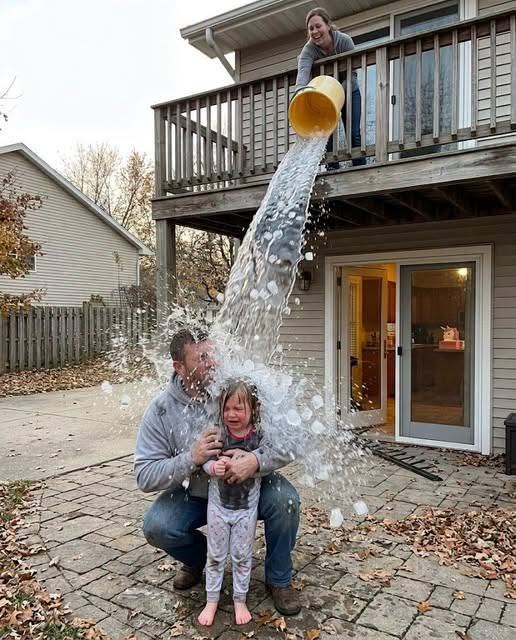
She was standing on the balcony.
She had a large yellow cleaning bucket in both hands.
“What are you doing?”
“She’s sick!” I shouted.
Sarah tipped the bucket.
The water hit us before I could move.
Gallons of icy water crashed over my shoulders and Sophia’s small body.
Ice cubes bounced across the patio stones.
Sophia’s pajamas turned dark instantly.
She made a weak sound against my chest.
I felt every muscle in my body tighten.
Sarah laughed.
“Fastest way to lower a fever.”
Then she said the sentence I would remember long after that day.
“Now take that burden and get out.”
She wasn’t finished.
“I’m not having my weekend ruined because she’s contagious.”
She turned away.
For one second, I wanted to follow her.
I wanted to demand an explanation.
I wanted to make her understand exactly what she had done.
But Sophia was in my arms.
That made the decision easy.
I carried my daughter toward the truck.
The birthday cake remained on the kitchen counter.
The sprinkles were bright beneath the kitchen light.
The unicorn’s pink frosting looked absurdly cheerful against everything that had just happened.
Nobody came after us.
Nobody stopped Sarah.
Nobody asked if Sophia was all right.
I started the truck and drove to the hospital.
At the emergency department, the bright fluorescent lights reflected off the wet fabric of Sophia’s pajamas.
A nurse took her temperature.
The number confirmed the seriousness of the fever.
The hospital began its normal intake process.
Questions followed.
What time had I found her?
Where had she been?
What had she been wearing?
How long had she been outside?
What happened immediately afterward?
I answered each question.
I didn’t exaggerate.
I didn’t have to.
The truth was already enough.
The hospital intake record documented the visit.
The fever was recorded.
The circumstances were documented.
Every detail became part of a paper trail.
And that mattered because Sarah had spent months believing that family arguments disappeared once everyone went home.
This wasn’t just an argument.
There was a locked patio door.
There was a security bar.
There was a fever.
There was the yellow bucket.
There was Lucas inside.
And there was the birthday cake sitting untouched on the counter.
Facts have a different kind of weight.
They don’t need anger to become serious.
At 5:07 p.m., while Sophia was being evaluated, I sat with my phone in my hand.
There was a number I had not used in years.
I looked at it.
Then I looked through the glass toward my daughter.
I remembered the years I had spent in the Army.
The training.
The discipline.
The constant distinction between what could be said and what should remain unsaid.
Sarah had spent months studying my clothes.
She had never studied my history.
That was her mistake.
I pressed call.
The person on the other end answered.
“Activate the team.”
My voice was calm.
“Return to my house. Target confirmed.”
I ended the call.
That was the moment everything changed.
Not because I suddenly became someone else.
I had been that person the entire time.
Sarah simply hadn’t known.
And sometimes the most dangerous mistake a person can make is believing that the quietest person in the room has nothing left to say.
My daughter had gone to the hospital on her fifth birthday.
Her pink unicorn cake was still waiting at home.
Her aunt had locked her outside because she was afraid of a ten-year-old’s soccer tryouts being disrupted.
And the man Sarah had dismissed as a “broke veteran” had just made a phone call she never imagined he could make.
At 5:19 p.m., my phone vibrated.
I looked down.
A message had arrived.
It contained a photograph.
My front door.
The image carried a security-camera timestamp.
4:23 p.m.
The same minute I had been trying to get Sophia inside.
The second photograph showed the yellow cleaning bucket beside the balcony doorway.
It was still there.
Sarah had left it exactly where she had used it.
I stared at the screen.
For months, Sarah had treated my patience as permission.
She had treated my silence as weakness.
She had treated my home like hers.
Now there was something she could not talk away.
Evidence.
At 5:31 p.m., Claire called from Chicago.
I answered.
She immediately heard something was wrong.
“What happened?”
I told her Sophia was in the hospital.
Claire went silent.
Then I told her about the patio.
The locked door.
The fever.
The water.
Sarah.
Claire’s voice cracked.
“Sarah did that?”
“Yes.”
Another silence followed.
Then Claire asked the question I had expected.
“Who did you call?”
I looked through the hospital glass again.
Sophia was still being cared for.
The birthday cake was still at home.
And Sarah was still inside the house, believing she had simply thrown an inconvenient child and her father out of her weekend.
She didn’t know about the call.
She didn’t know about the photographs.
She didn’t know what had been documented.
Most of all, she didn’t know who she had spent months insulting.
I had allowed Sarah to believe I was exactly what she wanted me to be.
A man with an old truck.
A faded hoodie.
Grease on his hands.
A “broke veteran.”
That image had protected my privacy for a long time.
Now it was about to protect something else.
My daughter.
The emotional truth was painfully simple.
An entire family can become comfortable with a person’s silence until the day that silence becomes a decision.
Sarah had mistaken mine for surrender.
It wasn’t.
It was restraint.
And restraint only matters when the person exercising it knows exactly what happens after it ends.