Travel Beyond the Ordinary and Discover New Places, Cultures, and Experiences Around the World.
The detective did not answer my mother.
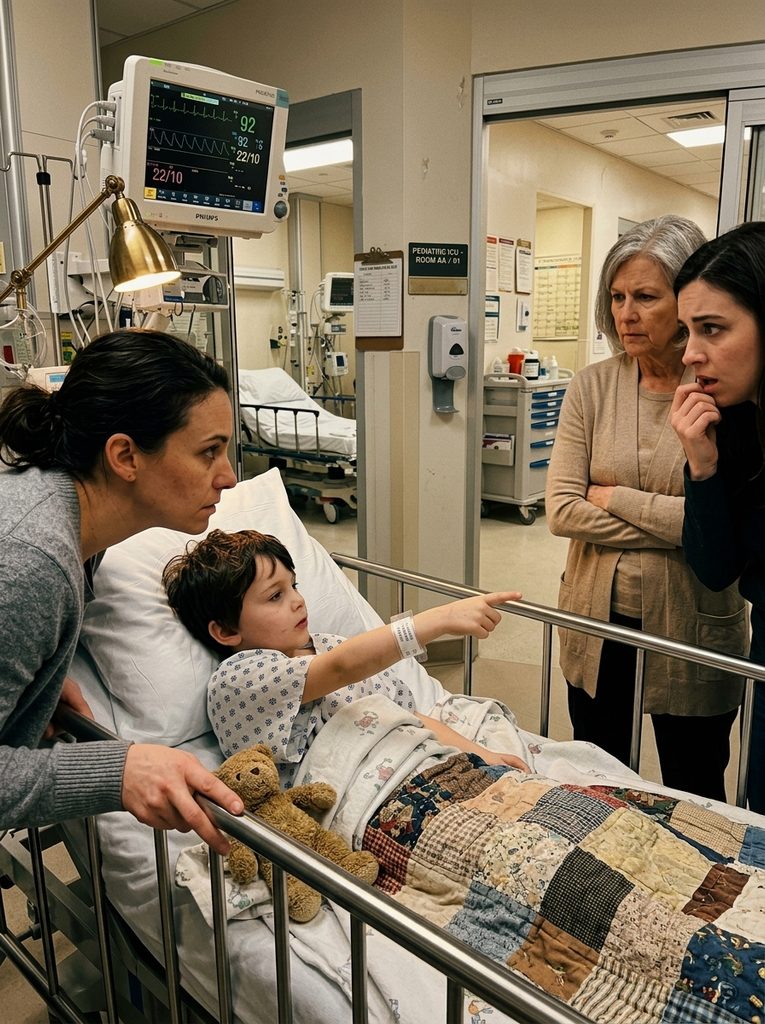
He looked at Noah, then at me, and asked the nurse to give us a few minutes.
My mother immediately protested.
“We’re his family.”
The detective finally looked at her.
“So am I aware.”
He turned to me instead.
“Your son may not be able to give a complete statement right now, but he doesn’t have to. The physical findings already tell us this wasn’t a simple fall.”
Madison started crying.
“Emily, this is a misunderstanding.”
I looked at her.
“What happened?”
She opened her mouth.
Nothing came out.
My mother answered for her.
“He fell.”
I looked through the glass at Noah’s small wrist.
“Which fall?”
Neither woman spoke.
The detective placed a photograph from the hospital intake file on the table.
It showed the clothing Noah had arrived in.
There was dirt along one sleeve.
A torn seam near the shoulder.
And a small blue plastic dinosaur clipped inside the pocket.
I recognized it immediately.
It was Noah’s favorite dinosaur.
The detective pointed to it.
“He was found holding this.”
My mother suddenly reached for the photograph.
The detective moved it away.
“Don’t.”
She froze.
Then he said something that changed the entire situation.
“The neighbor didn’t just find your grandson. She heard your mother telling someone to put him back inside before anybody saw him.”
My mother stared at him.
Madison looked at Mom.
And for the first time, my sister’s face showed something other than grief.
Fear.
I turned toward her.
“Who was she talking to?”
Madison whispered, “I don’t know.”
The detective looked at me.
“I think you do.”
He slid the visitor sign-in sheet toward me.
My mother’s name was there.
Madison’s name was there.
And beneath them was another entry written in my mother’s handwriting.
My ex-husband.
That was the moment I realized Noah’s injuries weren’t the only thing my family had been trying to hide.
They had been preparing a story before I even landed.
And someone had already decided what they wanted me to believe.
The name on that visitor sheet belonged to my ex-husband, Daniel.
For a second, I couldn’t understand what I was seeing.
Daniel was overseas.
He had told me two days earlier that his assignment had been extended and that he wouldn’t be home for another month.
I looked at the detective.
“That’s his name.”
“I know.”
“How could he have signed this?”
The detective didn’t answer immediately.
Instead, he asked me a question.
“Did you tell your mother your ex-husband was overseas?”
“Yes.”
“Did she know where he was stationed?”
“Yes.”
He nodded slowly.
“That matters.”
My mother stood.
“Emily, don’t start imagining things.”
I turned toward her.
“I haven’t imagined anything.”
“You’re upset.”
“My son is in intensive care.”
“I know.”
“No. You don’t.”
My voice broke before I could stop it.
“You left him outside.”
She looked away.
Madison stepped forward.
“Mom didn’t hurt him.”
The sentence came too quickly.
I looked at her.
“I didn’t say she did.”
Madison stopped breathing for a second.
That was enough.
The detective noticed it too.
He didn’t accuse her.
He didn’t need to.
He simply wrote something down.
My mother tried to take control of the conversation again.
“Emily, your sister and I were trying to discipline him.”
“Discipline?”
“He was acting out.”
“He is six.”
“He has been difficult lately.”
I thought about Noah hiding under my desk during thunderstorms.
I thought about him apologizing when someone else bumped into him.
I thought about the way he asked permission before taking a second cookie.
Difficult was not the word I would have used.
Then I remembered the phrase Madison had used on the phone.
He deserved it.
I looked at her.
“Why?”
Madison began crying harder.
My mother put a hand on her shoulder.
“She’s exhausted.”
“No.”
I shook my head.
“Let her answer.”
The detective didn’t stop me.
Madison stared at the floor.
“He broke something.”
“What?”
“A picture frame.”
“By accident?”
She didn’t answer.
My mother stepped in.
“He was throwing things.”
“What picture frame?”
Another silence.
Then Madison whispered, “The one of Dad.”
My mother’s expression changed.
I understood the significance immediately.
My father had died when I was twelve.
There was one photograph of him that Mom had always treated as sacred.
A small framed picture of him holding me when I was a baby.
Noah loved that photograph because I had told him the man in it was his grandfather.
I looked at my mother.
“That’s what this was about?”
“He broke it.”
“He’s six.”
“He knew it was important.”
I could barely believe the conversation.
“You hurt my son over a picture frame?”
My mother shook her head.
“No.”
Then Madison spoke.
“We didn’t mean for him to get hurt that badly.”
The room went still.
The detective raised his eyes.
I stared at my sister.
“Get hurt how?”
Madison covered her face.
My mother snapped, “Stop talking.”
And that was the first moment I knew the story they had prepared was already falling apart.
But it still wasn’t the whole truth.
The detective asked them both to leave the ICU.
My mother refused.
“I am his grandmother.”
“And Emily is his mother.”
He looked at her calmly.
“Right now, her consent is what matters for who stays in this room.”
My mother looked at me.
For years, that look had worked.
It was the look that said I was being ungrateful.
The look that said she had sacrificed everything for me.
The look that had made me apologize even when I wasn’t sure what I had done.
This time, I didn’t apologize.
“You need to leave.”
She stared at me.
“Emily.”
“Leave.”
Madison followed her.
The door closed.
I went back to Noah.
His fingers moved slightly beneath the blanket.
I took his hand.
His eyes opened.
“Mom?”
“I’m here.”
“Don’t let Grandma take me.”
The words nearly destroyed me.
I leaned closer.
“She won’t.”
Noah looked toward the door.
“She said you weren’t coming.”
My chest tightened.
“What did she say?”
“That you picked work instead of me.”
I closed my eyes.
There it was.
The story underneath everything.
My mother had never simply been angry that I was away.
She had been angry that I was becoming independent.
For months, she had told me I was neglecting my family.
She had complained about watching Noah.
She had said my job mattered more than the people who loved me.
I had ignored it because I needed the promotion.
Now I realized she had been turning my guilt into a weapon.
But there was another detail that didn’t fit.
The visitor sheet.
Daniel’s name.
I called him.
He answered on the third ring.
“Emily?”
“Where are you?”
Silence.
Then he said, “At the airport.”
My knees almost gave out.
“What airport?”
He told me.
He had been trying to fly home because he’d heard Noah was sick.
He hadn’t been at my mother’s house.
He hadn’t signed the hospital sheet.
Someone had written his name.
I told the detective.
His expression changed.
“Your mother may have put his name there to make it look like he was involved.”
“Why?”
“We’ll find out.”
But the answer came sooner than either of us expected.
The neighbor who found Noah came to the hospital.
She was an older woman named Mrs. Reynolds who lived two houses down.
She had seen my mother and Madison outside that night.
She had heard Noah crying.
And she had heard my mother say, “Get him back inside before Emily finds out.”
That sentence mattered.
But Mrs. Reynolds had something else.
She had seen Madison carrying a small plastic storage bin toward the shed.
Inside it were several of Noah’s things.
His blanket.
His dinosaur collection.
His favorite blue sweatshirt.
Mrs. Reynolds didn’t know why.
I did.
My mother had been trying to make it look as though Noah had run away from the house and somehow injured himself outside.
But Noah’s favorite things had been moved outside first.
It was staged.
Not perfectly.
Not cleverly.
But deliberately.
The detective asked me whether my mother had ever threatened to report me to child services.
I remembered the conversations.
“You work too much.”
“You travel constantly.”
“You’re barely home.”
“Maybe Noah would be better off with family.”
At the time, I had heard criticism.
Now I heard preparation.
My mother hadn’t wanted to babysit my son.
She had wanted leverage over me.
And when Noah resisted whatever she demanded that night, she had used him as the pressure point.
Still, one question remained.
Why had Madison said he deserved it?
The answer came from Madison herself the following afternoon.
She asked to speak with me alone.
The detective allowed it because I agreed to have the conversation monitored.
Madison sat across from me in a hospital consultation room.
Without makeup, she looked younger.
Almost like the sister who used to sleep on the floor beside my bed when we were children.
“I didn’t know she would hurt him.”
I said nothing.
“She told me Noah was becoming spoiled.”
“He is six.”
“I know.”
“She said you were ruining him.”
I looked down.
“She said I was?”
Madison nodded.
“She said you were always rescuing him from consequences.”
“What consequences?”
Madison swallowed.
“The picture.”
I waited.
“She wanted him to apologize.”
“He did?”
“He refused.”
“Why?”
Madison started crying.
“Because Mom told him to say he was sorry for breaking Grandpa’s picture, but Noah said he hadn’t broken it.”
My heart stopped.
“What?”
“He said Mom broke it.”
I stared at her.
Madison wiped her face.
“She had been angry for days.”
“Why?”
Madison hesitated.
Then she told me.
My mother had found an old box in the attic containing letters my father had written before he died.
Letters addressed to me.
Letters I had never seen.
My mother had kept them hidden for decades.
She had been afraid they would change how I saw her.
I felt the room tilt.
“What did the letters say?”
Madison shook her head.
“I don’t know.”
“Then why did Mom care?”
“Because Noah found them.”
Everything suddenly connected.
The picture frame.
The attic.
The shed.
My mother’s panic.
Noah had not simply broken a frame.
He had found something my mother didn’t want me to see.
The detective helped recover the box from the house after obtaining the necessary authorization.
Inside were eleven letters.
My father’s handwriting was unmistakable.
The first letter was written shortly before he died.
It wasn’t a confession of some secret crime.
It was something more painful.
He wrote about me.
About how much he loved me.
About how he wanted me to grow up believing I was capable of making my own decisions.
And then he wrote about my mother.
He said she had been struggling with fear since his diagnosis.
He worried that after his death, she would become so afraid of losing me that she would confuse love with control.
I read the sentence twice.
My mother had spent years telling me that she had sacrificed everything for me.
My father had apparently worried that one day I would mistake that sacrifice for ownership.
Another letter contained a request.
If I ever had a child, he wanted me to teach that child something simple.
That being loved did not mean being controlled.
I cried over that letter for a long time.
But it wasn’t the final truth.
The last letter had been written only weeks before my father died.
He had included a small photograph.
The same photograph Noah had supposedly broken.
On the back, my father had written:
“Emily, don’t let fear decide what your family becomes.”
I understood why my mother had hidden it.
She hadn’t wanted me to know that my father had anticipated this version of her.
She had spent years building a story in which every controlling decision was proof of love.
Now the story was sitting in my hands.
But understanding her did not excuse what happened to Noah.
That distinction became important.
My mother eventually admitted enough to investigators to establish what had happened that night.
She and Madison had argued with Noah.
Noah had tried to leave the room.
My mother grabbed him.
He fell.
When he tried to get up, Madison blocked the doorway.
The injuries became worse during the struggle.
Instead of calling for help immediately, they moved him outside.
They hoped he would wake up.
When he didn’t, panic took over.
The staged story came afterward.
My mother tried to make the accident look like something Noah had caused himself.
Madison had gone along with it because she was afraid of her mother.
But she was still responsible for what she did.
The detective told me that investigations would determine the appropriate charges and next steps.
I didn’t ask for revenge.
I asked for Noah to be safe.
That became my only priority.
The hospital kept him under close observation.
His condition slowly improved.
The first time he opened both eyes and asked for strawberry yogurt, I cried so hard the nurse had to hand me a tissue.
“Can I have two?”
I laughed through my tears.
“One.”
He thought about it.
“Two halves?”
I nodded.
“Two halves.”
That was our first real conversation after the night everything changed.
He was still frightened.
He startled whenever someone entered the room unexpectedly.
He asked whether Grandma was coming back.
I told him the truth.
“She isn’t going to see you unless the people responsible for your care say it is safe.”
He nodded.
He didn’t ask again.
Children understand boundaries faster when adults stop pretending they are complicated.
Daniel came home.
He and I talked about Noah.
Our marriage had ended for reasons that had nothing to do with this.
We were not going to pretend the crisis repaired everything.
But he was still Noah’s father.
And when he walked into the hospital room, Noah reached for him.
That was enough.
For the first time, the adults around Noah stopped making the moment about themselves.
We sat quietly.
We listened.
We let him decide whether he wanted one parent beside him or both.
A few weeks later, Noah was discharged.
He still had appointments.
He still had physical therapy for his wrist.
He still woke up sometimes after nightmares.
But he was home.
I put his dinosaurs back on the shelf.
The blue one went beside his bed.
The same dinosaur he had been holding when the neighbor found him.
One afternoon, Noah asked me about the photograph of my father.
I showed him the restored frame.
He studied the picture.
“Was Grandpa nice?”
I smiled.
“He tried to be.”
“Did he love you?”
“Yes.”
Noah thought about that.
“Then he would love me too.”
I hugged him.
“I think he would.”
We never put the photograph back where it had been.
Instead, I placed it on a small shelf beside Noah’s dinosaur collection.
The picture that had once been used as a reason to frighten him became something he could look at safely.
My mother did not come back into our lives.
Not immediately.
And perhaps not ever in the way she once had.
She sent letters.
Some apologized.
Some explained.
Some tried to make excuses.
I read them when I was ready.
I never answered the ones that asked me to make her feel better.
Eventually, Madison reached out.
She apologized to Noah before she asked anything from me.
That mattered.
She didn’t say she was innocent.
She didn’t say she was just following orders.
She told him she had been wrong.
Noah listened.
Then he asked her whether she was going to hurt him again.
Madison cried.
“No.”
He looked at me.
I didn’t answer for him.
It was his question.
His choice.
Eventually, he nodded.
That didn’t mean everything was fixed.
It meant one small door had been left open.
Months passed.
The legal process continued without me turning it into a public spectacle.
I cooperated when asked.
I kept records.
I showed up for Noah.
And I stopped explaining my choices to people who had already decided that my independence was an insult.
The promotion I had been afraid of losing came through.
I accepted it.
Not because work was more important than my son.
Because providing for him was part of loving him too.
But I changed one thing.
I stopped letting guilt make every decision.
I hired reliable childcare.
I built a support system that did not depend on one person controlling access to my life.
And when someone offered help, I learned to ask what they expected in return.
That question saved me from repeating the same pattern.
One year after the night in the hospital, Noah and I visited my father’s grave.
He carried the small blue dinosaur in his pocket.
We stood there together.
He placed the dinosaur on the grass.
“That’s Grandpa’s toy now,” he said.
I smiled.
“He might like it.”
We stayed for a few minutes.
Then Noah picked it up again.
“Actually, I think he wants me to keep it.”
I laughed.
“Probably.”
We walked back to the car.
Before getting inside, Noah looked at me.
“Mom?”
“Yeah?”
“Am I still allowed to be mad at Grandma?”
I knelt beside him.
“You’re allowed to feel whatever you feel.”
“What if I forgive her?”
“Then you can forgive her.”
“What if I don’t?”
“You don’t have to.”
He thought about it.
“Okay.”
Then he climbed into the back seat.
That was the lesson I wish someone had taught me years earlier.
Forgiveness is not the same thing as access.
Love is not the same thing as permission.
And being someone’s child does not mean you have to surrender your own.
My mother had spent years telling me that family meant putting everyone else first.
My father had left me a different message.
He had written that love should help a person become more themselves, not less.
For years, I hadn’t known which lesson I believed.
Then my six-year-old son spent a night fighting to survive because an adult had confused control with love.
I knew.
I knew exactly which lesson I wanted Noah to grow up with.
The hospital monitor no longer wakes me up.
Neither does the memory of the airport.
Sometimes I still remember my mother’s laugh.
Sometimes I still hear Madison saying, “He deserved it.”
But those sounds are no longer the ending of the story.
The ending is Noah asking for two halves of a yogurt.
The ending is his blue dinosaur sitting safely beside my father’s photograph.
The ending is my son sleeping with one sock on because two socks still make his feet angry.
And sometimes, before I turn off his bedroom light, he reaches for my hand.
I let him hold it.
I don’t pull him closer because I’m afraid of losing him.
I don’t tell him he owes me anything.
I simply stay until he falls asleep.
Because after everything that happened, I finally understood what my father had tried to tell me all those years ago.
The safest hand in a child’s life should never be the hand that closes around him.
It should be the hand that stays open long enough for him to know he can always reach for it.