“Kentucky, 1913. Sally Creech sat at her spinning wheel, smiling. Behind that smile — a dream. The mountains had no school. Children grew up unable to read. Her husband William owned land. Neighbors said: ‘Sell for profit.’ Sally shook her head: ‘Our children need more.’ They donated it all for Pine Mountain School. First students arrived that fall. One girl, ten, cried seeing books: ‘Really for us?!’ Sally hugged her: ‘Knowledge belongs to everyone.’ Some donate money. Others donate possibilities. Follow her model.”
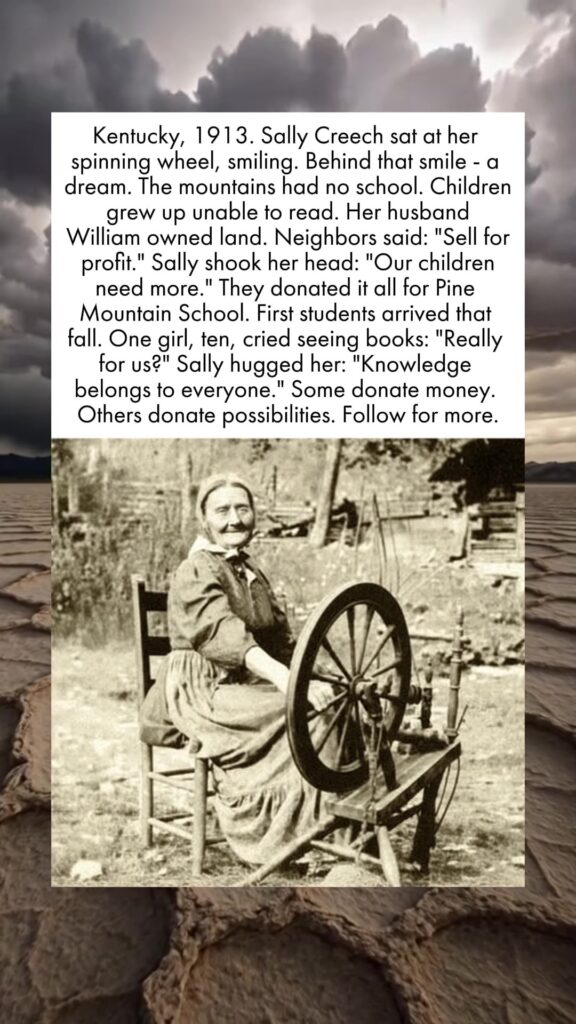
In the remote mountains of Kentucky in 1913, education was a luxury few could afford. Children grew up without books, without teachers, without the chance to dream beyond the hills. But one woman, Sally Creech, saw possibility where others saw profit.
She sat at her spinning wheel, weaving thread—but her true work was weaving futures. Her husband, William, owned land that neighbors urged him to sell. “It’s valuable,” they said. “You could make a fortune.” But Sally had a different vision.
“Our children need more,” she insisted.
Together, they donated the land to build what would become Pine Mountain Settlement School—a place where children could learn, grow, and imagine a life beyond survival. That fall, the first students arrived. One ten-year-old girl burst into tears at the sight of books. “Really for us?!” she asked, overwhelmed. Sally hugged her and whispered, “Knowledge belongs to everyone.”
The school wasn’t just a building—it was a revolution. It offered reading, writing, agriculture, and arts. It taught children how to think, not just how to work. And it became a beacon for rural education across Appalachia.
Sally didn’t donate money. She donated possibility. She gave land, time, and heart. Her legacy lives on in every child who walked through Pine Mountain’s doors and found their voice.
Today, Pine Mountain Settlement School still stands, offering environmental education, cultural preservation, and community outreach. It’s a living tribute to Sally’s belief that education is not a privilege—it’s a right.
Her story reminds us that change doesn’t always come from institutions. Sometimes, it comes from a woman at a spinning wheel, smiling at a dream.