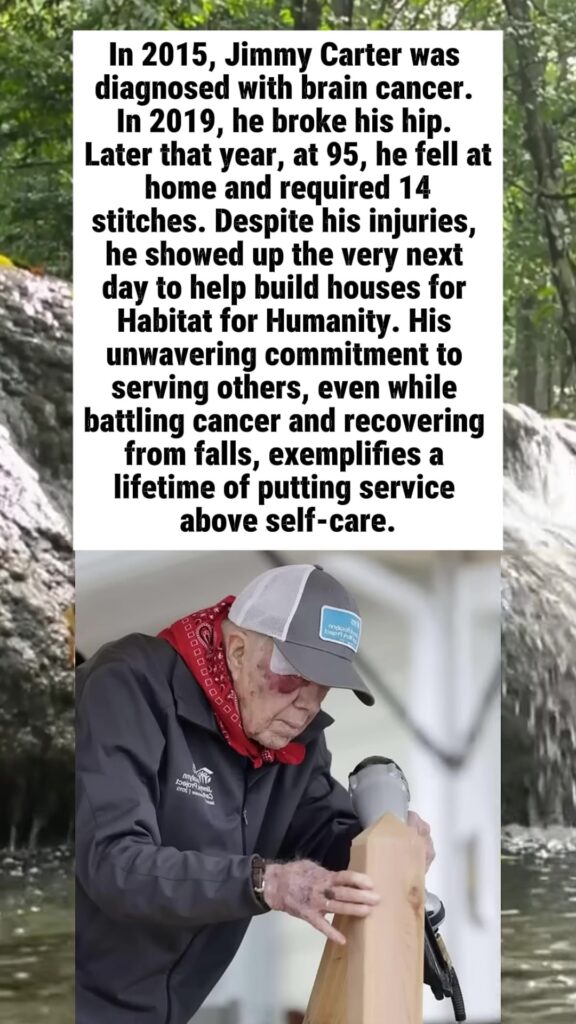
In 2015, Jimmy Carter was diagnosed with brain cancer. In 2019, he broke his hip. Later that year, at 95, he fell at home and required 14 stitches. Despite his injuries, he showed up the very next day to help build houses for Habitat for Humanity. His unwavering commitment to serving others, even while battling cancer and recovering from falls, exemplifies a lifetime of putting service above self-care.
In a world where public figures often retreat after their spotlight fades, Jimmy Carter kept showing up—not for applause, but for purpose.
Diagnosed with brain cancer in 2015, Carter faced a prognosis that would have sidelined most. But he continued his work with Habitat for Humanity, the organization he’d partnered with since 1984. He didn’t just fundraise—he built. Hammer in hand, boots in the mud, he helped construct homes for families in need.
Then in May 2019, at age 94, he broke his hip while preparing for another build. Most would have called it quits. Carter called it a delay.
Later that year, in October 2019, he fell at home, suffering a head injury that required 14 stitches. The next day, he arrived at a Habitat site in Nashville—bandaged, bruised, and smiling. He picked up a power drill and got to work.
Photos from that day show him with a black eye and a red bandana, surrounded by volunteers decades younger. But none matched his resolve.
Carter’s commitment wasn’t symbolic—it was physical. He believed that service was a moral obligation, not a seasonal gesture. Even as his body weakened, his spirit strengthened.
He once said, “I have one life and one chance to make it count for something.” And he did.
His work with Habitat for Humanity helped build over 4,000 homes across the globe. But more than structures, he built hope. He showed that leadership isn’t about titles—it’s about showing up, especially when it’s hard.
Jimmy Carter passed away in December 2024 at age 100, but his legacy lives on in every nail driven, every wall raised, and every volunteer inspired by his example.