CARDS REMINDED HER SHE SURVIVED
San Antonio, 1860s. They called her Lottie Deno. Red hair, calm eyes, hands that never shook. Saloon men thought she’d be easy. By sunrise, she’d cleaned them out. A man accused her of cheating once. She said quietly: “Sir, the cards tell truth enough.” He left. Whispers followed her — lost fiancé, hidden crime, Southern belle turned gambler. Lottie never corrected them. Just dealt another hand. Years later, she retired to New Mexico, rich and quiet. Her neighbor found her shuffling cards in her kitchen. “Why still play?” “Reminds me I survived.” Some women conquer the West with guns. Others with grace under pressure.
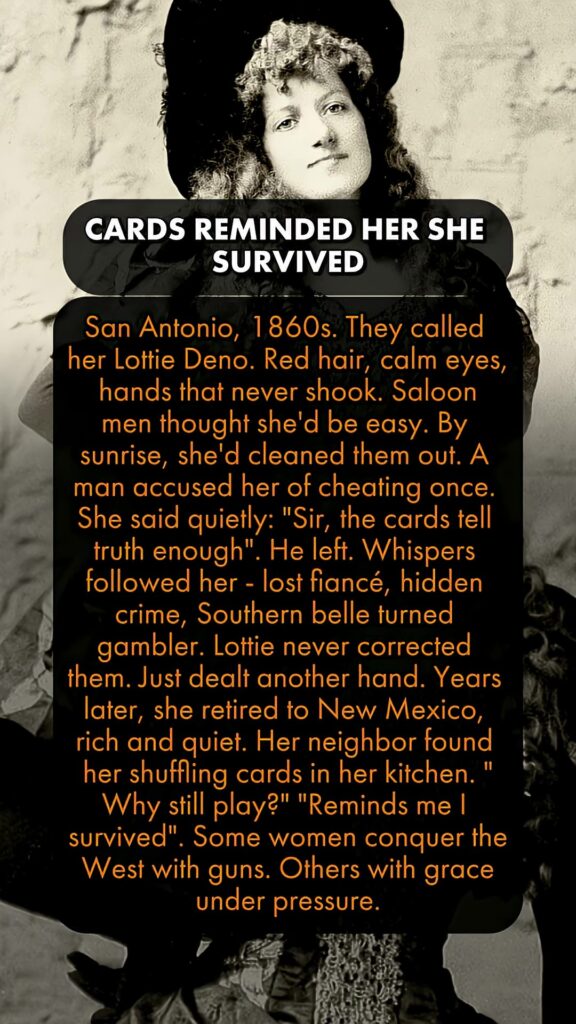
In the dust and danger of the American Southwest, one woman carved her legend not with a gun, but with a deck of cards. Her name was Lottie Deno, born Carlotta J. Thompkins in 1844 in Warsaw, Kentucky. Raised in a wealthy family, her father—a horse breeder and gambler—taught her the art of poker early on. After his death, Lottie took her skills on the road, traveling through Detroit, Mississippi riverboats, and eventually settling in San Antonio, Texas during the 1860s.
With red hair, calm eyes, and hands that never shook, Lottie entered saloons where men underestimated her. By sunrise, she’d often cleaned the table, leaving stunned gamblers in her wake. Her reputation grew. She was known as the “Angel of San Antonio,” and later, “Mystic Maud” and “Queen of Poker.”
One night, a man accused her of cheating. She didn’t flinch. “Sir, the cards tell truth enough,” she said. He left. Her legend stayed.
Rumors swirled around her: a lost fiancé, a hidden crime, a Southern belle turned outlaw. Lottie never confirmed or denied them. She let the whispers build her myth while she dealt another hand.
Eventually, she moved to New Mexico, married fellow gambler Frank Thurmond, and retired into quiet wealth. But she never let go of the cards. A neighbor once found her shuffling in her kitchen. “Why still play?” they asked. “Reminds me I survived,” she replied.
Lottie lived until 1934, passing away at age 89. She had become a Sunday school teacher, a respected citizen—but the cards never left her hands.
Her story is more than poker. It’s about resilience, reinvention, and the power of silence. In a world where women were expected to fade into the background, Lottie dealt herself into history.
She didn’t conquer the West with violence. She did it with grace under pressure, a sharp mind, and the quiet strength to endure.