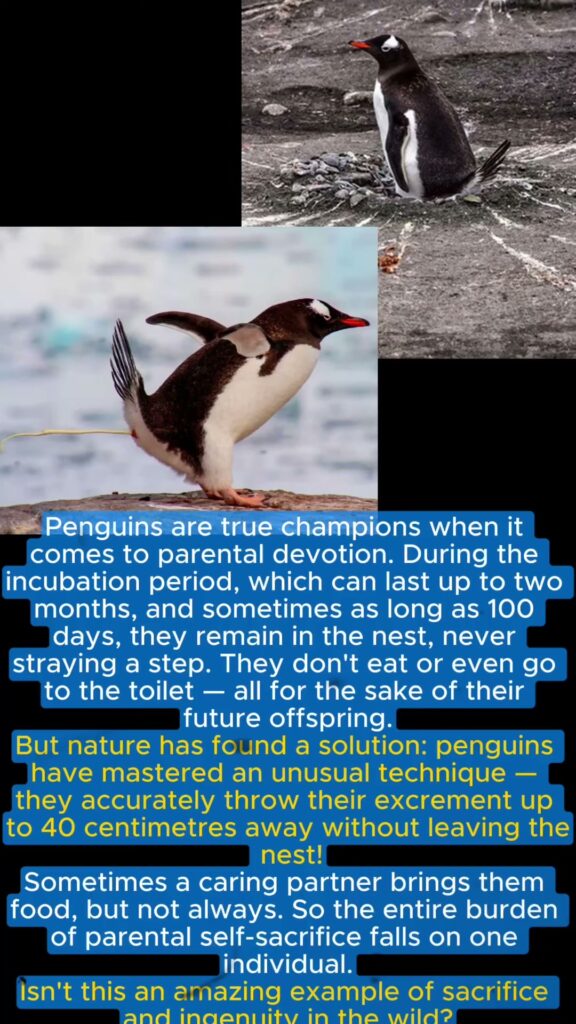
Penguins are true champions when it comes to parental devotion. During the incubation period, which can last up to two months, and sometimes as long as 100 days, they remain in the nest, never straying a step. They don’t eat or even go to the toilet — all for the sake of their future offspring. But nature has found a solution: penguins have mastered an unusual technique — they accurately throw their excrement up to 40 centimetres away without leaving the nest! Sometimes a caring partner brings them food, but not always. So the entire burden of parental self-sacrifice falls on one individual. Isn’t this an amazing example of sacrifice and ingenuity in the wild?
In the icy reaches of Antarctica and sub-Antarctic islands, penguins demonstrate one of nature’s most astonishing acts of parental devotion. During the incubation period, which varies by species and can last anywhere from 32 to 100 days, one parent—often the male in species like the emperor penguin—remains motionless on the nest, enduring brutal winds and starvation to protect the fragile egg beneath their body.
They do not leave. They do not eat. They do not even relieve themselves in the usual way.
Instead, nature has equipped them with a remarkable adaptation: penguins can project their excrement up to 40 centimeters away, keeping the nest clean without ever stepping off the egg. This behavior, studied in detail by ornithologists, is not random—it’s precise, directional, and essential to maintaining hygiene and preventing contamination of the egg.
In some species, like the Adélie or Gentoo penguin, partners may take turns incubating and foraging. But in others, such as the emperor penguin, the burden falls entirely on one parent for weeks. The fasting period can last up to 115 days, during which the penguin loses nearly half its body weight.
This extreme endurance is not just biological—it’s emotional. Penguins form strong pair bonds, and their vocalizations help them reunite in crowded colonies. The returning partner often brings regurgitated, nutrient-rich food, but timing is critical. If the foraging partner is delayed, the incubating parent may perish—or abandon the egg in desperation.
And yet, most do not. They wait. They suffer. They protect.
This behavior is a testament to evolutionary ingenuity and emotional resilience. It shows that survival in the wild is not just about strength—it’s about sacrifice, precision, and unwavering commitment to the next generation.
Penguins remind us that parenting, in its purest form, is an act of love that defies hunger, cold, and even biology.