Hollywood divorces usually end with divided assets and sensational headlines. But when Antonio Banderas and Melanie Griffith separated, he refused to divide the most valuable thing—his love for her daughter, Dakota. He didn’t become her “former stepfather.” Back in 1999, when Dakota was just 10, it was he who gave her her first role in his directorial debut, Crazy in Alabama. He saw in her not just a stepdaughter but a future star, and he invested his faith in her long before the rest of the world did. To everyone else, she was Melanie Griffith’s daughter, but to him, she always remained simply “my daughter.” Their story isn’t about legal documents, but about a choice—the choice to be a family even after the formal obligations were gone. It is a rare Hollywood testament to the fact that true bonds are forged not by blood, but by heart.
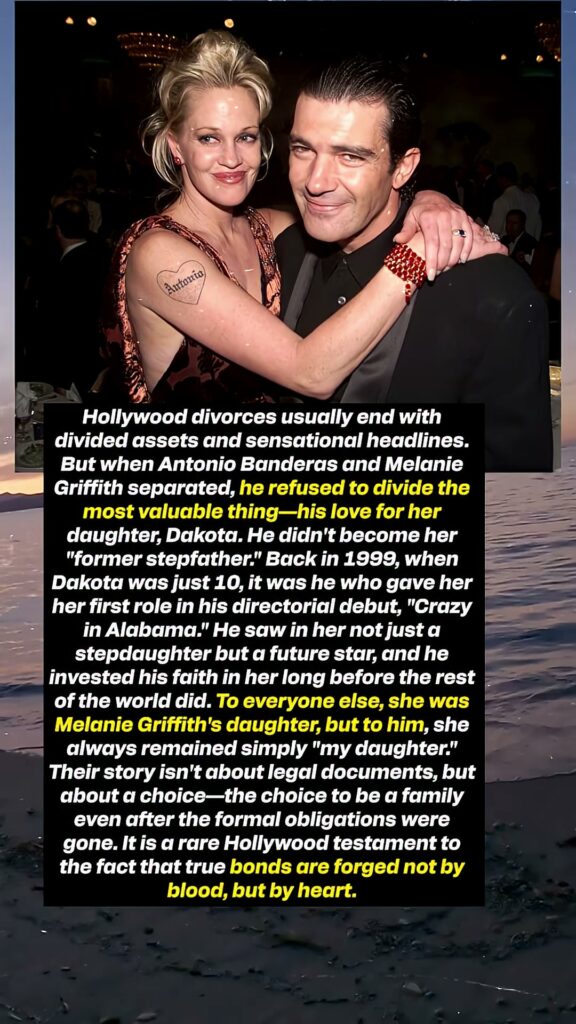
In the world of Hollywood, where relationships often dissolve into headlines and custody battles, Antonio Banderas made a different kind of choice. When his marriage to Melanie Griffith ended in 2015 after nearly two decades, he didn’t walk away from her daughter, Dakota Johnson. He stayed.
Antonio entered Dakota’s life when she was just six years old, after marrying Melanie in 1996. From the beginning, he treated her not as a stepchild, but as his own daughter. He nurtured her creativity, encouraged her curiosity, and gave her her first acting role in his 1999 directorial debut, Crazy in Alabama, when she was only ten.
To the public, Dakota was the daughter of Melanie Griffith and Don Johnson. But to Antonio, she was simply “my daughter.” That bond didn’t dissolve with divorce. It deepened.
In interviews, Dakota has spoken warmly of Antonio, calling him “a beautiful human being” and “my bonus dad.” She credits him with helping shape her artistic instincts and emotional intelligence. Antonio, in turn, has praised her talent and grace, saying he’s proud of the woman she’s become.
Their relationship is a rare example of chosen family—a connection built not on blood or legal obligation, but on love, loyalty, and shared life. Antonio didn’t have to stay in Dakota’s life. He chose to. And that choice became a quiet legacy of care in an industry often defined by detachment.
Even after the marriage ended, Antonio continued to support Dakota’s career and personal growth. He attended her premieres, celebrated her milestones, and never stopped calling her family.
In a world where fame often fractures relationships, Antonio and Dakota remind us that true bonds are forged in the heart—and that sometimes, the most powerful love is the one that chooses to stay.