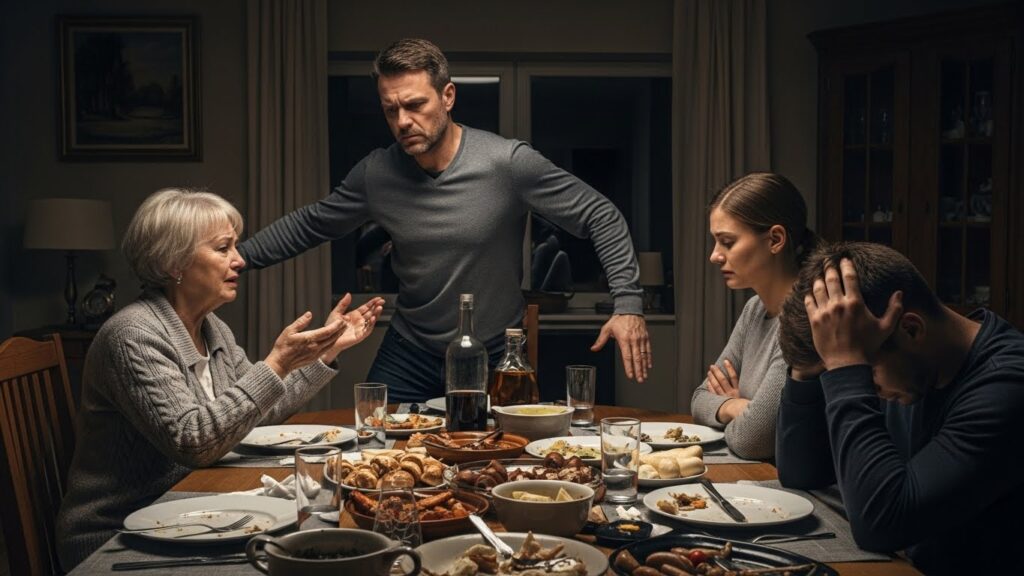
Hello Readers, throwaway because some extended family members know my main account. I’ve been carrying this for exactly one year now, and I think I’m finally ready to write it out. One argument at a family dinner on Christmas Day 2025 turned into the moment I went no-contact with my entire immediate family. It wasn’t dramatic yelling or plate-throwing—it was quiet, calm, and final. I haven’t spoken to my parents or my two siblings since I walked out that night.
I’m 30F, the middle child. My brother Ryan is 33M, married with a toddler; my sister Emily is 27F, engaged. We grew up in a upper-middle-class family in the Midwest—Dad is a corporate VP, Mom is a part-time real-estate agent, private schools, summer camps, big house with a pool. From the outside, we had it all. Holidays were always at our parents’ house: decorated to perfection, Mom’s elaborate meals, Dad carving the turkey, group photos in matching pajamas. We were the family other people envied.
But underneath, there was always this unspoken rule: don’t rock the boat. Dad’s word was final. Mom smoothed everything over with smiles and “let’s not fight on holidays.” Disagreeing with Dad meant being labeled “difficult” or “disrespectful.” Ryan, the golden boy, never challenged him. Emily learned early to stay quiet. I was the one who occasionally pushed back—small things, like wanting to study art instead of business, or questioning why we never talked about feelings. Every time, I’d get shut down, and Mom would pull me aside later with “he’s under a lot of stress, just let it go.”
I spent years biting my tongue to keep the peace.
By 2025, I’d built a life I was proud of. Good job in graphic design, healthy relationship with my boyfriend of four years, therapy that helped me set boundaries, close friends who felt like chosen family. I still went home for holidays because I loved my parents and siblings, and I hoped that as we all got older, things would soften.
Christmas 2025 was supposed to be special—Ryan’s little girl was two and a half, walking and talking, the “first real Christmas” with a grandchild. I drove four hours with gifts and desserts. Everyone was there: parents, Ryan and his wife Jess, Emily and her fiancé Mike, the toddler, and my aunt and uncle.
Dinner went fine at first. Kid running around, laughter, too much wine. Then, toward dessert, conversation turned to politics—something we’d always avoided, but the 2024 election fallout was still fresh.
Dad started it casually: complaining about “kids these days being brainwashed by social media” and how “common sense is gone.” It escalated quickly to immigration. He made a comment I’d heard versions of before: “We should close the borders completely until we figure out what’s going on. These people come here and take everything.”
Ryan nodded along. Jess stayed quiet. Emily changed the subject once, but Dad circled back.
I’d promised myself I wouldn’t engage. But when he said, “Anyone who disagrees just hates this country,” something snapped.
I put my fork down calmly and said, “Dad, I disagree. Completely. I think we have a moral obligation to help refugees, and the data doesn’t support the idea that immigrants are ‘taking everything.’”
The table went silent.
Dad’s face hardened. “Of course you do. You live in your liberal city bubble with your art friends. You don’t see the real world like I do.”
I kept my voice steady. “I’m not attacking you. I’m just saying I see it differently.”
He laughed—sharp, dismissive. “You’ve always thought you’re smarter than everyone else here. Moved away and decided we’re all backward.”
Ryan jumped in: “Come on, it’s Christmas. Let’s not do this.”
But Dad wasn’t stopping. “No, let her talk. She wants to lecture us in our own house.”
Mom tried: “Honey, maybe we can talk about something else—”
I looked at Dad. “I’m not lecturing. I’m telling you how I feel when you say those things. It hurts. And it makes it hard to be here.”
He leaned forward. “Then maybe you shouldn’t come if it’s so hard. We’re a family. We don’t have to agree on everything, but we don’t bring this divisive crap to the table.”
I felt every eye on me. Emily staring at her plate. Ryan sighing like I was the problem.
I said quietly, “I’ve been coming here for 30 years and never felt like I could say what I actually think without being called divisive or disrespectful. I’m tired of pretending that’s okay.”
Dad’s voice rose: “This is my house. My rules. If you don’t like it, there’s the door.”
The room froze.
I looked around the table. No one spoke up. Not Mom, not Ryan, not Emily. The toddler started crying from the tension.
I stood up slowly. “Okay.”
I thanked Mom for dinner, kissed the toddler goodbye, grabbed my coat, and walked out.
No one followed me.
I drove the four hours home in silence, crying only after I parked.
That night, texts started coming in.
Mom: “Please come back. He didn’t mean it. He’s just stressed.”
Ryan: “You know how Dad gets. Why did you have to push it on Christmas?”
Emily: “I’m sorry it went bad. Maybe call Dad tomorrow when he’s calmer?”
I didn’t reply to any.
The next day, Dad sent one text: “When you’re ready to apologize for ruining Christmas, we can talk.”
I didn’t respond.
It’s been a full year. Not a single call, text, or email from any of them. No birthday card (mine was in March), no “how are you,” nothing. My aunt reached out once asking why I “abandoned the family,” and when I explained, she said, “He’s your father. You owe him respect.”
I went to therapy weekly for months. My boyfriend has been a rock. My friends threw me a “chosen family” Christmas this year.
I grieve the family I thought I had—the one where love meant showing up even when it’s hard. But I finally understand that love without respect isn’t love I can live with.
One argument at a family dinner ended all contact.
I didn’t leave because I stopped loving them.
I left because I finally started loving myself enough to stop accepting silence as the price of belonging.
Some days I miss them terribly. Most days, I feel freer than I ever did at that table.
If you’re reading this and you keep swallowing your voice to keep the peace—ask yourself what the peace is really costing you. Sometimes the door isn’t slammed on you. Sometimes you have to open it yourself and walk through.
Thanks for reading. I needed to say this out loud.