Hello Readers, throwaway for obvious reasons. I’ve been sitting on this for four months, trying to make sense of it, and I think I’m finally ready to share. In August 2025, I went back to my childhood home to help my parents pack for their move. While cleaning out the attic, I found something that flipped everything I thought I knew about my family upside down. A secret no one—not my parents, not my siblings—ever warned me about. And once I saw it, there was no unseeing it.
I’m 36F, the youngest of three. My brother Matt is 40M, sister Jenna is 38F. We grew up in a big colonial house in a leafy suburb outside Boston—built in 1928, creaky floors, huge attic, the kind of place kids dream about exploring. Our parents bought it in 1985, right after they got married. Dad is a retired history professor, Mom was an elementary school teacher. Solid, loving, predictable people. Family dinners every night, vacations to the Cape, open-door policy for our friends. I always felt safe there. Lucky, even.
The house was on the market by summer 2025—parents downsizing to a condo in Florida for retirement. They asked us kids to come help sort 40 years of stuff. Matt and Jenna couldn’t make it (busy with their own families), so it was just me for a long weekend in August.
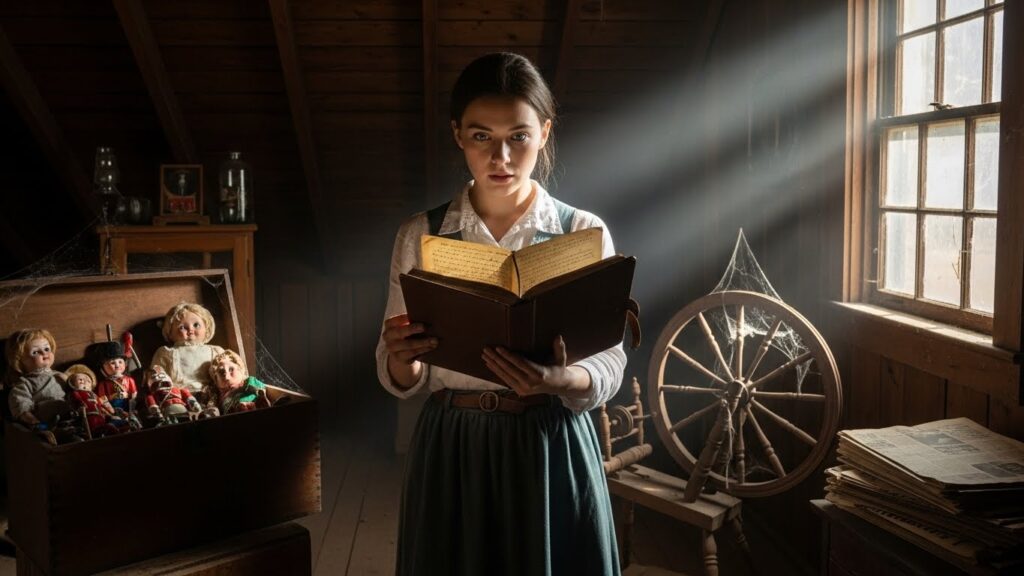
We started in the attic—boxes of old toys, holiday decorations, report cards, photo albums. Nostalgia overload. I was laughing at my awkward middle-school photos when I noticed a small wooden trunk tucked behind some insulation in the far corner. It was old, cedar, with a rusty padlock that had already broken off years ago. No one had mentioned it.
I dragged it into the light. Inside: yellowed papers, a few leather-bound journals, and a stack of envelopes tied with twine.
The top envelope was addressed to “Margaret Ellis” in beautiful handwriting. Postmarked 1943.
My mom’s maiden name is Margaret Ellis.
But Mom was born in 1958.
I opened it anyway.
It was a love letter—from a soldier named Thomas, stationed in England during WWII. He wrote about missing her, promising to marry her when he came home, describing the ring he’d bought. Intimate, passionate stuff.
There were dozens of letters like it—1943 to 1945. Then they stopped.
Under the letters were the journals. The first entry, dated January 1946, was in different handwriting—my grandmother’s, I realized. (I’d seen her Christmas card signatures.)
She wrote about her daughter Margaret—born October 1945—how beautiful she was, how much she looked like her father. How Thomas never came home (killed in the Battle of the Bulge, December 1944). How Margaret’s “father” (the man Grandma married in 1947, the grandfather I knew as Pop) had agreed to raise her as his own.
I kept reading.
Grandma wrote about the shame of being an unwed mother in 1940s small-town Massachusetts. How her parents sent her away to a “home for wayward girls” in Vermont for the pregnancy. How she gave birth alone, nearly died from complications. How she came home with baby Margaret and told everyone the child belonged to her and her new husband (they married quickly in 1947).
Pop knew the truth from day one. He loved Grandma fiercely and accepted Margaret as his daughter without hesitation. They never told a soul.
The last journal entry, from 1958 (the year my mom turned 13), said: “Margaret asked again why she doesn’t look like Daddy or me. We told her she takes after my side of the family. I hate lying to her. But the world is cruel to children born out of wedlock. Better she never knows the shame.”
I sat on the attic floor crying.
My mom isn’t my grandfather’s biological daughter.
Pop—the man who taught me to ride a bike, who walked me down the aisle, who I grieved so hard when he died in 2019—wasn’t my mom’s bio dad.
And no one ever told her.
I took the trunk downstairs. Mom was in the kitchen making tea. I set it on the table and said, “Mom, we need to talk.”
She looked at the trunk, went pale, and sat down hard.
“You found it,” she whispered.
“You knew?”
She nodded, tears starting. “I found the letters when I was 22, cleaning the attic for my wedding. I confronted your grandmother. She begged me never to tell anyone—said it would hurt Pop, that he’d been my real father in every way that mattered. I promised her I wouldn’t.”
I asked why she never told us.
“Because it didn’t change anything,” she said. “Pop was my dad. He loved me unconditionally. Telling you kids would only make you see him differently, or me differently. I wanted you to remember him as the hero he was.”
Dad walked in midway through. He knew too—Mom told him before they married. They both decided to let the secret die with them.
I was reeling. Not angry, exactly—more overwhelmed. All those years I’d heard Mom say, “I don’t look like Daddy at all,” and we’d laugh it off. The family joke about how Jenna and I took after Mom’s side, Matt after Dad’s. The way Mom always got quiet on Veterans Day.
Everything made sense in a new, painful way.
I asked if she ever wished she’d known growing up.
She cried harder. “Sometimes. I wondered why I felt… different. But Pop never treated me differently. He was at every recital, every graduation. When he died, he left me the same as your aunt and uncle. Biology didn’t matter to him.”
We sat there for hours talking. I read some letters aloud. We cried over Thomas’s words—how much he’d loved the daughter he never met.
I asked if she wanted to tell Matt and Jenna.
She thought about it, then said, “No. Let them keep their memories pure. It’s my story to carry.”
I respected that, but it’s been hard. I see Mom differently now—stronger, somehow, for protecting Pop’s legacy and her own heart all these years.
The house sold in October. Parents moved to Florida. I kept one of Thomas’s letters (with Mom’s blessing) in a frame—no name, just his words about love and home.
My childhood home revealed a secret no one warned me about: that the man I called Grandpa chose to be my mother’s father every single day, even though biology never asked him to.
Love isn’t always blood. Sometimes it’s a promise kept for 70 years.
I miss that house. But I’m grateful it gave me the truth before it belonged to someone else.
To anyone cleaning out an old family home—check the corners. You might find more than dust.
Thanks for reading. I needed to share this somewhere safe.