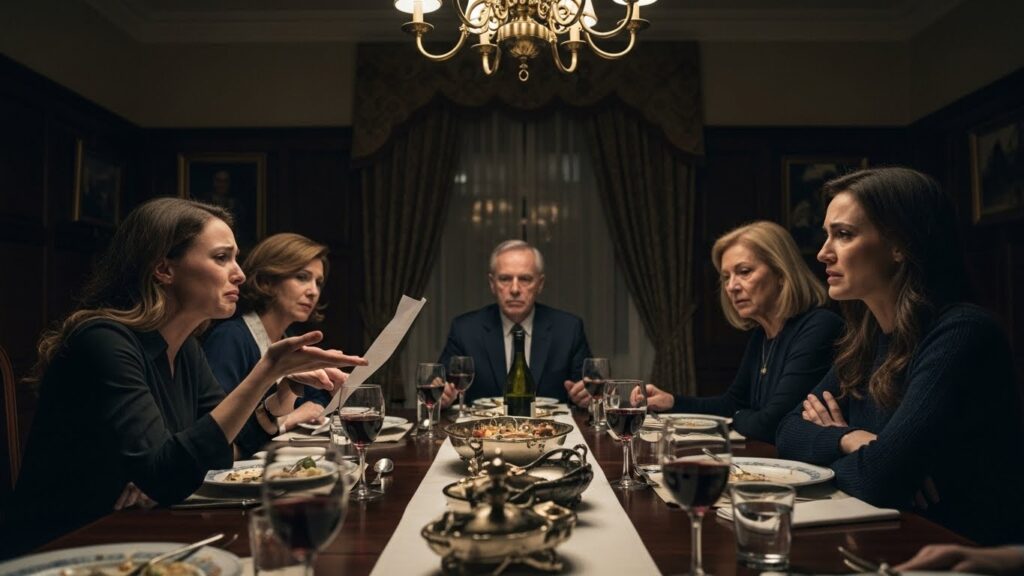
Hello Readers, throwaway because some family members still think I’m the villain in this story. I’ve been carrying this for eight months, and it still keeps me up at night. One question my sister asked during the reading of our grandmother’s will in May 2025 turned a close sibling relationship into something unrecognizable. We haven’t spoken since July, and I don’t know if we ever will again. This isn’t about the money—it’s about what the fight revealed about who we really are to each other.
I’m 29F, the younger sister. My sister “Lauren” is 32F, married with a toddler. We grew up in a comfortable suburb outside Chicago—just the two of us girls, Mom a teacher, Dad an accountant. Classic Midwestern family: Friday pizza nights, summer lake vacations, big holiday gatherings with Grandma. Lauren was the responsible one—straight A’s, college scholarship, married at 25, first grandkid. I was the “free spirit”—art school, traveled after graduation, moved to the city, built a career in illustration without a safety net. We were different, but close. She was my maid of honor (even though I eloped). I was her biggest cheerleader when she had fertility struggles. We talked almost daily.
Grandma—“Gram”—was 91 when she passed in April 2025. She was the anchor: widowed at 60, lived independently until the end, sharp as ever. She’d built a small nest egg—house worth $700k, savings, investments, jewelry. Total around $1.1 million. She always said, “I’m splitting everything 50/50 between my girls. No favorites.”
We believed her. No reason not to.
Gram’s will reading was May 10 at the lawyer’s office. Just me, Lauren, our parents, and Gram’s sister (Great-Aunt Joan). We were sad but not tense—hugging, reminiscing.
The lawyer read the basics: debts paid, small gifts to charity and Aunt Joan.
Then the main bequest.
House to be sold, proceeds split equally.
Jewelry and personal items: Lauren gets first choice of three pieces, then me, alternating until done.
Savings and investments: $50,000 to Lauren “for her dedication in my final years,” the remainder split 50/50.
I blinked. “Dedication in her final years?”
Lauren looked as surprised as I was.
The lawyer explained: a codicil added in February 2025, signed and witnessed when Gram was still lucid (doctor’s note attached). It thanked Lauren for “weekly visits, managing medications, and being my companion when I needed it most.”
I wasn’t angry at first—just confused. I lived three hours away; Lauren lived 20 minutes from Gram. She did visit more, handled some doctor stuff when Gram’s hips got bad. I came when I could, called daily, sent art and letters. I figured Gram just wanted to acknowledge the logistics.
But then Lauren spoke.
“Wait… so I get an extra $50k because I lived closer? That doesn’t seem like Gram.”
The lawyer: “It’s her expressed wish.”
Lauren looked at me, eyes narrowing. “You’re not mad, right? It’s only because I was there more.”
I forced a smile. “Of course not. It makes sense.”
Inside, something stung. Not the money—I’m doing fine—but the implication that I hadn’t been dedicated enough.
Mom and Dad stayed neutral. Aunt Joan muttered, “Gram knew what she was doing.”
We left quietly. Hugs were stiff.
I thought we’d talk it out later.
We didn’t.
Texts started that night.
Lauren: “I feel weird about the $50k. Maybe we should split it anyway?”
Me: “If that’s what you want, sure. It’s Gram’s wish, but I’m not upset.”
Lauren: “No, I’ll keep it. I did earn it—I was there every week, handling everything while you were off living your city life.”
That hurt.
Me: “I visited when I could. Distance isn’t a choice to not care.”
Lauren: “You could’ve moved closer. You chose not to.”
The fight escalated fast.
She accused me of being “jealous” my whole life—of her stability, her family, her closeness to Gram.
I accused her of acting entitled, like proximity made her love more valid.
Parents tried mediating: “It’s what Gram wanted. Let it go.”
But Lauren kept pushing: “If you’re so okay with it, why did you look shocked at the reading?”
Because it felt like Gram had judged us—and found me wanting.
By June, we were barely speaking. She posted passive-aggressive Instagram stories about “family who show up.”
I stopped replying.
July: the house sold. Closing money distributed.
Lauren got her $50k plus half the rest (~$450k each after fees).
She sent me a text: “Money’s in. Thanks for not contesting. Guess Gram knew who really cared.”
I lost it.
Called her: “This isn’t about money. It’s that you’re acting like I didn’t love Gram as much because I didn’t live next door.”
She cried: “You always made me feel like the boring one for staying close to home. Now you’re mad I got rewarded for it.”
We screamed. Said things we can’t unsay.
I hung up: “I’m done pretending this doesn’t hurt.”
She blocked me.
Parents begged us to reconcile: “You’re sisters. This is silly.”
But Lauren told them if they “took my side,” she’d limit their time with her kid.
They stayed neutral—meaning they didn’t push her.
I went no-contact.
It’s been eight months.
Mom sends monthly updates: “Lauren asks about you.” (She doesn’t.)
Dad: “She’ll come around.”
Aunt Joan told me privately: “Gram worried you girls would fight. She added the $50k hoping it would balance things—Lauren gave up career growth to stay near her.”
That made it worse.
I grieve three things: Gram, the sister I thought I had, and the family narrative that we were equally loved.
Lauren got the money. I got the truth: proximity bought her “dedication” points, and my independence was quietly judged.
We’re not enemies. We’re strangers now.
My sister’s inheritance question—“Did I really earn this extra?”—split us forever.
Because the real question was: “Who loved Gram more?”
And neither of us liked the answer we heard.
I miss her. But I won’t beg for a relationship where love is measured by zip codes.
If your family has unspoken scorekeeping—talk about it before someone’s gone. Because money doesn’t cause the fight.
It just exposes the one that was already there.
Thanks for reading. I needed to say this somewhere.