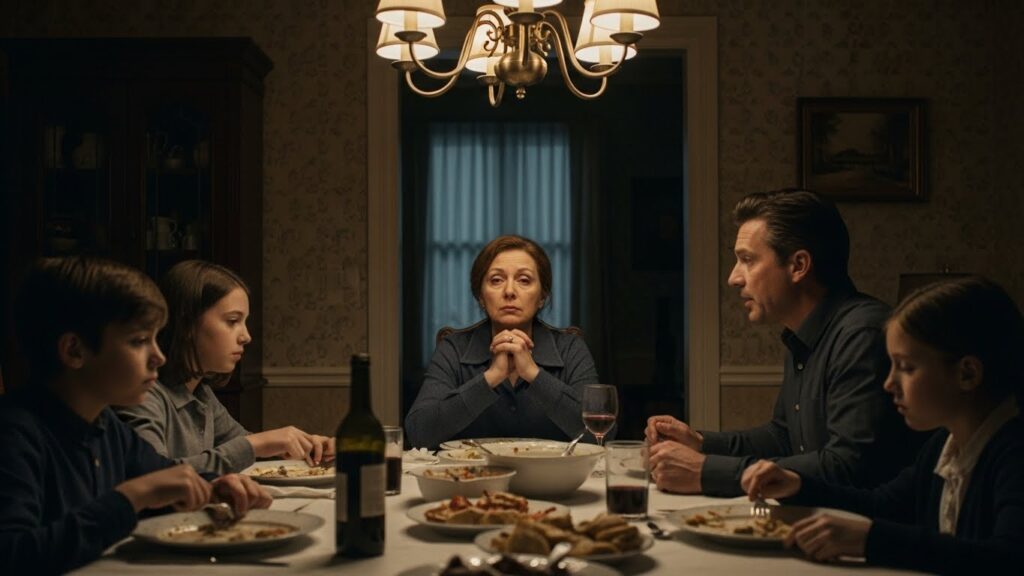
Hello Readers, throwaway because my family would know this story in an instant. I’ve been carrying this night around for over a year, turning it over in therapy, in journals, in 3 a.m. wide-awake moments. One ordinary family dinner in November 2025 ended with my mother saying absolutely nothing when she should have spoken up—and that silence finally explained why our relationship has always felt like walking on eggshells. It wasn’t anger or tears or a big revelation. It was quiet. And that quiet told me everything I’d been missing for thirty years.
I’m 30F, only child. My parents are still married—Mom 58F, Dad 60M. We grew up in a comfortable suburb in Connecticut: nice schools, summer camp, family vacations to the same beach house every year. On the surface, perfect. Dad is a high-school history teacher turned administrator—outgoing, beloved by students, tells stories at parties. Mom is a retired librarian—soft-spoken, organized every bake sale, remembered every birthday. She was the “quiet one,” but I always thought it was just her personality: gentle, conflict-averse, the peacemaker.
I was the classic good girl: straight A’s, no rebellion, tried to make them proud. But there was always this undercurrent with Mom—an unspoken expectation that I would anticipate her needs, mirror her opinions, never rock the boat. If I disagreed with her—even mildly—she’d go silent for days. Not angry silence, just… absence. No calls, short texts, “I’m fine” if I asked. I learned early: keep Mom happy, or lose her warmth.
I thought it was my fault for being “too sensitive.”
The dinner was November 22, 2025—early Thanksgiving with just the four of us (my parents, me, and my boyfriend “Nate,” 31M, who they’d met a few times). Nate and I had been together 18 months; things were serious. I’d been nervous bringing him home—Mom could be cool with new people if they didn’t fit her exact vision.
Dinner was lovely at first. Mom’s turkey, Dad’s bad jokes, wine flowing. Conversation light: Nate’s job in software, my promotion, their upcoming cruise.
Then Dad asked Nate, innocently, “So what are your plans long-term? Thinking marriage, kids?”
Nate smiled, squeezed my hand. “Definitely marriage—when the time’s right. Kids… we’ve talked about it. I’d love them someday, but Alex and I agree we want to travel more first, make sure we’re ready.”
Normal answer. Honest.
Mom’s fork stopped halfway to her mouth.
She set it down slowly.
The table waited.
Finally she said, voice small: “You don’t want children?”
Nate, sensing tension: “Not right now. We’re on the same page—maybe later, maybe not. We’re happy as we are.”
Mom looked at me. “You don’t want to be a mother?”
I kept my voice steady. “I’m not sure yet, Mom. I love kids, but I also love my career and freedom. Nate and I will decide together when we’re ready—if ever.”
Silence.
Dad tried to smooth it: “Plenty of time. You’re young.”
But Mom just stared at her plate.
Then she said, very quietly: “I always thought you’d want what I had.”
I felt the old eggshells under my feet.
“Mom, I love what you and Dad have. But my life might look different. That doesn’t mean I love you less.”
She didn’t reply.
Just picked up her fork and kept eating.
The rest of dinner was surface chatter—Dad and Nate carrying it, me forcing smiles.
Dessert: Mom brought out pie, served everyone, skipped herself.
No one mentioned it again.
Nate and I left early. In the car he said, “Your mom seemed upset.”
I brushed it off: “She’ll be fine.”
But she wasn’t.
Texts stopped. Calls went to voicemail. When I reached her a week later: “I’m just tired, honey.”
Thanksgiving proper was canceled—“Mom’s not feeling well.”
Christmas: small, tense. Mom pleasant but distant. Gifts wrapped perfectly, but no warmth.
I finally confronted her in January 2026, over coffee at her house.
“Mom, you’ve been quiet since that dinner. Are you upset I might not have kids?”
She looked out the window for a long time.
Then: “I gave up everything for you. My career, my friends, my body, my youth. I thought… someday you’d understand why it was worth it. That you’d want the same joy.”
I felt tears coming. “I do understand. I’m grateful every day. But wanting a different life doesn’t make me ungrateful.”
She nodded, eyes wet. “I know. Logically. But when you said you might not… it felt like you were saying my choices weren’t worth it.”
I reached for her hand. “Your choices were perfect for you. I love you for them. I just might choose differently.”
She squeezed my hand—briefly—then let go.
“I need time to accept that.”
It’s been a year.
We talk—monthly calls, texts about safe topics (weather, recipes). She’s warm with Nate, asks about work.
But the closeness is gone.
No more late-night chats. No “I’m proud of you” without a pause.
I mourn the mother-daughter bond I thought was unbreakable.
My mother’s silence at dinner explained everything.
It wasn’t about grandkids.
It was that her entire identity—her sacrifices, her purpose—was tied to me repeating her life.
And when I said I might not, she couldn’t hide the hurt.
I don’t blame her. I understand now: she gave everything, hoping I’d validate it by wanting the same.
But I can’t live her life to prove hers was worthwhile.
We’re finding a new normal—polite, careful, less intimate.
It’s painful.
But it’s honest.
And maybe that’s the best we can do.
Thanks for reading. I needed to share this somewhere.