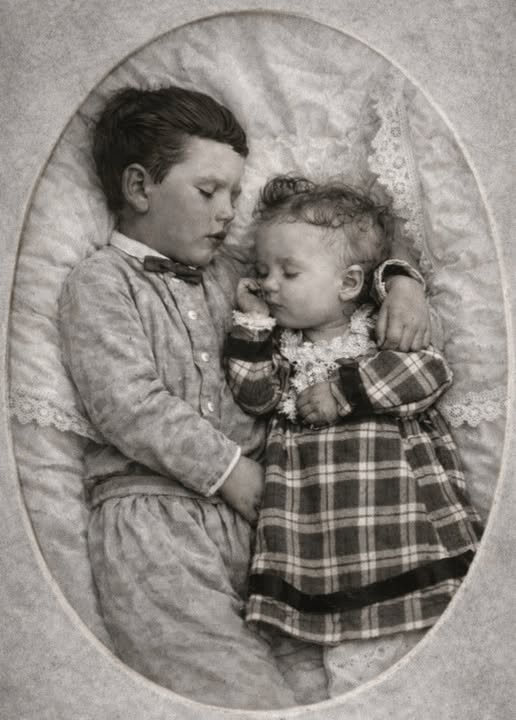
She lay still beneath winter light, small hands folded where play had once lived. In the winter of 1891, a house sat so quiet it felt like the walls were holding their breath. Grief in those days did not shout or collapse—it pressed inward, heavy and unspoken. In the dim parlor, a small white-draped table held a coffin, and inside rested two children, a brother no more than five and a sister barely three. Dressed as if for Sunday service, their hair carefully parted, their faces calm in a way no sleep could explain, his arm curved gently around her, as if even now he meant to protect her from a world that had already taken too much.
Their mother sat close, hands locked together, holding a thin ribbon that once tied back her daughter’s hair. She did not cry. She did not move. She stared, because how do you look away from the last place your children will ever be? Behind her stood their father, not old, but bent beneath a grief that had nothing to do with time. Words were useless here. Silence carried everything—love, guilt, disbelief, and the unbearable weight of what would never return. Flowers filled the room with sweetness that felt almost cruel, unable to soften the truth that laughter had ended in this house.
When the photograph was taken, it was not meant for the world. It was meant for memory. For the day a drawer would be opened and trembling fingers would trace faded faces. For nights when names would be whispered into the dark. Long after the room emptied and the flowers wilted, the image remained—a fragile witness to love that had nowhere left to go. They left together, faces peaceful, hands almost touching, as if the journey beyond felt less frightening side by side. And when love has no place to land, when it cannot be given or held anymore, what does it become—if not grief, quietly refusing to forget?