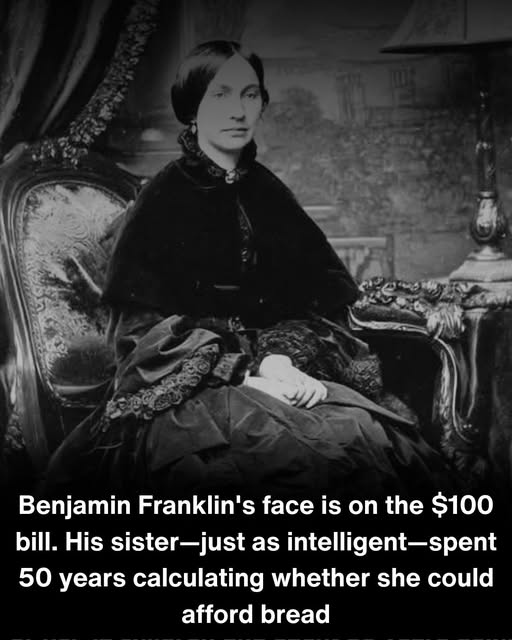
Boston, 1727. Jane Franklin was fifteen years old when her family told her it was time to marry. She had no dowry. No prospects. The family couldn’t afford to feed another mouth.
Edward Mecom was a saddlemaker with a trade. That was enough. Jane married him and her future was decided.
Her brother Benjamin, seven years older, had already left home. He’d learned printing, moved to Philadelphia, started making connections. Doors opened for him. Opportunity recognized him.
Jane’s door led somewhere else entirely.
Within a year, she was pregnant. Then pregnant again. And again.
Twelve children in twenty-two years. Twelve pregnancies that left her body exhausted, her finances stretched impossibly thin, and her heart broken over and over.
Her first child, Josiah, died at age five. Her second, Edward Jr., survived but developed severe mental illness—violent, unstable, and there was no care available. She just lived with the fear.
Her daughter Sarah died as a toddler. Her son Benjamin—named for her famous brother—died at age three. Another daughter Jane died at seven. Then another. Then another.
She kept a mental ledger of the dead.
While Benjamin Franklin was in London meeting with Parliament, scientists, and artists, Jane was in Boston counting pennies to buy flour.
While Benjamin published Poor Richard’s Almanack and became wealthy, Jane took in boarders and did sewing repairs by candlelight to pay rent.
While Benjamin invented lightning rods and bifocals, Jane calculated whether she could afford firewood for winter.
This wasn’t failure. This was life as a woman in eighteenth-century America.
And here’s what makes Jane’s story devastating: she was intelligent. Possibly as intelligent as her famous brother. She taught herself to read voraciously. She followed politics. She understood complex ideas and wrote eloquent letters that historians now study.
But intelligence without opportunity is just potential that dies quietly.
Benjamin knew this. In his letters to Jane, he sometimes expressed guilt about their vastly different paths. He acknowledged they were born into the same family with similar capabilities—but being born male or female determined everything.
Jane never complained. She didn’t have time for self-pity. Survival was full-time work.
When Edward’s mental illness worsened, Jane became the sole provider. She opened a boarding house. She made soap and sold it. She took in sewing. She repaired clothing. Whatever work came, she did.
The arithmetic was relentless and unforgiving.
Three shillings for rent. Two for bread. One for candles. How much soap could she make this week? How many boarders could she feed on what remained? One miscalculation meant hunger. Another meant eviction.
During the American Revolution, it got worse. British troops occupied Boston. Prices skyrocketed. Basic goods disappeared.
“Flour is five pounds per barrel,” she wrote to Benjamin in 1775. “I cannot afford it. We eat whatever we can find.”
While her brother was in France negotiating treaties and dining with aristocrats, Jane was in Boston trying to figure out how to feed her remaining children on almost nothing.
She also became the Franklin family’s invisible infrastructure. Relatives sent letters through her. She passed news of births, deaths, marriages, illnesses. She coordinated help—when someone needed money, she knew who to ask. When someone needed shelter, she found it.
Essential. Unpaid. Invisible.
In 1776, her daughter died in childbirth. Then her grandson. Then her son Peter.
By 1785, of her twelve children, only one was still alive: her daughter Jenny.
Eleven children dead. Eleven times she’d prepared small bodies for burial. Eleven times she’d continued anyway because there was no alternative.
Benjamin occasionally sent money. It helped, but it wasn’t regular or sufficient. Jane was proud—she hated asking—but eventually desperation won. Her letters began including careful, indirect mentions of her financial situation.
Benjamin increased his support. But he was busy being Benjamin Franklin—diplomat, inventor, celebrity. His fame absorbed him. Jane understood. She was genuinely proud of her brother.
But imagine the cognitive dissonance.
Newspapers praised Benjamin Franklin’s genius. People sang his accomplishments. He represented America to the world—proof that talent and hard work led to success.
Meanwhile his sister—equally intelligent, equally hardworking—was struggling to afford bread.
It wasn’t that Jane worked less. It was that the world valued men’s work and treated women’s labor as if it didn’t exist.
Jane’s letters are among the few surviving documents we have from working-class women of this era. Most women’s writing was destroyed or never preserved. Jane’s only survived because her brother was famous enough that archivists kept his correspondence.
We almost lost her voice entirely.
What survives reveals extraordinary intelligence. She discussed philosophy, politics, religion. She analyzed the Revolution’s impact on ordinary people. She described economic realities historians rarely documented.
She also wrote about soap recipes, debt collection, and whether she could afford sugar.
Because survival and intellect aren’t opposites—they’re intertwined.
When Benjamin died in 1790, he left Jane a house and a small income. Finally, at age seventy-eight, she had financial security.
She lived four more years in relative comfort—the first financial peace of her adult life.
By then eleven of her children were dead. Her husband had died years earlier. Most of her siblings were gone. She’d spent sixty-three years calculating survival.
Four years of security. Then she died.
Jane Franklin Mecom died in 1794, age eighty-two. Her obituary was brief. No public mourning. No recognition of her intelligence or resilience.
Benjamin Franklin’s death four years earlier had been marked by national mourning. The French National Assembly wore black armbands. Twenty thousand people attended his funeral.
Jane was buried quietly in Boston.
For two hundred years, she was barely a footnote in Benjamin Franklin’s biographies. “He had a sister in Boston” was about all historians mentioned.
Only recently have scholars begun examining her letters seriously—recognizing them as rare documentation of women’s experiences in early America.
What they reveal is staggering.
Jane wasn’t extraordinary because she was remarkable—she was extraordinary because she was ordinary. She represents millions of women whose intelligence was wasted, whose labor was invisible, whose resilience was expected without recognition.
Think about the parallel lives. Benjamin and Jane born into the same family, same gene pool, probably similar intellectual potential.
Benjamin got education. Jane got domestic training.
Benjamin got apprenticeship. Jane got marriage at fifteen.
Benjamin got patronage and connections. Jane got pregnancy and poverty.
Benjamin got fame. Jane got survival.
The difference wasn’t talent or work ethic. The difference was that Benjamin was born male in a world that invested in men and extracted from women.
Jane’s survival was its own kind of genius. The emotional intelligence required to bury eleven children and continue functioning. The strategic thinking required to stretch inadequate resources for decades. The mathematical precision required when every miscalculation meant disaster.
This was intellectual labor. Problem-solving under extreme pressure. Adaptive thinking in impossible circumstances.
But history called it “women’s work” and dismissed it as if it required no intelligence at all.
Today we talk about invisible labor women perform. The emotional work. The planning and coordinating. The arithmetic of survival that mothers still do—calculating budgets, managing households, juggling impossible demands.
Jane Franklin Mecom was doing that two hundred fifty years ago. In a world with no running water, no electricity, no social safety net, no legal rights.
She did it for sixty-three years.
And history almost erased her entirely because her labor was exactly what women were expected to do.
Benjamin Franklin is on the $100 bill. His face represents American success, ingenuity, self-made achievement.
Jane Franklin Mecom represents the millions of women whose intelligence, labor, and resilience made that achievement possible—by raising children, managing households, maintaining families, and doing the invisible work that allowed some people to become famous.
She wasn’t erased because she was unimportant. She was erased because her kind of labor was expected, invisible, and essential.
For women today juggling impossible demands, calculating survival, managing crisis after crisis—Jane is proof that resilience is its own form of genius.
She buried eleven children and survived sixty-three years of poverty through sheer strategic brilliance.
And history barely remembered her name.
Until now.
Jane Franklin Mecom (1712-1794): As intelligent as her famous brother, worked three times as hard, survived what would have destroyed most people, and was almost erased from history because she did it all while female.
Her brother got the $100 bill. She deserves recognition too.
Story based on Jane Franklin Mecom’s surviving letters, Benjamin Franklin’s correspondence, and historical research by Jill Lepore and other scholars. Shared to honor the invisible work that makes visible achievement possible.