My name is Allison, I’m 32 years old, and I live in Topeka, Kansas. I found out by accident, the kind that changes how you see your own life in hindsight. It was parent-teacher conference night, and I was already nervous. My son, Ethan, is seven—quiet, gentle, and the kind of kid teachers describe as “no trouble at all.” I always worry that means he’s invisible. His teacher, Mrs. Collins, smiled warmly as we sat down. We talked about reading progress, math skills, and how kind Ethan was to other kids. Then she hesitated, fingers folding together like she was choosing her words carefully. “I want to ask something,” she said. “Is everything okay at home… with meals?” My stomach tightened. I told her yes. I work two jobs. Things are tight, but I budget carefully. We always have dinner. Breakfast, too. Lunch money was… complicated. Some weeks I sent it. Some weeks I meant to and forgot. I assumed the school would notify me if there was an issue. She nodded slowly, then said, “I thought so. I just wanted to make sure.” I didn’t think much of it until she added, quietly, “Ethan hasn’t gone without lunch.”
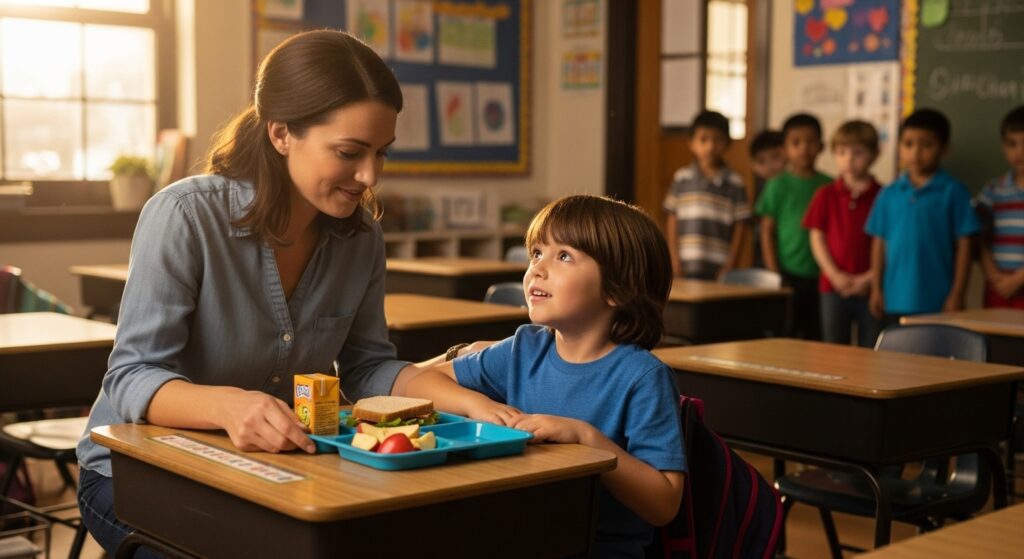
I looked at her, confused. She took a breath. “On the days he doesn’t have lunch money, I make sure he eats.” The room felt smaller. She explained that Ethan never complained. Never asked. When other kids lined up for lunch, he’d sit at his desk and read. When asked why he wasn’t eating, he’d say he “wasn’t that hungry.” He never wanted anyone to call home. “So I started bringing extra,” she said. “I told him it was leftover. That it would go to waste otherwise.” I felt my eyes burn. She wasn’t feeding him because he was starving. She was feeding him because he was trying not to be a burden. The realization hit me harder than any bill or late notice ever had. My son had been protecting me. At seven years old. I apologized immediately. Embarrassed. Ashamed. She stopped me.“Ple ase don’t,” she said. “You’re doing your best. He’s a good kid. He just feels things deeply.” That night, I asked Ethan about it gently. He shrugged and said, “Mrs. Collins said sharing is good.”
Then he added, “I didn’t want you to worry.” I cried in the bathroom so he wouldn’t see. The next week, I set up automatic lunch payments. I packed extras when I could. I wrote Mrs. Collins a letter I still don’t think captured how grateful I was. But what stayed with me wasn’t the kindness alone—it was the reason it was needed. I thought I was hiding our struggles well. I didn’t realize my son was learning how to disappear so I wouldn’t feel bad. Sometimes help doesn’t come because you ask. Sometimes it comes because someone notices what you’re trying too hard to hide.