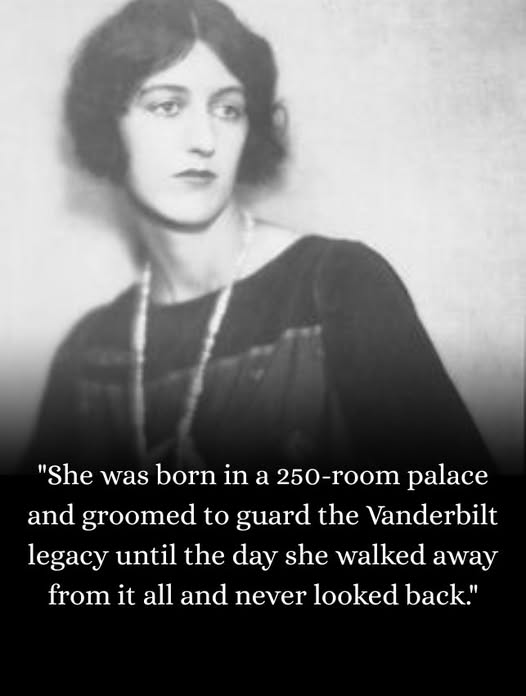
August 22, 1900. Biltmore Estate, North Carolina. Cornelia Stuyvesant Vanderbilt was born in the Louis XV Bedroom of America’s largest private home—a château with 250 rooms, 135,000 square feet, and 125,000 acres of North Carolina mountains.
Her father, George Washington Vanderbilt II, had built an American palace that defied imagination. Indoor swimming pool. Bowling alley. Banquet hall seating 64. A library with 23,000 books. Electric elevators. Central heating. Technology most Americans couldn’t dream of.
And Cornelia was its only heir.
She grew up wandering endless hallways, playing in rooms most families could never afford to visit. She had tutors, servants, every material advantage imaginable.
But she also had something else: constant surveillance. Every photograph showed her in perfect dresses, perfect poses. Every public appearance was choreographed. Every decision filtered through what was appropriate for a Vanderbilt.
When her father died suddenly from an emergency appendectomy in March 1914, thirteen-year-old Cornelia’s world shattered. Her mother Edith managed the estate, but everyone knew—this inheritance would be Cornelia’s burden to carry.
Society’s expectations were clear: marry well, produce heirs, maintain the Vanderbilt legacy. That was her purpose.
So in April 1924, twenty-three-year-old Cornelia married John Francis Amherst Cecil—British aristocrat, diplomat, handsome, suitable, approved by everyone who mattered.
Five hundred guests packed All Souls Cathedral in Asheville. Thousands lined the streets. Newspapers called it a society wedding for the ages.
The world saw a fairy tale. What they didn’t see was a woman slowly suffocating.
For eight years, Cornelia tried. She lived at Biltmore with John. She gave birth to two sons—George in 1925, William in 1928. She hosted society events. She even helped open Biltmore to the public in 1930 to stimulate the Depression-era economy.
She performed the role perfectly.
But something inside her was dying.
The mansion that represented ultimate privilege had become a prison. Every decision required considering the family name. Every opinion had to be appropriate. She couldn’t be anything except what everyone expected.
By 1932, Cornelia reached her breaking point.
She told John she needed to study art in New York. A brief trip. A temporary escape.
She never came back.
From New York, Cornelia went to Paris—the city where Americans went to reinvent themselves in the 1930s, where artists and expatriates built lives free from who they’d been expected to be.
In Paris, something unexpected happened: Cornelia began to deliberately disappear.
She stopped attending society events. Stopped posing for photographs. Stopped performing American royalty.
She dyed her hair bright pink. Changed her name to “Nilcha.” Immersed herself in bohemian life.
In 1934, she divorced John Cecil—an unthinkable scandal for someone of her standing.
American newspapers erupted:
VANDERBILT HEIRESS DIVORCES
AMERICA’S PRINCESS ABANDONS PALACE
Society matrons whispered: What a waste. What a scandal.
Cornelia felt something else entirely: freedom.
For the first time in her life, she was making choices based on what she wanted, not what was expected.
She remained in Europe through the chaos of the 1930s and World War II, choosing uncertainty and authenticity over security and performance.
In October 1949, she married again—Captain Vivian Francis Bulkeley-Johnson, a British war veteran. That marriage lasted until his death in February 1968.
Then at seventy-two in 1972, she married William Goodsir—twenty-six years her junior.
By then, she’d been away from Biltmore for forty years. She lived quietly in London and Oxford, rarely photographed, almost never interviewed. She went by “Mary” in her daily life.
The woman who’d once been America’s most famous heiress had successfully vanished.
But here’s what matters: Cornelia didn’t abandon her sons.
George and William were raised at Biltmore with their father. Cornelia remained connected to them throughout her life. She stayed in contact, loved them from across the ocean, maintained relationships despite the distance.
And those sons did something remarkable.
They transformed Biltmore from a struggling private mansion into a thriving historic landmark. They opened it to visitors, created sustainable tourism, built wine operations and hospitality businesses around the estate.
Today, Biltmore welcomes over a million visitors annually. It remains privately owned by Cornelia’s descendants—one of the few American estates that successfully transitioned from private palace to sustainable heritage site.
That future was possible because Cornelia had the courage to walk away—to let her sons find their own relationship with Biltmore rather than forcing them into predetermined roles.
When Cornelia died February 7, 1976, at age seventy-five in Oxford, obituaries struggled to define her legacy.
Rebel? Scandal? Woman who squandered extraordinary privilege?
Or simply someone who understood that inheriting a 250-room mansion doesn’t mean you have to live in it?
What Cornelia Vanderbilt proved is both simple and revolutionary:
Privilege can be a gift. It can also be a cage.
Sometimes the bravest act isn’t accepting what you’re given—it’s walking away to discover what you actually want.
The world expected her to guard a legacy, to be a symbol, to sacrifice herself to maintain an empire.
She chose to become herself instead.
She inherited America’s largest mansion, unimaginable wealth, and a lifetime of expectations. At thirty-two, she walked away from all of it.
The world called it scandal. Her sons made Biltmore thrive.
Sometimes the real inheritance isn’t the mansion. It’s the courage to leave what doesn’t fit—even when the whole world is watching.