The US and Israel continue to strike Iran, hitting oil storage depots and refining facilities for the first time.
The United States and Israel are continuing large-scale strikes on Iran, including an attack on an oil depot on Saturday, as the conflict has widened to include the Gulf region as well as Lebanon and Iraq.
Iran has said the US will pay for waging war and continued its retaliatory strikes on Israel and US military assets in Kuwait, Qatar, Saudi Arabia and the United Arab Emirates, despite Iranian President Masoud Pezeshkian promising on Saturday to halt attacks on Gulf states as long as their territories were not used to attack Iran.

Here is where things stand on day nine of the war:
In Iran
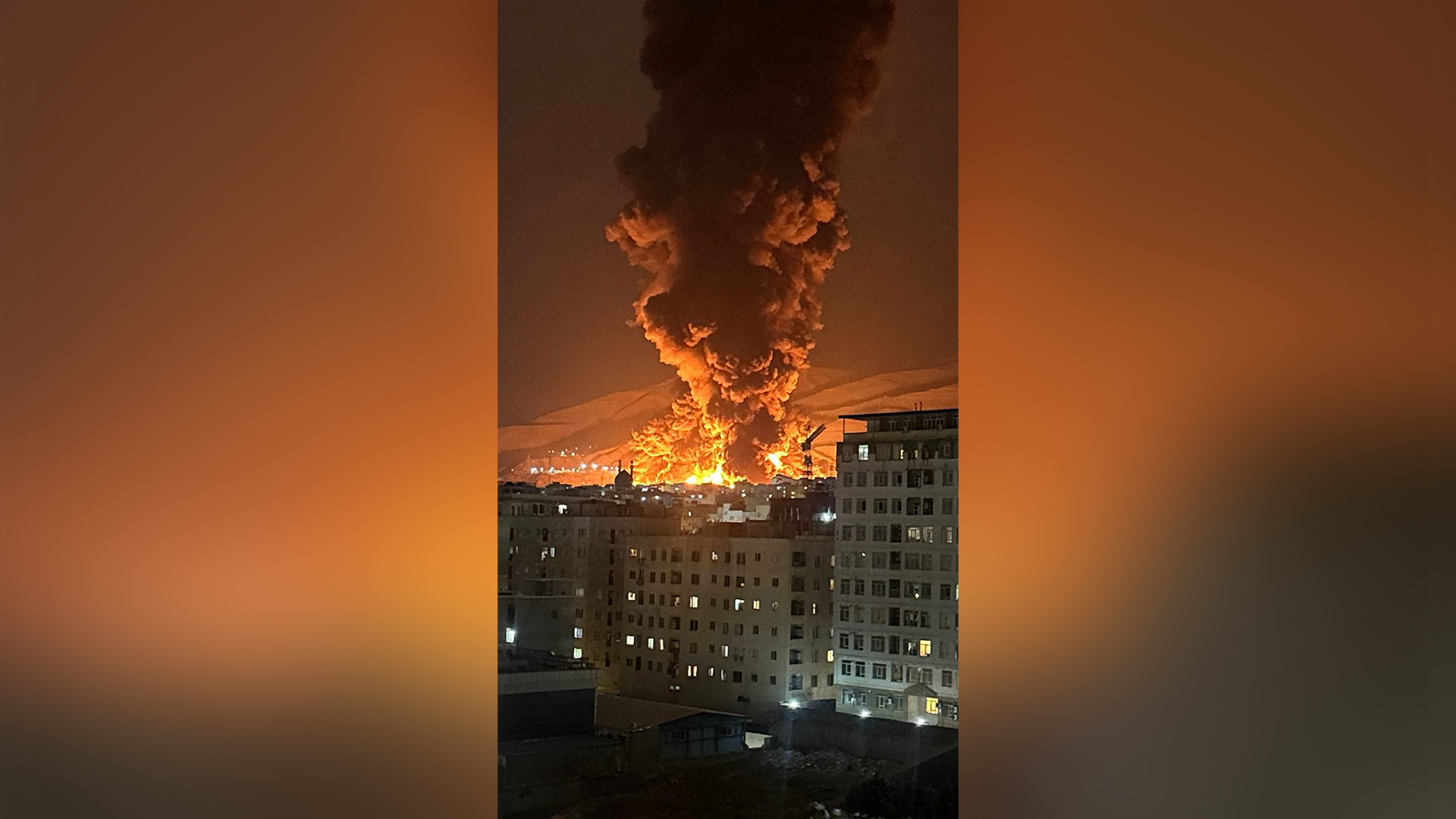
- Military attacks and rising casualties: The US and Israel have continued large-scale strikes on Iran and struck oil storage depots and refining facilities for the first time in the country. Late on Saturday, local media captured footage of a massive fire raging at the Shehran oil depot on the outskirts of Tehran. The Israeli military claimed responsibility for striking fuel storage and related sites it alleges are affiliated with the Iranian armed forces. At least 1,332 people have been killed since Israel and the US launched attacks on February 28.
- US demands: President Donald Trump continued with his demand for an “unconditional surrender” from Iran. Late on Saturday, he stated that the war would continue for “a little while” but stressed that Washington was not looking “to settle with Tehran”.
- Maritime threats and movements: The Iranian military confirmed that the Strait of Hormuz remains open, but it explicitly stated that it would target any US or Israeli ships attempting to pass through. On Saturday, when asked by journalists about the lack of traffic through the strait, Trump said it was the choice of the ships and claimed that Washington has “wiped out” Iran’s navy.
- Relations with neighbours: President Masoud Pezeshkian reiterated that Tehran wants good relations with the brotherly neighbouring countries, stating that the enemy is trying to create divisions. Pezeshkian said his remarks were “misinterpreted by the enemy that seeks to sow division with neighbours”, state TV reported on Sunday. His comments came as countries across the Gulf region reported drone strikes from Iran.
- Iran’s new leadership: Ayatollah Mohammad-Mahdi Mirbagheri, a member of Iran’s Assembly of Experts, hinted that a decision on a successor to the slain Supreme Leader Ayatollah Ali Khamenei was near. In a video posted by the Fars news agency on Telegram, Mirbagheri said “great efforts to determine the leadership” had been made and that “a decisive and unanimous opinion” had been reached.
- War crimes: Human Rights Watch said the attack on a primary school in southern Iran that killed at least 160 people, many of them schoolchildren, should be investigated as a war crime. Al Jazeera’s investigation has also found that the targeting of the school was likely “deliberate”, while The New York Times reported that the strike may have been carried out by the US.
- Intelligence report: A report conducted by the US National Intelligence Council found that a “large-scale” US-led assault on Iran was unlikely to topple the country’s government, according to The Washington Post. The report also described the prospect of Iran’s fragmented opposition taking control of the country as “unlikely”.
- Oil trade: The war has roiled global markets, and oil prices have hit multiyear highs, with the Strait of Hormuz effectively shut. In one week of the war, Brent crude oil price climbed 27 percent, the biggest weekly gain since the COVID-19 pandemic in 2020.
In Gulf nations
- Bahrain: An Iranian drone attack caused material damage to a water desalination plant in Bahrain, the country’s Ministry of Interior said. This comes a day after Iranian Foreign Minister Abbas Araghchi said the US attacked a freshwater desalination plant on Qeshm Island in southern Iran, setting a “precedent”. There was no immediate comment from Iran following Bahrain’s statement. The majority of the Gulf countries largely depend on desalinated water for their inhabitants’ consumption.
- Qatar, Kuwait and the UAE: The three countries reported incoming missiles and drones in their territories, despite the Iranian president’s assurance of no attacks on neighbouring countries. Kuwait said two border security personnel were killed while on duty, and said attacks on its international airport and social security office also caused fires.
- Saudi Arabia: It said an attack on Riyadh’s diplomatic quarter was foiled and several drones were downed in its airspace.
- Gulf Cooperation Council: The GCC said Iran’s continued attacks against Bahrain and Kuwait are “dangerous acts of aggression” that threaten regional security and stability. The bloc comprises Bahrain, Kuwait, Oman, Qatar, Saudi Arabia and the United Arab Emirates.
- Aviation and evacuation updates: Following significant regional airspace closures and flight cancellations, Qatar’s Hamad international airport partially resumed air navigation via dedicated “emergency routes”. Qatar Airways operated special flights from London, Paris, Madrid, Rome, Frankfurt and Bangkok to Doha on Sunday. According to the airport’s website, all of those flights landed safely.
In Israel
- Iranian strikes: The Israeli military said Iran launched several missiles towards Israel. Air raid sirens were activated in southern Israel, including in the Negev Desert.
- Iran’s Islamic Revolutionary Guard Corps (IRGC) described the latest attack as the “27th wave of Operation True Promise”.
In the US
- Timeline of the war: President Trump said the war would continue for “a little” while, and that it was going “unbelievably good” for the US military. The White House has said the campaign may last four to six weeks.
- US casualties: The caskets of the six American service members killed in the retaliatory Iranian strikes against the US arrived in the US. Trump presided over the arrival ceremony of the slain soldiers as commander-in-chief of the US military. He described their deaths as a “very sad day” for the Americans.
- Pentagon chief threat: US Defense Secretary Pete Hegseth issued a new threat to Iran. “If you kill Americans, if you threaten Americans anywhere on earth, we will hunt you down without apology and without hesitation, and we will kill you,” he said on X.
- Nuclear stockpile: Axios reported that the US and Israel have discussed the possibility of deploying special forces to seize Iran’s stockpile of highly enriched uranium. The news outlet said the mission would likely take place “at a later stage” of the war.
In Lebanon, Iraq
- Israeli forces bombed a hotel in downtown Beirut, killing at least four people and wounding 10 others. The Israeli military said it struck “key commanders in the Quds Force’s Lebanon Corps” who were operating in Beirut.
- Early on Sunday, Israel carried out a raid on the southern suburbs of the Lebanese capital.
- Israel threatened the residents of Arnoun, Yohmor, Zrariyeh East and Zrariyeh West villages in southern Lebanon with an imminent attack, ordering them to flee north of Nabatieh governorate immediately.
- Hezbollah said it targeted Israeli forces in the town of Marba in southern Lebanon.
- Growing numbers of residents have fled areas, including Tyre and Beirut’s southern suburb of Dahiyeh. Schools in Beirut are now being used as shelters.
- Kurdish Peshmerga forces shot down a drone over the Kurdish area of Sulaimaniyah in northern Iraq amid a series of aerial attacks on the region, according to news outlet Rudaw.
- Trump said he did not want to make the war “more complex than it already is” by allowing the Kurds to join the war. Earlier, multiple publications had reported that Trump was in active talks with Iranian and Iraqi Kurdish groups, and that Washington had hoped to use them to spur a popular uprising.
- Iraqi Brigadier General Haider al-Kharki has said neither Iraqi forces nor members of the regional Kurdish Peshmerga forces have crossed into Iran since the US-Israel war on the country started.