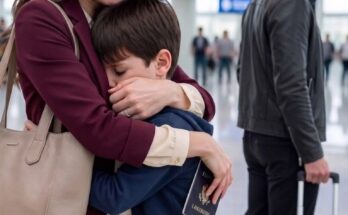
I was still holding the discharge papers when my mother told me to take a bus.
The automatic hospital doors slid open behind me, letting out a burst of cold air that hit the fresh pain in my abdomen hard enough to make me stop walking. Three stitches. That was what the doctor said after the minor emergency procedure, like three stitches sounded small enough to be harmless. It did not feel harmless. Every step pulled at the skin just above my hip, and even breathing too deeply made my side throb.
I had texted my parents an hour earlier to tell them I was being discharged and asked if one of them could pick me up. I was not asking for flowers or sympathy. I just did not want to stand outside a suburban hospital in northern New Jersey, slightly drugged, sore, and alone.
My phone rang as I reached the curb.
“Hey, sweetheart,” my mother said, distracted, as if she were calling from a grocery aisle instead of responding to her son leaving the hospital.
“Where are you?” I asked.
“At the mall,” she said. “We’re getting things for Chloe’s birthday dinner. Your father’s carrying bags.”
I waited for the rest of the sentence, the part where she said they were already on the way.
Instead she added, “Can’t you just take a bus?”
For a second, I thought I had misheard her.
“A bus?” I repeated.
She lowered her voice, irritated now, like I was making this harder than it had to be. “Evan, you’re not dying. The doctor sent you home, didn’t he? We already promised Chloe we’d make tonight special. She’s been emotional all week.”
I looked down at the white bandage taped over my stitches, then at the cars pulling up under the hospital awning. Families were helping each other with bags, opening doors, arguing gently over medication instructions. People belonged to someone. That truth hit me harder than the incision pain.
“So you’re not coming,” I said.
My mother sighed. “Don’t be dramatic. Take a bus or call a car. We’ll see you at home.”
Then she hung up.
I stood there with my overnight bag in one hand and the phone in the other, staring at my own reflection in the black screen. Chloe. It was always Chloe. My younger sister never had to ask twice for anything. If she wanted a custom cake, she got one. If she wanted a weekend trip, my father moved meetings. If she cried, the whole household tilted around her feelings. I had spent years telling myself it was just different personalities, different needs, different timing. Standing outside that hospital, hurting and abandoned while my parents shopped for balloons and wrapped gifts, I finally stopped lying to myself.
I called a taxi.
The ride home took thirty-two minutes. By the time I got inside the empty house, my anger had gone past hot and settled somewhere cold and precise. I went upstairs, sat carefully on the edge of my bed, opened my laptop, and logged into the insurance portal connected to my bank.
Primary beneficiary: Chloe Mercer.
I stared at her name for a long moment.
Then I deleted it.
I replaced it with a charitable medical fund in my own name, saved the changes, and printed the confirmation.
Three weeks later, Chloe went to the doctor for something that made the whole family panic.
The call came on a Tuesday morning while I was at work reviewing bids for a commercial renovation project in Newark.
My phone lit up with my father’s name. He almost never called during office hours unless something was wrong, and after what happened at the hospital, I had kept contact with my parents down to the bare minimum. Short replies. No family dinners. No pretending.
I let it ring twice before answering.
“What?” I said.
There was no greeting. Just my father’s voice, tense in a way I had not heard since the recession nearly wiped out his business years earlier.
“It’s Chloe.”
I leaned back in my chair, staring through the glass wall of my office at a conference room full of junior staff setting up drawings. “What about her?”
“She found a lump,” he said. “The doctor thinks it may be serious. They’re running more tests.”
For one sharp second, all my anger disappeared and something older took its place: fear. Not because Chloe and I had ever been close, but because illness has a way of collapsing history into the present. She was still my sister. Still the girl whose hand I held when she was eight and scared of thunderstorms. Still the teenager I defended when boys at school humiliated her online. Families rot slowly, but memory does not always rot with them.
My father kept talking.
“Your mother is beside herself,” he said. “Chloe’s scared. She… she asked about the policy.”
I frowned. “What policy?”
Silence.
Then I understood.
My mother must have told her. Or maybe Chloe had known all along that she was listed on my life insurance, some ugly practical comfort hidden in the family structure. Chloe had always been treated as if everyone’s resources naturally bent toward her future.
“The policy from work,” my father said carefully. “The one where she was your beneficiary.”
I felt something in me go still.
“She isn’t,” I said.
Another silence. Heavier this time.
“What do you mean?” he asked.
“I changed it.”
His breathing shifted. “When?”
“The day I got home from the hospital. The day Mom told me to take a bus because you were both too busy preparing for Chloe’s birthday.”
He let out a slow breath, already angry. “That’s what this is about? Evan, for God’s sake, this is your sister.”
“No,” I said. “This is about the fact that when I needed my family, you were at the mall buying decorations.”
My father lowered his voice in that dangerous way he used when trying to sound reasonable while boiling underneath. “You are seriously bringing that up now, when Chloe could be sick?”
“I’m bringing it up because now you suddenly remember I exist.”
He started to say my name, but I cut him off.
“Did anyone call when I got home that night? Did Chloe? Did Mom? Did you? No. Not until this became about something you might lose.”
That was the truth neither of us wanted to sit with. If Chloe had not been frightened, if the doctor had not mentioned the word biopsy, my beneficiary choice would still be invisible. A cruel little secret lodged in paperwork. But fear changes people. It shines light into corners they were happy to ignore.
My father’s voice cracked for the first time. “She thought you’d always take care of her.”
I laughed once, low and stunned. “Of course she did.”
We ended the call badly. He accused me of punishing the family over one mistake. I told him it was not one mistake. It was a system. A pattern. A lifetime of being the reliable one until reliability turned into invisibility.
That evening, my mother called crying. Not the theatrical crying she used to win arguments, but something rawer, messier. She said Chloe’s doctor had found more than one abnormality and wanted additional imaging. She said Chloe was terrified. She said the hospital bills could become serious if things turned into surgery, treatment, long-term care. She did not ask directly for the policy to be changed back. She did not have to.
The request sat inside every sentence.
I drove home that night through hard summer rain with my wipers slamming back and forth, thinking about stitches, bus stops, shopping bags, birthday candles, and the exact sound of my mother dismissing my pain because Chloe was “emotional.” Maybe to them it had been one thoughtless moment. To me, it had been revelation. Not about who Chloe was. I had always known that. About who I was to them.
An option. A backup. A resource.
By the end of the week, the tests came back with partial answers. Not cancer, not yet at least, but a serious condition involving her reproductive health that could require surgery and expensive follow-up. The family panic shifted from catastrophic to strategic. My parents moved into planning mode. Specialist consultations. Insurance questions. Costs. My mother called twice more. My father once. Chloe texted only six words.
Can we please talk? I’m scared.
I stared at the message for a long time.
Then I replied: I know. I was scared too.
Chloe came to my apartment on a Sunday afternoon carrying none of the confidence she had worn her entire life.
Usually, my sister entered rooms like she was expected, loved, and already forgiven for whatever had happened before she arrived. That day she stood outside my door in an oversized sweatshirt, hair pulled back, face pale and stripped of makeup, like someone who had been forced to meet herself without an audience.
I opened the door and said nothing.
She looked at the floor first. “Can I come in?”
I stepped aside.
My apartment overlooked the Passaic River, all clean lines and exposed brick, the kind of place my mother liked to describe as “impressive but lonely,” usually with a hint that success without family was a sad substitute. Chloe sat on the edge of my couch and folded her hands together so tightly her knuckles went white.
“The doctor said it’s endometriosis with complications,” she said. “There’s a lot of damage already. They think I might need surgery soon.”
I nodded once. “Dad told me.”
Her eyes filled immediately, but she held the tears back. “I didn’t know about the policy until Mom mentioned it after the appointment. I swear I didn’t come here just because of that.”
I leaned against the kitchen counter, arms folded, and looked at her. “Then why are you here?”
That question broke something.
She started crying, not elegantly, not in the soft wounded way she used at family gatherings when she needed sympathy. She cried like a person whose usual tools had failed. “Because I’m scared,” she said. “And because I think I’ve spent years acting like you’d always be there no matter how badly everyone treated you.”
The honesty startled me enough that I did not interrupt.
She wiped her face with both hands and kept going. She said she remembered the hospital night. She said she had heard our mother mention I was being discharged, but she had not asked any questions because she was busy obsessing over the dinner reservation, her dress, the photos, the perfect version of her birthday she had come to expect. She admitted that was not the first time she had let the family orbit around her without checking who got pushed out of the frame.
“You always handled everything,” she said, voice shaking. “So I never had to think about what it cost you.”
There it was. The ugliest truth in the room. Not that she had hated me. Not that my parents had consciously loved me less every single day. It was something more ordinary and, in its own way, more brutal: they had all built a family structure around my endurance. I was the one who would understand. Wait. Sacrifice. Cover. Drive. Pay. Fix. Chloe was the one protected from discomfort, and eventually she confused that protection with entitlement.
“I changed the beneficiary because that night I finally realized none of you believed I could ever choose myself,” I said.
She nodded through tears. “You were right.”
Those three words did more than any apology my parents had attempted.
For the first time since the hospital, I felt my anger loosen just enough to let grief through. I sat across from her, careful of the old scar that still tightened when I moved the wrong way, and told her what that night had actually felt like. The humiliation of standing alone outside. The pain. The way Mom’s voice sounded annoyed that my discharge had interrupted shopping. The taxi driver who asked if someone was meeting me at home, and how I lied and said yes because I could not bear to explain the truth to a stranger.
Chloe cried harder at that.
Then she said something I did not expect.
“If you never change it back, I’ll understand.”
I believed her.
That mattered more than the policy itself.
Over the next month, I went with her to one specialist appointment, then another. Not because my parents pressured me. In fact, after one sharp conversation, I told them clearly that if they tried to turn me into the family financier again, I would walk out for good. I went because Chloe asked me directly, without entitlement, and because fear had stripped enough vanity away for us to meet each other as adults for maybe the first time in our lives.
Her surgery was scheduled for early October. It went well. Recovery was ugly but manageable. The condition would affect her long term, maybe her fertility, maybe more, but it was treatable. Serious, not fatal.
A week after the procedure, my parents came to my apartment together. My mother cried. My father apologized in the stiff, incomplete way proud men do when full humility still terrifies them. Neither apology was perfect. Real ones rarely are. But they said the words I had needed for years: We failed you.
I never put Chloe back on the policy.
Instead, months later, after the dust settled, I created a smaller separate trust that could help with legitimate medical emergencies for any immediate family member, with strict conditions and my control over it. Not as surrender. Not as guilt. As structure. As boundaries. As proof that care and access were not the same thing.
The day I was discharged from the hospital with three stitches in my abdomen, my parents told me to take a bus because they were busy preparing for my sister’s birthday.
That was the day they lost the version of me who would absorb anything and still call it love.
What they got after that was harder to manipulate.
But in the end, it might have been the only version of me capable of saving what little family we had left.