📖 PART 1 — The Envelope He Never Meant Me to Ignore
There are parts of a home that hold more than objects, places where time settles quietly into dust and silence, where the ordinary becomes something heavier after loss, and it was in my late husband’s garage, among boxes he had not opened in years and tools he no longer had the strength to use, that I found the envelope that changed everything, tucked carefully between two old containers as if it had been placed there deliberately, not hidden exactly, but not meant to be found casually either, and the moment I saw his handwriting on the front, steady and unmistakable even after all these years, I felt something shift inside me, something small but undeniable, because the words written there were not casual, not routine, not something he would have written without reason: For my wife. Don’t show our son.
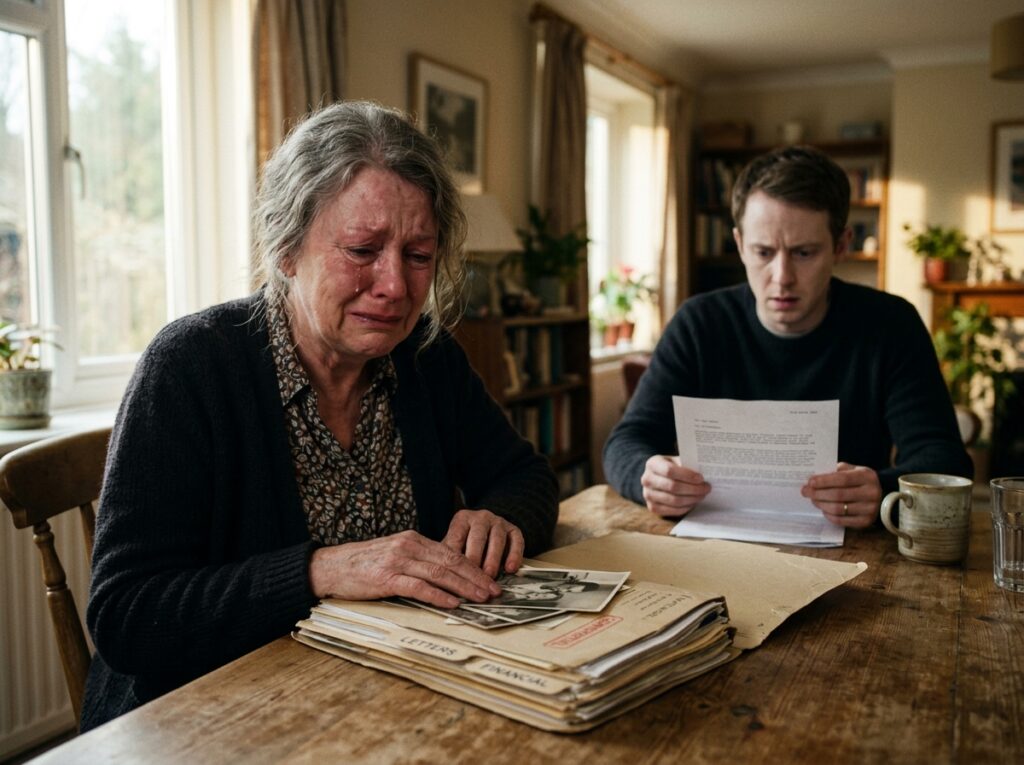
I stood there longer than I should have, holding the envelope in my hands, feeling the quiet weight of something I did not yet understand, because my husband had never been a man who relied on secrecy, not in the way that required instructions, not in the way that separated one part of the family from another, and yet there it was, written clearly, deliberately, a line drawn between me and our son without explanation, and for a moment, I considered putting it back, closing the lid on whatever it contained and leaving it exactly where it had been, because opening it felt like crossing into something I wasn’t prepared for, something that might change how I saw him, how I saw us, how I saw the years we had spent believing we understood everything about each other.
But curiosity is never just curiosity when it comes to the past.
It is instinct.
And instinct, when it comes quietly like that, is rarely wrong.
I opened the envelope slowly, careful not to tear it, as if preserving it might preserve the meaning behind it, and inside, I found something unexpected, something that didn’t answer questions but instead created more of them, a small metal key, heavier than it looked, cold against my palm, with a number engraved along its side, precise and deliberate, and beneath it, a folded piece of paper with an address written neatly in his handwriting, an address I didn’t recognize at first, not immediately, but familiar enough in its structure to suggest something important.
A bank.
A safe deposit box.
Something he had placed there intentionally.
Something he had never mentioned.
And something he had specifically told me not to share with our son.
That was the part I couldn’t ignore.
Not the key.
Not the address.
But the instruction.
Because secrets can exist for many reasons, but warnings, especially ones written so clearly, are rarely unnecessary, and as I stood there in the quiet of that garage, surrounded by the remnants of a life I thought I had understood completely, I realized that whatever my husband had left behind wasn’t meant to be discovered lightly, wasn’t something he expected me to find without purpose, and more importantly, it wasn’t something he wanted our son to know about.
Which meant one thing.
He had been protecting something.
Or someone.
And as I folded the paper back carefully, slipping the key into my hand, feeling its weight settle into something more than metal, something closer to responsibility, I understood that leaving it there, pretending I hadn’t found it, was no longer an option, because whatever waited behind that address had been placed there for me, not for him, not for anyone else, but for me to discover when the time was right.
And something told me—
that time had already come.
So I made a decision.
Quietly.
Without telling anyone.
I would go to the bank.
I would open the box.
And I would find out what my husband had kept hidden all these years—
even if the truth inside
was something I wasn’t ready to face.
📖 PART 2 — The Box He Left Behind
There is a certain kind of silence that exists only in places built for secrets, the kind that doesn’t feel empty but contained, as if the walls themselves understand that what passes through them is not meant to travel any further, and that was exactly what I felt the moment I stepped into the small bank my husband had written down, a place so ordinary on the outside that no one would think twice about it, yet carrying a quiet gravity that made every movement inside it feel deliberate, measured, as though time slowed slightly within its walls. I stood at the counter with the envelope in my hand, explaining as simply as I could what I had found, offering the key, the address, and my identification, and although the clerk nodded politely, professionally, I could tell from the way she glanced at the number engraved on the key that this was not something routine, not something people walked in with every day, and within minutes, I was guided down a narrow hallway into a private room where questions were replaced by procedure, and curiosity by quiet efficiency.
They brought out the safe deposit box without comment, a small metal container bearing the same number as the key in my hand, and placed it in front of me on a simple table before leaving the room, closing the door behind them with a soft click that seemed louder than it should have, not because of the sound itself, but because of what it represented, the moment where access became responsibility, where whatever was inside that box would no longer belong to the past alone, but to me as well.
For a brief moment, I didn’t move.
Not out of fear.
But out of awareness.
Because opening it would mean stepping into something my husband had chosen to keep separate from the life we shared, something he had protected not by hiding it completely, but by placing it just out of reach, waiting for a time when I would need to know.
And now—
that time had arrived.
I turned the key slowly, feeling the mechanism shift with a quiet precision that mirrored the care with which everything had been arranged, and when I lifted the lid, I expected something simple, something practical—documents, perhaps financial records, something that would explain itself quickly and leave little room for interpretation—but what I found instead was something entirely different, something that didn’t explain anything at first, but instead deepened the mystery in a way that made my chest tighten slightly as I leaned closer.
Photographs.
Dozens of them.
Carefully stacked.
Organized.
Preserved.
I picked up the first one with unsteady hands, not because it was fragile, but because of the way it felt, the weight of it, the sense that I was holding something more than just an image, and when I turned it over, I recognized the scene immediately—it was our house, years ago, before renovations, before changes, before time had softened its edges, and standing in the frame, just barely visible near the window, was my son, younger, unaware of the camera, unaware of anything beyond the moment he was living in.
At first, it didn’t make sense.
Why would my husband keep this here?
Why not in an album?
Why not somewhere we could both see it?
I set it aside and reached for the next.
And then the next.
And slowly, something began to shift.
The images were not random.
They followed a pattern.
A timeline.
Moments captured not for memory—
but for record.
My son entering rooms.
Opening drawers.
Handling things that were not his.
At first, small things.
Almost nothing.
But then—
larger moments.
Clearer.
Deliberate.
My hands stilled as the realization began to take shape, not fully, not all at once, but enough to make the room feel smaller, enough to make the silence heavier, because this wasn’t about memory, this wasn’t about nostalgia—this was documentation.
Evidence.
And beneath the photographs—
there was a folder.
Thick.
Carefully arranged.
My name written across the front in my husband’s handwriting.
Not rushed.
Not uncertain.
Deliberate.
As if he knew exactly when I would open it.
As if he knew exactly what I would find.
And as I placed the photographs back down, my fingers lingering slightly longer than necessary, I realized that whatever truth was waiting inside that folder was not something he could tell me while he was alive, not something he was willing to confront openly, but something he had prepared carefully, patiently, for the moment when I would have no choice but to see it for myself.
I hesitated for only a second.
Then I opened it.
📖 PART 3 — The Truth He Carried Alone
There are truths that don’t announce themselves with clarity the moment you uncover them, truths that unfold slowly, piece by piece, until what once felt impossible becomes undeniable, and as I opened the folder my husband had left behind, I felt that shift immediately, not because I understood everything at once, but because I could sense the weight of what I was about to learn long before the details fully revealed themselves, the kind of weight that settles quietly into your chest and stays there, waiting for you to catch up to it. The first page was not emotional, not dramatic, but structured, precise, a record rather than a confession, listing dates, amounts, account numbers, written in his careful handwriting, and at first, it meant nothing more than information, disconnected pieces of something I couldn’t yet place, until I began to recognize patterns, small at first, then clearer, then impossible to ignore.
Withdrawals.
Transfers.
Repeated over time.
Not random.
Not accidental.
Deliberate.
And then—
a name.
Our son’s.
I stopped reading for a moment, not because I didn’t understand, but because I did, because sometimes the mind tries to slow down what the heart already knows, tries to delay the moment when understanding becomes acceptance, and I felt that resistance rise quietly within me, not wanting to believe what the pages were showing, not wanting to connect the careful documentation in front of me with the person I had raised, the child I had trusted, the man I thought I understood.
But the evidence did not leave room for interpretation.
It was not one incident.
Not one mistake.
It was a pattern.
Built over years.
Small amounts at first.
Almost invisible.
Then gradually—
larger.
More frequent.
More confident.
As if he had learned how far he could go
without being noticed.
I turned the page slowly, my hands steadier now, not because the shock had passed, but because something else had taken its place, something quieter, something sharper, the need to understand fully, to see everything clearly rather than look away from it, and that was when I realized that this wasn’t just financial, it wasn’t just about money being moved or taken, it was about trust, about boundaries, about the quiet crossing of lines that were never meant to be crossed, repeated so often that they became normalized, hidden behind the comfort of family, behind the assumption that closeness removes consequence.
And my husband had known.
All of it.
For years.
There were notes in the margins, not emotional, not angry, but observational, almost clinical in their tone, as if he had been watching, documenting, trying to understand rather than react, trying to see the full shape of something before deciding what to do about it, and as I read them, I began to understand something even more unsettling than the truth itself—he hadn’t confronted our son, hadn’t stopped him, hadn’t exposed him.
He had waited.
Watched.
Recorded.
And then—
prepared.
The final pages were different.
Less structured.
More personal.
A letter.
Written to me.
Not in haste.
Not in fear.
But with clarity.
“If you’re reading this,” it began, “then I’m no longer there to explain it to you, and I’m sorry for that, because this is something I chose not to tell you while I was alive, not because I didn’t trust you, but because I didn’t want you to carry the weight of it while I still could.”
I sat back slightly, the words settling into me in a way that felt heavier than anything I had read before, because now this was no longer just information, no longer just records and patterns, it was intention, it was choice, it was the explanation behind everything that had been left unsaid.
“I noticed it years ago,” he continued, “small things at first, things easy to dismiss, easy to explain away, and I told myself it would stop, that he would correct himself, that it was temporary, but it didn’t stop, and over time, I realized something I didn’t want to accept—he wasn’t taking because he needed to. He was taking because he believed he could.”
I closed my eyes briefly.
Not in denial.
But in understanding.
Because that difference—
need versus belief—
changes everything.
“I didn’t confront him,” the letter went on, “because I wanted to understand how far it would go, how much of it was impulse and how much of it was choice, and I realized something important—if I stopped him, he would stop temporarily, but if I let him continue, I would see the truth clearly, without excuse, without confusion.”
My grip tightened slightly on the paper.
Because now—
I understood what my husband had been doing.
He wasn’t ignoring it.
He was measuring it.
Preparing for it.
“I’ve secured everything,” the final paragraph read, “not just for myself, but for you. Accounts have been moved, protections have been put in place, and what remains here is for you to decide. I did not want to turn our son into an enemy while I was alive, but I will not allow him to harm you when I am gone.”
The words didn’t feel like a warning.
They felt like protection.
Quiet.
Deliberate.
Complete.
And for the first time since I found the envelope in the garage, I understood what it had all meant, not just the key, not just the box, not even the records, but the instruction written so clearly on the front of that envelope.
Don’t show our son.
Because this wasn’t just a secret.
It was a line.
A boundary drawn by a man who knew something I had not yet been ready to see.
And now—
I had seen it.
All of it.
Which meant one thing.
What came next…
was no longer his decision.
It was mine.
📖 FINAL PART — The Choice He Left Me
There are moments when the truth does not arrive as a question, does not wait for permission or hesitation, but settles into place with a quiet certainty that leaves only one thing behind—choice, and as I sat alone in that small, silent room at the bank, my husband’s letter still in my hands, the weight of everything I had just read resting heavily but clearly within me, I understood that what he had left me was not just knowledge, not just evidence, but something far more difficult, far more important—the responsibility to decide what to do with it, to determine not only how I would see our son moving forward, but how I would protect myself from a truth that had been hidden in plain sight for far longer than I had ever realized.
I did not rush out of that room.
I did not react immediately.
Because decisions made too quickly are often shaped by emotion rather than clarity, and what my husband had given me required the opposite, it required steadiness, it required distance, it required the ability to separate what I felt from what I now knew, and so I sat there for a while longer, reading the letter again, not searching for something new, but allowing its meaning to settle more deeply each time, understanding not just the actions he had taken, but the reason behind them, the quiet way he had chosen to protect me without turning our son into something we could not come back from while he was still alive.
But he was no longer here.
And that line—
the one he had carefully avoided crossing—
now rested entirely in my hands.
When I finally left the bank, I carried everything with me, not just the documents and photographs, but the clarity they had given me, the understanding that what I had always believed about my family, about the trust that held it together, was no longer complete, and that moving forward meant seeing things as they truly were, not as I had hoped they would be.
I did not call my son immediately.
Not that day.
Not the next.
Because I needed to see him clearly, not as the child I had raised, not as the version of him I had held onto, but as the person revealed through years of quiet actions I had never known about, and when I did finally reach out, when I asked him to come over, there was something different in my voice, something he must have heard, because he didn’t question it, didn’t delay, didn’t ask why.
He arrived that evening.
Calm.
Unaware.
The same as always.
And for a moment, I simply looked at him, not searching for guilt, not searching for signs, but observing, the way my husband must have done for years, the way someone watches when they are trying to understand rather than assume, and I realized then that the hardest part of all of this was not what he had done, but how normal he still seemed, how easily he stood there in front of me as if nothing had changed, because for him—
nothing had.
“Sit down,” I said quietly.
He did.
Without hesitation.
Without suspicion.
And for a moment, neither of us spoke, the silence between us filled with something he could not yet see, something that had already reshaped everything on my side of the table while he remained exactly where he had always been.
“I went to the bank today,” I said finally.
That was all.
Nothing more.
But it was enough.
I saw it then—
the smallest shift.
Barely noticeable.
But there.
His posture tightened slightly, his expression changing just enough to break the calm he had walked in with, and in that moment, I knew something important, something that didn’t require evidence or explanation anymore.
He understood.
Not everything.
But enough.
“What bank?” he asked.
And there it was—
not confusion.
Not curiosity.
But caution.
I placed the folder on the table between us.
Not dramatically.
Not forcefully.
Just… there.
“I found something your father left behind,” I said.
He didn’t touch it.
Didn’t move.
Just looked at it as if it might confirm something he had spent years avoiding.
“You can read it,” I added.
My voice steady.
Not accusing.
Not emotional.
Because this wasn’t about confrontation.
It was about truth.
He hesitated for only a moment before reaching for the folder, and as he opened it, as his eyes moved across the pages, I watched the same process unfold in him that had unfolded in me earlier that day—the shift from uncertainty to recognition, from recognition to realization, from realization to something far more difficult to hold.
Understanding.
He didn’t speak right away.
Didn’t try to explain.
Didn’t deny it.
Because there are moments when denial becomes impossible, when the weight of what is in front of you leaves no room for anything but acceptance, and I saw that weight settle into him, not all at once, but enough to change the way he sat, the way he breathed, the way he looked at me when he finally lifted his head.
“I was going to fix it,” he said quietly.
The words came slowly.
Carefully.
As if he had said them before.
Perhaps to himself.
Perhaps many times.
“I was going to put it back.”
I nodded slightly.
Not in agreement.
But in acknowledgment.
Because intention—
does not erase action.
“I know,” I said.
And I did.
I understood the difference between what he had planned
and what he had done.
But understanding something
does not mean accepting it.
“I’m not here to argue,” I continued, my voice calm, even now, even here, because this moment did not need anger, it did not need raised voices or accusations, it needed clarity, the same clarity my husband had carried quietly for years, the same clarity he had passed to me when he left that envelope behind.
“I’m here to decide what happens next.”
He didn’t respond.
Because for the first time—
he was no longer in control of the outcome.
“I won’t expose you,” I said after a moment.
His eyes lifted slightly.
Surprised.
Hopeful.
But I continued before that hope could take shape.
“Not because you don’t deserve it,” I added calmly. “But because your father chose not to, and I understand why.”
That was the truth.
Not forgiveness.
Not yet.
But understanding.
“But I will protect myself,” I said.
And there it was—
the line.
Clear.
Final.
“All accounts are closed,” I continued. “Everything has been moved. You won’t have access to anything that belongs to me again.”
He didn’t argue.
Didn’t protest.
Because he knew.
He had already seen it in the documents.
“And from this point on,” I added quietly, “if you want to be in my life, it will not be because you feel entitled to it.”
The room fell silent again.
But this time—
it was different.
Not heavy.
Not uncertain.
Just… settled.
Because the truth had been spoken.
The line had been drawn.
And what remained was simple.
Choice.
He sat there for a moment longer, then closed the folder carefully, placing it back on the table in front of me, his movements slower now, more deliberate, as if something inside him had shifted in a way he could not yet fully understand, and when he finally stood, he did not say anything else, did not try to fix the moment with words that would not hold, did not ask for immediate forgiveness.
He simply nodded.
And left.
I remained seated for a while after he was gone, my hands resting lightly on the table, the quiet of the room returning slowly, naturally, as if it had been waiting for this moment to pass, and as I looked down at the folder one last time, I realized that what my husband had left me was not just protection, not just a warning, but something far more lasting.
Clarity.
Because in the end, this was never about the money.
It was about trust.
About boundaries.
About the quiet understanding that love—
without respect—
is not enough.
And as I stood, gathering the papers, placing them back where they belonged, I felt something settle inside me, not relief, not even resolution, but something steadier.
Something stronger.
The knowledge that I could see clearly now.
And that from this point forward—
no one would decide my life for me again.
THE END.!