PART 1
The engine room of the USS Vanguard was a furnace of controlled chaos, filled with the deafening roar of failing machinery, the sharp smell of burning oil, and the frustrated curses of the best naval engineers the Navy could gather. For three straight days, the carrier’s primary propulsion system had been dying a slow, agonizing death, leaving the billion-dollar warship dead in the water during critical Pacific exercises. Teams of elite technicians, civilian contractors, and senior engineering officers had worked around the clock, but nothing worked. Every diagnostic came back inconclusive, every repair attempt only made the problem worse. The atmosphere was thick with tension and the quiet fear of a career-ending failure.
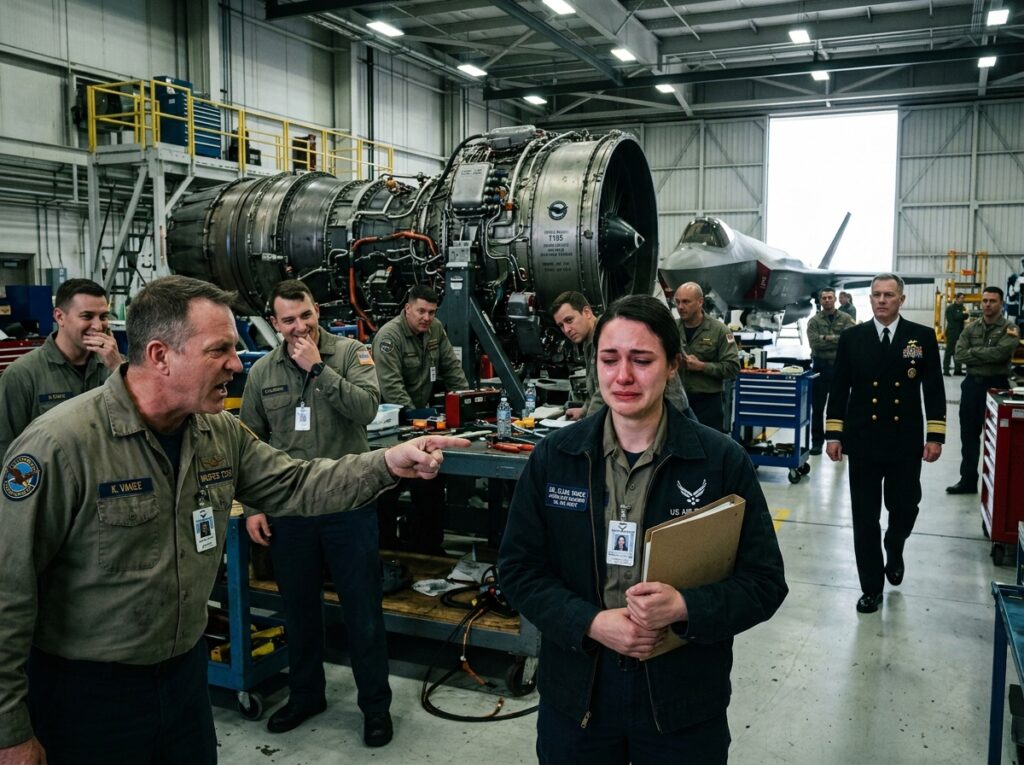
I stood just outside the main hatch in my plain civilian clothes — dark jeans, black jacket, hair pulled back tightly — watching the scene unfold with the kind of calm that only comes from knowing exactly how broken something truly is. My presence had not been announced. I had simply walked onto the ship using credentials very few people on board even knew existed.
The moment I stepped through the hatch and into the sweltering engine room, my father’s voice cut through the noise like a whip.
“WHO LET HER IN HERE?”
Every head turned. The room, which had been buzzing with urgent activity, suddenly froze. My father, Captain Richard Harlan, Commanding Officer of the USS Vanguard, stood near the main console, his face already twisting with rage and embarrassment. Technicians and officers stared at me, then at him, and then back at me. A few of them started to chuckle — nervous, awkward laughter that spread quickly because my father had spent the last three days telling anyone who would listen that his daughter was “just some office girl who liked playing mechanic at home.”
“Look at this,” my father barked, his voice dripping with contempt. “My own daughter thinks she can walk in here and fix what the best minds in the Navy couldn’t. Get her out of my engine room before she wastes any more of our time.”
The laughter grew louder. A senior chief petty officer smirked and shook his head. Someone muttered, “This is a warship, not a family reunion.” My father crossed his arms, staring at me with the same dismissive look he had given me for twenty-two years — the look that said I was nothing more than a disappointment who had never measured up to the Harlan name.
I said nothing.
I simply stood there, hands at my sides, letting the humiliation wash over me like it had so many times before. The heat from the failing engine pressed against my skin, but it was nothing compared to the burning shame my own father had just poured over me in front of fifty hardened sailors and engineers.
Then the hatch behind me opened again.
Heavy footsteps echoed through the engine room. Everyone turned as a tall man in crisp Navy dress whites entered, four silver stars gleaming on his shoulders. Rear Admiral James Caldwell stopped beside me, looked at the frozen crowd, and spoke in a calm, authoritative voice that carried perfectly over the dying hum of the engines.
“Actually…” he said, his eyes sweeping across the room before settling on my father, “she is Rear Admiral Riley J. Harlan, United States Navy. Chief Engineer of Naval Sea Systems Command, former Director of Propulsion Systems Development, and the only person alive who personally designed the exact fail-safe protocol this engine is currently suffering from.”
The room fell completely silent.
My father’s face drained of all color. The smug expression he had worn just seconds earlier shattered into pure, ice-cold shock.
PART 2
The silence that followed Rear Admiral Caldwell’s words was absolute — heavier than the failing engines, sharper than any order ever given on that ship. For several long seconds, no one breathed. The only sound was the dying groan of the propulsion system and the distant hum of emergency generators struggling to keep the lights on.
My father’s face went from flushed red to ghostly white in an instant. The man who had commanded this carrier with iron authority, the man who had spent twenty-two years belittling me at every family gathering, every holiday, every phone call, now looked like someone had ripped the deck out from under his feet. His mouth opened, closed, then opened again, but no sound came out. The smug, dismissive expression he had worn while mocking me just moments ago had completely shattered.
“R-Riley…?” he finally stammered, his voice barely recognizable. “That’s… that’s not possible. You’re… you’re my daughter. You work in some… some civilian engineering firm. You fix office equipment. You—”
Rear Admiral Caldwell cut him off with calm but unmistakable steel in his voice.
“Captain Harlan, allow me to clarify. Your daughter is Rear Admiral Riley J. Harlan — one of the youngest flag officers in the Navy. She designed the very fail-safe system currently malfunctioning on this ship. She personally oversaw the integration of these engines during construction. She has more hours troubleshooting nuclear propulsion systems than most chief engineers have years of service.”
He turned to the stunned technicians and officers.
“Gentlemen, the reason you couldn’t fix it is because the problem is buried in a classified override protocol that only three people in the entire Navy are authorized to access. One of them is standing right here.”
Every head in the engine room slowly turned toward me.
The same men who had laughed at my father’s jokes about me folding laundry now stared with a mixture of awe, disbelief, and dawning horror. A senior chief petty officer who had smirked earlier now looked like he wanted the deck to swallow him whole. One lieutenant whispered, “Holy shit… that’s Admiral Harlan?”
My father took one shaky step backward, his hand gripping the console for support. The color had not returned to his face. For the first time in my life, I saw genuine fear in his eyes — not fear of the enemy, not fear of losing his command, but fear of the daughter he had spent decades diminishing.
“Riley,” he said again, his voice cracking. “Why didn’t you… why didn’t you ever tell me?”
I finally spoke, my voice quiet but carrying clearly through the massive engine room.
“I did tell you, Dad. Many times. When I graduated top of my class at the Naval Academy. When I made lieutenant commander at twenty-eight. When I was selected for the propulsion development program. When I earned my first star. Every single time, you laughed. You told your friends I was delusional. You told Mom I was embarrassing the family name. You told everyone I was just playing dress-up in a uniform I didn’t deserve.”
My words landed like precision strikes. Several officers shifted uncomfortably. One older master chief looked at my father with visible disappointment.
I took a slow step forward, my eyes never leaving his.
“So I stopped telling you. I stopped explaining. I let you believe whatever made you feel superior. Because the truth was simpler: you never wanted a daughter who outranked you. You wanted a daughter you could control.”
Tears welled in my father’s eyes — something I had never seen before. Not once in thirty-six years.
Behind him, my mother (who had come aboard for the dinner) stood frozen near the hatch, her hand covering her mouth as silent tears ran down her face.
Rear Admiral Caldwell cleared his throat.
“Captain Harlan, with your permission, Rear Admiral Harlan will take command of the repair operation. We have less than six hours before this affects the entire carrier strike group.”
My father didn’t answer. He simply stared at me, broken.
I looked at the gathered engineers and spoke with the calm authority I had earned through blood, sweat, and thousands of hours in rooms far more dangerous than this one.
“Gentlemen, clear the main console. I need full diagnostic access to the classified layer. We’re going to fix this engine the way it was designed to be fixed.”
As the technicians moved quickly to obey, I glanced back at my father one last time.
The man who had once told an entire room of veterans that I “used to do laundry on base” now looked smaller than I had ever seen him.
And for the first time in my life, I felt no satisfaction in his pain.
Only the heavy, quiet weight of everything we had both lost.
PART 3
The engine room, which had been filled with mocking laughter only minutes earlier, was now so quiet you could hear the individual fans struggling against the failing system. Every technician, every officer, every sailor present stood frozen, their eyes shifting between me and my father as the weight of Rear Admiral Caldwell’s revelation settled over them like thick smoke.
My father’s hand was still gripping the console so tightly his knuckles had turned bone-white. His mouth opened and closed several times, but no sound came out. The man who had commanded this entire carrier with absolute authority — the man who had spent twenty-two years telling anyone who would listen that his daughter was a failure, a dreamer, someone who “played mechanic” in her spare time — now looked utterly shattered.
“Riley…” he finally whispered, his voice hoarse and broken. “This… this can’t be real. You’re not… you can’t possibly be…”
I stepped forward slowly, my boots ringing softly on the metal grating. The heat from the dying engines pressed against my skin, but it was nothing compared to the fire that had been burning inside me for decades.
“I am, Dad,” I said quietly, my voice carrying clearly through the massive space. “I graduated first in my class from the Naval Academy. I earned my engineering doctorate while serving on submarines. I designed the fail-safe system that’s currently killing this propulsion plant. And while you were telling your friends that I was ‘just doing laundry on base,’ I was leading teams that kept nuclear carriers operational in the most hostile waters on Earth.”
One of the senior chief petty officers — the same man who had smirked when my father mocked me — now looked physically ill. He stepped forward and saluted me sharply.
“Ma’am… my apologies. We had no idea.”
I returned the salute with a small nod. “None needed, Chief. You were following the information you were given.”
I turned back to my father. His eyes were glassy, his shoulders slumped in a way I had never seen before. The proud, larger-than-life Captain Harlan was crumbling right in front of the men he commanded.
“All those years,” I continued, my voice steady but heavy with pain, “every time I came home on leave, every time I tried to show you my commendations, every time I told you about my work… you laughed. You told Mom I was embarrassing the family. You told your fellow officers that your daughter was delusional. You made sure everyone knew I was the family joke.”
Tears finally spilled down my father’s face. Real tears. Not the performative kind he used during promotion ceremonies, but raw, ugly tears of a man watching his entire worldview collapse.
“I thought… I thought you were making it up,” he choked out. “I thought you were trying to impress me. I never… I never imagined…”
“You never wanted to imagine,” I said softly. “Because if I had actually succeeded, it would have meant you were wrong. And Captain Richard Harlan is never wrong.”
Rear Admiral Caldwell cleared his throat. “Captain Harlan, we don’t have time for this. The strike group is waiting. Rear Admiral Harlan is the only person who can fix this in the window we have left.”
I looked at the gathered engineers. “Gentlemen, clear the main diagnostic station. I need Level-5 classified access. Now.”
The technicians moved with surprising speed and respect, making way for me as I approached the main console. My fingers flew across the keyboard with practiced ease, diving deep into the hidden layers of code that no one else in the room could access. Within minutes, I had isolated the exact cascading failure that had baffled the entire team for three days.
My father watched me in stunned silence, his world continuing to fracture with every command I gave, every technical term I used with absolute precision.
As I worked, I spoke without looking at him.
“You taught me one thing, Dad. You taught me that if I wanted respect, I would have to earn it somewhere else. So I did. I earned it in engine rooms hotter than this one. In submarines two hundred meters underwater. In rooms where one wrong decision could start a war.”
I entered the final override sequence and watched as the system began to stabilize.
“And now,” I said, finally turning to face him, “I’m here saving the ship you command… after you spent twenty-two years telling everyone I couldn’t even fix a toaster.”
My father’s legs gave out. He sank slowly into a chair, staring at me like he was seeing a stranger.
The entire engine room watched in complete silence as the massive propulsion system slowly roared back to life under my hands.
PART 4
The massive engines of the USS Vanguard began to thrum back to life under my fingers, their deep, powerful rhythm slowly replacing the dying groans that had filled the compartment for three days. Green indicators lit up across the console one by one as the classified override protocol I had written years ago finally took hold. The technicians and engineers watched in stunned silence, their earlier laughter completely evaporated, replaced by a mixture of awe and discomfort.
My father remained slumped in the chair, staring at the screens like a man watching his entire life burn in front of him. His once-commanding presence had shrunk into something small and broken. Captain Richard Harlan — the man who had spent twenty-two years mocking my career, calling me delusional, and telling entire rooms of veterans that his daughter “used to do laundry on base” — now looked like a ghost of the father I once knew.
“Riley…” he whispered again, his voice barely audible over the reviving engines. “All this time… you were really…?”
I didn’t look at him immediately. My eyes stayed on the diagnostic readouts as I made final adjustments. Only when the system reached full stability did I turn to face him.
“Yes, Dad. All this time.”
The words hung heavy in the sweltering air. Rear Admiral Caldwell stood quietly to the side, arms behind his back, observing everything with the careful detachment of a senior officer who had seen many family tragedies play out in uniform.
My mother stepped closer, tears streaming down her face without shame now. “I should have believed you,” she said, her voice trembling. “Every time you tried to show us your awards, every time you came home exhausted from deployment… I let your f
ather convince me you were exaggerating. I failed you, baby. I failed you so badly.”
I felt something tight and painful twist in my chest, but I kept my face composed. Years of training had taught me how to lock emotions down when lives depended on calm decisions.
“You didn’t just fail me, Mom,” I said quietly. “You both made sure the entire family, the entire circle of friends, and half the Navy thought I was a joke. While I was qualifying on nuclear reactors at twenty-eight, Dad was telling people I couldn’t even hold down a secretary job. While I was briefing the Secretary of the Navy, he was laughing about how I ‘played dress-up in a uniform.’”
My father made a choked sound and buried his face in his hands. The proud captain who had commanded respect through fear and authority was now openly weeping in front of his own crew.
One of the master chiefs stepped forward and saluted me sharply. “Ma’am, on behalf of the engineering department… thank you. We were hours away from a full mission abort.”
I returned the salute. “You’re welcome, Chief. The system should hold now, but I’ll stay aboard until we reach full operational status.”
I finally looked directly at my father again. His eyes were red, his shoulders shaking. For the first time in my life, I saw something close to genuine remorse in them.
“Riley,” he rasped, “I don’t know how to fix this. I don’t know how to take back twenty-two years of… of treating you like you were nothing.”
I stood tall, the weight of my rank and everything it represented resting comfortably on my shoulders now.
“You can’t take it back, Dad. Those years are gone. The humiliation, the laughter, the way you made me feel small in every room I walked into — those things don’t disappear just because you finally see the truth.”
I paused, letting the words settle.
“But you can start by never doing it again. To anyone.”
The engine room was completely silent except for the healthy, powerful hum of the restored propulsion system. Every sailor present watched the exchange with wide eyes, witnessing a captain being humbled by his own daughter in the most public, devastating way possible.
My father slowly rose to his feet. He looked at me — really looked at me — perhaps for the first time in my adult life. Then, with visible effort, he straightened his posture and saluted me.
It was not the crisp, formal salute of rank. It was slower. Heavier. Full of regret.
“Rear Admiral Harlan,” he said, his voice thick with emotion, “thank you for saving my ship.”
I returned the salute cleanly, holding it for a long second before dropping my hand.
“You’re welcome, Captain.”
As I turned back to the console to run final checks, I felt the enormous weight of everything we had broken between us. Some fractures could be repaired. Others would remain as scars — permanent reminders of what pride and disbelief could destroy.
But for the first time in twenty-two years, my father was finally looking at the real me.
And the real me was no longer invisible.
PART 5 (Final Part)
The restored engines of the USS Vanguard thrummed with steady, powerful life beneath our feet, their deep rhythm vibrating through the steel deck like a heartbeat returning to a dying body. The engineering crew moved with renewed purpose, checking readouts and confirming stability, but their eyes kept drifting back to the center of the room where the real drama was unfolding. The air was still thick with heat, oil, and the heavy silence of men witnessing something they would talk about for years.
My father stood before me, completely broken. The once-imposing Captain Richard Harlan, who had commanded this carrier with iron discipline and unshakeable pride, now looked like a man who had lost everything that mattered. Tears carved clean lines down his weathered face as he stared at me — not with the dismissive gaze I had known my entire life, but with raw, devastating recognition.
“Riley…” His voice cracked badly. “All these years… every dinner, every holiday, every time I told people you were just… playing around… I was destroying you. I was destroying my own daughter.”
He took one shaky step closer, his shoulders trembling.
“I called you delusional. I laughed at you in front of my friends, in front of other officers, in front of your own mother. I told them you couldn’t even hold down a real job. While you were out here… designing systems that keep ships like this alive… while you were earning stars on your shoulders… I was making you the punchline of my stories.”
A sob tore from his throat — ugly, painful, and completely unfiltered.
“I’m so sorry, Riley. I’m so fucking sorry. I was scared. Scared that if you became better than me, I would have nothing left to be proud of. So I made sure you stayed small. God forgive me… I made sure everyone saw you as small.”
My mother stepped forward, openly weeping now, and wrapped her arms around him, but her eyes never left mine.
“I let him do it,” she whispered. “I stayed quiet because it was easier than fighting him. I betrayed you every single time I smiled and changed the subject. You deserved so much better than us.”
The entire engine room watched in absolute silence. No one dared speak. These hardened sailors, engineers, and officers — men who had faced death in every ocean — stood witness to a different kind of battlefield: a family destroying itself and trying, too late, to salvage what remained.
I looked at both of them for a long moment. Twenty-two years of humiliation, dismissal, and quiet heartbreak flashed through my mind. Every mocking laugh. Every “she’s just playing soldier” comment. Every time I had swallowed my pride and stayed silent.
Then I spoke, my voice calm, steady, and final.
“I spent years trying to make you proud. Then I spent more years trying to survive your shame. I became Rear Admiral Riley J. Harlan not because of you, but in spite of you. I earned every star, every commendation, and every scar without your belief. And I survived.”
I took a slow breath.
“I forgive you. Both of you. But forgiveness doesn’t mean I will forget. It doesn’t mean things go back to how they were. From now on, you will address me as Admiral Harlan when we are in uniform. And when we are not… you will have to earn the right to call me your daughter again.”
My father’s face crumpled completely. He stepped forward and, for the first time since I was a little girl, he saluted me — not as his subordinate, but as his superior officer. The salute was slow, trembling, and filled with more regret than any words could carry.
“Rear Admiral Harlan,” he said, voice thick with tears, “thank you for saving my ship… and for showing me who my daughter really is.”
I returned the salute cleanly and held it for several heartbeats.
“You’re welcome, Captain.”
As I turned to leave the engine room with Rear Admiral Caldwell, I paused at the hatch and looked back one last time. My father was still standing there, crying openly in front of his entire crew. My mother held him, both of them finally seeing the cost of their pride.
I didn’t feel joy in their pain.
I felt only the quiet, heavy peace of a wound that had finally been acknowledged.
Outside on the flight deck, the Pacific wind whipped across my face as the carrier began moving forward once again under full power. I looked out at the endless horizon, the weight of my stars resting comfortably on my shoulders.
I was no longer the daughter they tried to erase.
I was Rear Admiral Riley J. Harlan.
And for the first time in my life, I was finally free.
THE END