At 8:43 p.m., my husband broke my arm at 33 weeks pregnant. He said “LOOK WHAT YOU MADE ME DO,” then drove me to St. Matthew’s and coached my lie. Six minutes after the X-ray technician read my full name, he stepped into the hall, made one call, and Garrett’s perfect smile began to crack.
Garrett twisted my wrist beside my pregnant belly. The snap was thin, dry, almost neat. My daughter kicked hard before the pain even reached my elbow. He looked at the angle of my hand, then at my stomach, and said, “Look what you made me do.”
The pot roast on the stove had already stopped steaming. Lemon cleaner still clung to the black marble island. Under-cabinet lights glazed the white kitchen in soft gold while the air-conditioning turned the sweat at the back of my neck cold. My left hand hung wrong. Fingers swelling. Wedding band biting into skin that didn’t fit anymore.
Garrett Hartford stood a step away in a white dress shirt that still looked pressed, cuffs clean, jaw smooth, hair perfect from whatever $1,200 barber he used in White Plains. He was 38, handsome in the polished, donor-banquet way. Two months earlier, his photo had gone up beside a $250,000 pledge to the children’s wing.
I was barefoot in black maternity leggings and one of his old Yale T-shirts, hair slipping out of a plastic clip, one ankle swollen from carrying eight months of baby.
“You were 22 minutes late,” he said.
“I called.”
“I was in a meeting.”
Then the softer one came, the one he used when he wanted the room to agree with him.
“You always make everything difficult.”
The pain hit all at once after that. It traveled hot and white from my wrist to my shoulder, turned my knees loose, and pushed bile into the back of my throat. My good hand slid across the marble for balance.
“I was at the doctor,” I said.
That should have mattered. The extra ultrasound. The way the baby had measured big. The nurse asking if I’d been sleeping. None of it mattered once Garrett started rearranging the night into the version he preferred.
His face changed the way it always changed. Rage first. Then regret. Then that careful tenderness that made my skin crawl worse than the shouting ever did.
“We need to go now,” he said quietly. “You tripped on the stairs.”
He took the keys. My phone. My wallet. Then he placed one hand at the small of my back and walked me through the garage like a husband helping his pregnant wife after an accident nobody could have prevented.
The Range Rover smelled like leather, cedar, and the takeout coffee he’d left in the cupholder that morning. Every crack in the road sent a sharp wire of pain up my arm. Streetlights dragged gold across the windshield. Brick houses and clipped hedges passed in clean, expensive rows like nothing ugly had ever happened on that street.
“You tripped on the stairs,” Garrett said again.
The baby shifted under my ribs. My palm spread over my stomach.
“Can you hear me?”
One nod. That was enough for him.
At 9:07 p.m., he pulled up to St. Matthew’s emergency entrance, circled around to open my door, and called for help before my feet touched the pavement.
“My wife fell,” he told triage, voice warm and breaking in all the right places. “She’s 33 weeks pregnant. Please help her.”
A nurse looked straight at me. Garrett’s hand rested in the middle of my back, light enough to look loving, firm enough to steer.
“Stairs,” I whispered.
First they checked the baby. Gel cold on my stomach. Elastic straps around me. A fast heartbeat fluttering through the monitor like little shoes running down a hallway. The cuff tightened on my arm. Garrett answered half the questions before I did. He even gave a small embarrassed smile, like the whole thing had become inconvenient theater.
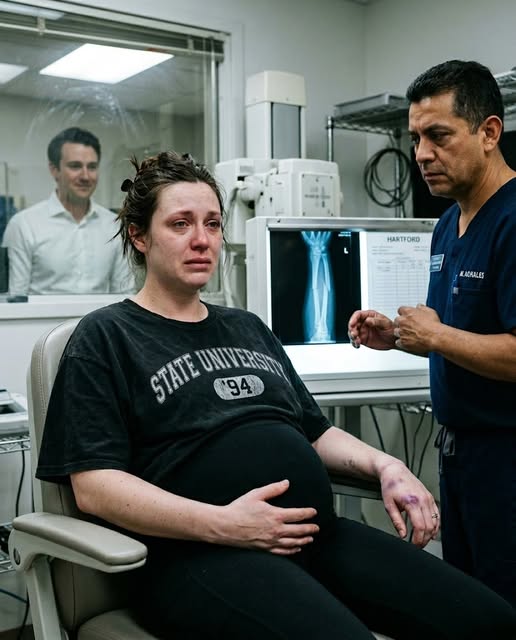
The X-ray room was colder than the exam bay. Fluorescent light. Bleach in the air. Metal plate waiting under my arm. A broad-shouldered technician in navy scrubs came in holding a tablet. His badge read Mateo Ruiz. Tired eyes. Crooked name tag. The kind of face that had seen too much and kept working anyway.
“Her husband can wait behind the shield,” he said.
Garrett smiled. “She gets anxious without me.”
“Hospital policy.”
That was the first no Garrett had heard all night.
Mateo moved carefully, one instruction at a time, while I bit the inside of my cheek hard enough to taste blood. He turned to the monitor. His hand stopped. Not a gasp. Not a dramatic jerk. Just stillness.
His eyes moved from the image to my chart. Then to the purple fingerprint marks already lifting under my skin. Then back to the screen.
“Mrs. Hartford,” he said softly, and his voice had changed. “Has anyone asked if you can safely go home tonight?”
Behind the glass, Garrett straightened.
Mateo touched the chart once more. My full name sat there in bold black letters. He finished the image. He stepped into the hallway. He looked down at the file one last time, pulled out his phone, and made a call that was not to hospital security.
Six minutes later, the elevator doors opened.
Garrett turned toward the sound, ready with that same polished smile.
Then he saw who was stepping out.
The 33-weeks-pregnant woman whose husband had just snapped her arm and coached her to lie about it was never weak, never clumsy, and never at fault.
She was REAR ADMIRAL ELENA VOSS, four-star general of the United States Navy, former Supreme Commander of Allied Forces in the Pacific — a woman who had spent thirty years leading black operations that rescued the vulnerable and protected the innocent with cold, surgical precision.
The massive authority she had deliberately kept hidden beneath layers of quiet civilian life and obedient wife role was now awakening with ferocious intensity, cold, precise, and utterly unstoppable.
Because while she lay on that X-ray table with her broken arm and her unborn daughter kicking inside her, the wife they thought they could silence and control had no idea that one phone call was about to bring her hidden world crashing into Garrett’s perfect lie — and the man who believed he could break her without consequence was about to watch his entire life crack wide open in front of people who mattered.