The manager gave me a steady, professional smile. The other man did not smile at all. He studied the passbook in my hands the way people study something old enough to have outlived several versions of the world.
“Mr. Mercer?” he said.
I nodded.
“I’m Thomas Whitaker, regional director. Jennifer brought this to my attention. Would you mind stepping into my office for a moment?”
I followed them. The office was quiet, with heavy wood furniture and a view of the lake. They closed the door.
Thomas sat down across from me and opened a thick file he had already pulled.
“This passbook was issued in 1974 by First Cleveland Savings and Loan,” he began. “Your grandfather, Chester Mercer, opened it with an initial deposit of $12,000 — which was a very large sum at the time. Over the years, he made consistent additional deposits. When the bank merged and eventually restructured in the late 1980s, this account was converted into a high-yield trust with automatic reinvestment.”
He turned the screen toward me.
The current balance was $4,872,341.76.
I stared at the numbers until they stopped making sense.
Thomas continued gently.
“Your grandfather never touched the principal after 1982. He set it up so that only you could access it — with specific instructions that it was to remain untouched until you came in person after his death. He left a letter with us.”
He handed me an envelope. The handwriting was unmistakably Grandpa’s.
I opened it with shaking hands.
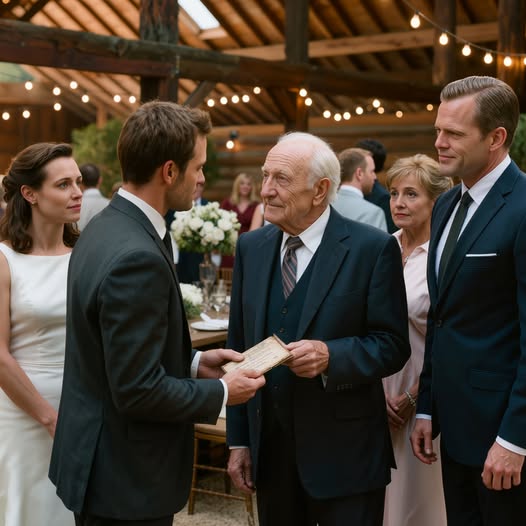
“Declan,
If you’re reading this, I’m gone. I never told anyone about this account because I didn’t want it turned into another thing for them to fight over. I built it for you — the one who always showed up, who worked with his hands, who never asked for anything he didn’t earn. Use it to build the life you want, not the one they expect. Don’t let them make you small.
Love, Grandpa Chester”
I sat there for a long time, the letter in my lap, tears I didn’t realize were falling hitting the paper.
When I finally looked up, Thomas said, “The account is fully yours. No one else has access. We can transfer the funds today if you’d like.”
I didn’t transfer everything. I left a portion in the trust and took enough to change my life and my family’s future — but on my terms.
I went home that afternoon and told Naomi everything. She cried with me. Then we sat down and made a plan.
Two weeks later, at a family dinner my mother had insisted on, my father was bragging again about how he had “guided” the family finances for years.
I waited until the table was quiet.
Then I slid the bank statement across the table.
“Grandpa left me something,” I said calmly. “It wasn’t a closed account. It was a trust. Over four and a half million dollars.”
The room went dead silent.
My mother’s fork stopped halfway to her mouth.
My father turned red, then pale.
Preston laughed nervously. “You’re joking.”
I wasn’t.
I looked at all of them — the family that had dismissed Grandpa’s gift, that had mocked me for years, that had treated me like the least important person at every table.
“I’m not angry,” I said. “I’m just done pretending I need your approval. From today, I’m stepping back from supporting things you never valued. The house payments, the emergencies, the ‘loans’ that never get repaid — they end now.”
My father started to protest.
I stood up.
“Grandpa didn’t leave this for me to keep carrying people who only reach for me when they need money. He left it so I could finally live without apology.”
I walked out with Naomi and our son.
We bought a beautiful home with land. I started my own electrical contracting company. We traveled. We lived.
My family tried to reach out — first with anger, then with sudden “love.” I kept my distance.
Sometimes the best inheritance isn’t the money.
It’s the freedom to stop shrinking yourself to fit into a family that never saw your worth.
THE END