I Hadn’t Seen My Mother in Eighteen Years… Until She Walked Into My Uncle’s Boardroom in a $5,000 Coat, Called Me “Sweetheart,” and Asked Where the Money Was. She Thought She Had Come to Claim an Inheritance. What She Didn’t Know Was That My Uncle Had Left a Red-Wax Envelope With One Line Written Across It.
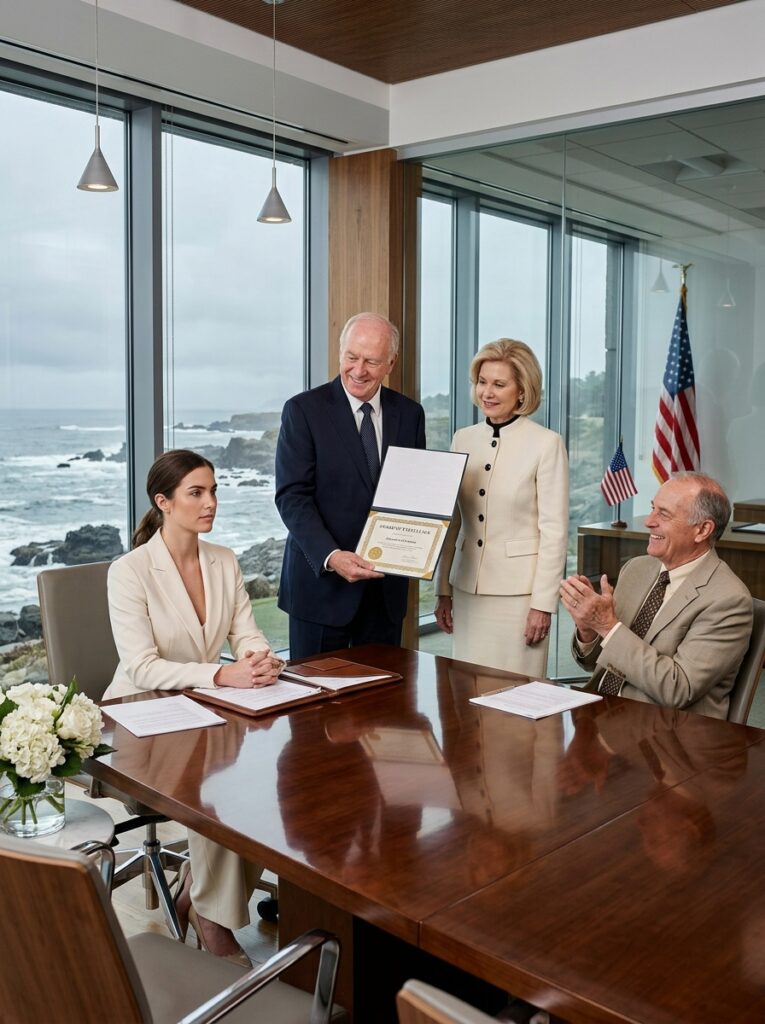
I HADN’T SEEN MY MOTHER IN EIGHTEEN YEARS… UNTIL SHE WALKED INTO MY UNCLE’S BOARDROOM IN A FIVE-THOUSAND-DOLLAR COAT, CALLED ME “SWEETHEART,” AND ASKED WHERE THE MONEY WAS.
SHE THOUGHT SHE HAD COME TO CLAIM AN INHERITANCE.
WHAT SHE DIDN’T KNOW WAS THIS: MY UNCLE HAD LEFT A RED-WAX ENVELOPE ON THE TABLE WITH ONE LINE WRITTEN ACROSS IT—
READ ONLY IF PAULA SAWYER APPEARS.
My name is Morgan Allen, and by the time Paula Sawyer looked me in the eye again, I had already spent eighteen years learning never to expect anything from her.
She sat less than three feet from me in my uncle’s boardroom in Ravenport, Massachusetts, wearing money the way some women wear apology—expensively, and without meaning it. Blonde hair perfectly set. Pale polished nails. A face softened by maintenance, not regret. Outside the floor-to-ceiling windows, the Atlantic was hammering the rocks below. Inside, the room smelled like polished wood, cold air, and the kind of silence that makes every careless word feel expensive.
At the head of the table sat Marvin Klene, my uncle’s lawyer, broad-shouldered and unreadable, with a recorder glowing red between us like a warning light.
“The recording begins,” he said.
My mother laughed softly, like the whole thing was a family misunderstanding she could charm her way through.
“Oh, Marvin,” she said.
Then she turned to me with that smile. The same smile I remembered from broken promises, overdue rent, and the kind of love that only ever showed up when it needed something.
“We’re all family here, aren’t we, darling?”
Darling.
That word hit me like old smoke.
It was the same word she used when she said she’d be back soon.
The same word she used before she left me at sixteen with an empty refrigerator, unpaid bills, and a note that said, You’ll be alright.
I didn’t move.
Elliot had trained that out of me.
“Emotions are information,” he used to say. “Don’t hand them over for free.”
My mother leaned forward, perfume drifting over the table like a threat disguised as elegance.
“It’s been a long time,” she said. “But tragedy has a way of bringing people back together. Elliot was my brother. We can handle this like family. We can sort out the estate fairly.”
Fairly.
READ PART 2 (Final Epilogue) Click Here :My Uncle’s Boardroom in a $5,000 Coat, Called Me “Sweetheart,” and Asked Where the Money Was…Part_2
That was her new word for money.
Across from her sat Grant Weller, the man she had brought for polish and pressure. Sharp suit. Strong cologne. The kind of man who mistakes confidence for authority because no one has corrected him properly yet. He slid a thick blue file onto the table and tapped it once.
“We prepared preliminary settlement terms,” he said. “Just to make this easier for everyone.”
I almost smiled.
Because that was exactly the kind of sentence people use right before they realize they have entered a room they do not understand.
Eighteen years earlier, I had walked into a different room and understood nothing.
I was sixteen, coming home from a diner shift with twelve dollars in my pocket and my hair tied back badly, when I felt it before I saw it. The apartment was too quiet. No TV. No shouting. No cabinets slamming. Just stale air and the low hum of the refrigerator like it already knew something I didn’t.
Her closet was empty.
Her coat was gone.
Her suitcase too.
On the kitchen counter sat a note written on the back of an overdue electric bill.
I can’t do this anymore.
I need room to breathe.
Three days later, the landlord told me rent was already two months behind. By Friday, I was sitting in a school counseling office trying not to cry while a social worker asked if there was any relative left I could name.
There was only one.
Elliot Sawyer.
He arrived in a charcoal suit that looked too formal for a public school office and asked me just one question.
“Is that all?”
I lifted my backpack.
He nodded once. “Then let’s go.”
In the car, he didn’t offer comfort.
He offered structure.
“I won’t pretend to be your friend, Morgan,” he said, eyes on the road. “But you will be able to rely on me. You’ll have food. You’ll have a place to live. You’ll finish school. And you will never have to beg anyone for stability again.”
That was Elliot.
He didn’t make life soft.
He made it solid.
He taught me balance sheets, contracts, leverage, timing, and the way money reveals character faster than grief ever does. He taught me that lies usually dress too carefully, and truth often arrives carrying anger. He taught me that most people show you exactly who they are the second inheritance enters the room.
And when he got sick, he handled death the way he handled everything else.
Like a deadline.
Six months of transfers. Revised ownership documents. Board protections. Sealed instructions. Private meetings that stretched past midnight. Six months of building walls around what he had made, because he knew exactly who would come sniffing once he was gone.
From his bed facing the Atlantic, he gave me one final warning.
“When she shows up,” he said, his voice rough but steady, “don’t mistake her appearance for love. She’ll come to take what she believes she can take.”
And now she was here.
Marvin began reading the property summary.
The cliffside house in Ravenport.
The art.
The lighting fixtures.
The investment accounts.
Then came the company.
“Black Harbor Defence Corporation,” Marvin read. “Seventy-six percent control, with an estimated value exceeding forty million dollars.”
My mother inhaled sharply.
Grant pushed the blue file closer and lowered his voice.
“As I said, we’ve made a reasonable preparation. Paula is perfectly willing to take on the administrative responsibilities related to the company. Of course, Morgan will be handsomely compensated.”
Marvin didn’t even glance at the file.
He just kept reading.
The silence in the room changed.
No longer emotional.
Clear.
Then he reached for a second envelope.
Thick cream paper.
Red wax seal.
My uncle’s handwriting.
Across the front, in bold letters:
Conditional Appendix
Read only if Paula Sawyer appears
For the first time that morning, my mother’s smile flickered.
Just once.
Then she widened it again.
“Oh, Elliot,” she said softly. “Always needing to control everyone.”
Marvin placed one hand over the seal.
“Your brother anticipated this day,” he said. “These instructions remain confidential unless you appear in person.”
Grant sat up straighter. “What exactly does that mean?”
“It means,” Marvin said, “Elliot understood why she might come.”
My mother turned too fast and grabbed my hand across the table.
Her fingers were cold.
“Morgan,” she said, and her voice lost every trace of sweetness. “Don’t let this turn into some ugly money issue. Whatever he wrote, we do not need to make this more complicated than necessary. We can settle this privately.”
I looked down at her hand on mine.
Then I removed it.
Slowly.
Set it back on the table like it belonged to someone else.
And said the only words that mattered:
“Read it.”
Grant leaned toward her. “Paula, don’t say another word.”
But Marvin had already broken the wax seal.
My mother’s face changed for real then.
“What did Elliot do?” she asked.
It was the first honest question she had asked all morning.
Marvin unfolded the pages, adjusted his glasses, looked directly at her, and said:
“Ms. Sawyer, your brother left very specific instructions about the day you chose to come back and ask about his money…”