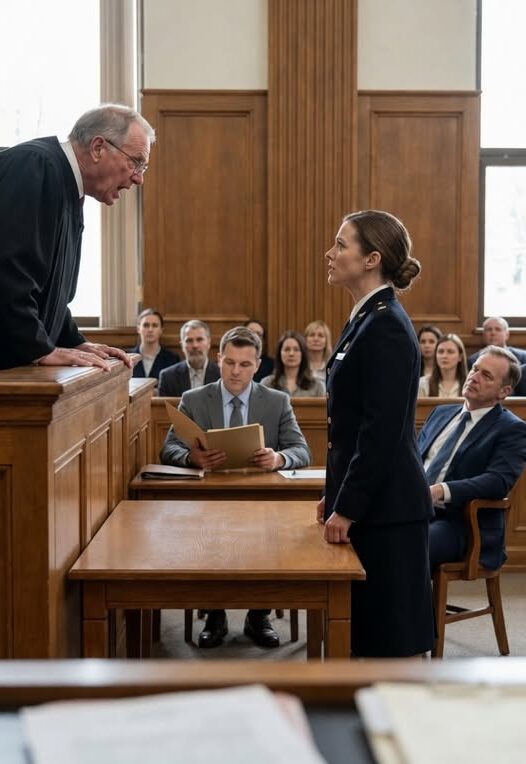
My father smirked across the courtroom and said, “You don’t even have the money to hire a lawyer,” loud enough for strangers to laugh, and I stood there alone in uniform with no counsel beside me while his expensive attorney flipped through his folder like the case was already over, but the second the judge looked at me, paused, and said, “For the record, she won’t be needing one,” the entire room changed—because the man who had spent my whole life calling me a disappointment, a runaway, and a stain on the Garrison name had absolutely no idea what was sitting in that file, what the judge was about to read into the record, or why his own lawyer suddenly looked like he wanted to vanish from the courtroom altogether…
“You don’t even have enough money to hire a lawyer.”
My father said it loud enough for people nearby to hear, his tone amused, like it was something worth laughing at. And some of them did. Not openly cruel, just enough to sting.
I stood alone at the respondent’s table, hands resting lightly on the surface, fingers still, not from calm, but from discipline. I didn’t look at him. I wasn’t going to give him that.
Across the room, he leaned back like he owned the place, relaxed, confident, completely sure of himself.
“She really came in here alone,” he added, shaking his head. “No lawyer, no real case. Just a uniform and attitude.”
A quiet murmur moved through the room.
Then the judge stepped in.
“Mr. Garrison, that’s enough,” he said evenly.
My father smirked but leaned back.
The judge turned to me. “Ms. Garrison, you understand you have the right to legal representation.”
“Yes, Your Honor.”
“And you’re choosing to proceed without it.”
“Yes, sir.”
He looked at me for a moment longer than most people ever did. Not judging. Recognizing something.
Then he nodded.
“For the record,” he said calmly, “she won’t be needing one.”
That was the moment everything shifted.
I didn’t move. But across the aisle, my father’s lawyer suddenly froze. He had been casually flipping through his folder just seconds earlier. Now his hand stopped mid-page. His eyes scanned something, then snapped up to me, then back down again.
His expression changed fast.
Confusion. Tension. Realization.
“Wait…” he muttered quietly.
My father leaned closer. “What is it?”
The lawyer didn’t answer right away. He kept staring at the page like it might somehow change.
Then, barely above a whisper, “Oh my God.”
I kept my gaze forward, but I felt it, the shift in the room. Like the air itself had changed.
The courthouse carried that familiar scent of old buildings, polished wood, paper, dust, and time. It felt colder inside, or maybe it just always does in places where people bring their worst moments.
I had arrived early. Sat quietly at the back. Watched everything. Clerks moving with purpose. Lawyers greeting each other like it was just another routine day. A bailiff had glanced at my uniform, noticed the ribbons, then said nothing.
That was fine with me.
I wasn’t there for acknowledgment.
I was there because I had no choice.
Two weeks earlier, I’d been outside fixing a broken fence my old dog had pushed through. The wood was warped, the nails bent, and my knee was aching the way it always did when something deeper stirred.
That’s when the envelope came.
Thick. Official. The kind that never carries good news.
I didn’t need to open it to know who sent it.
Some things make themselves clear just by existing.
I wiped my hands, leaned back against the post, and let the weight of it settle.
“I guess it’s time,” I said quietly.
And for the first time in years, I knew this wasn’t going to end the way he expected.