The months that followed the diagnosis were a battlefield of fear, hope, exhaustion, and unbreakable love.
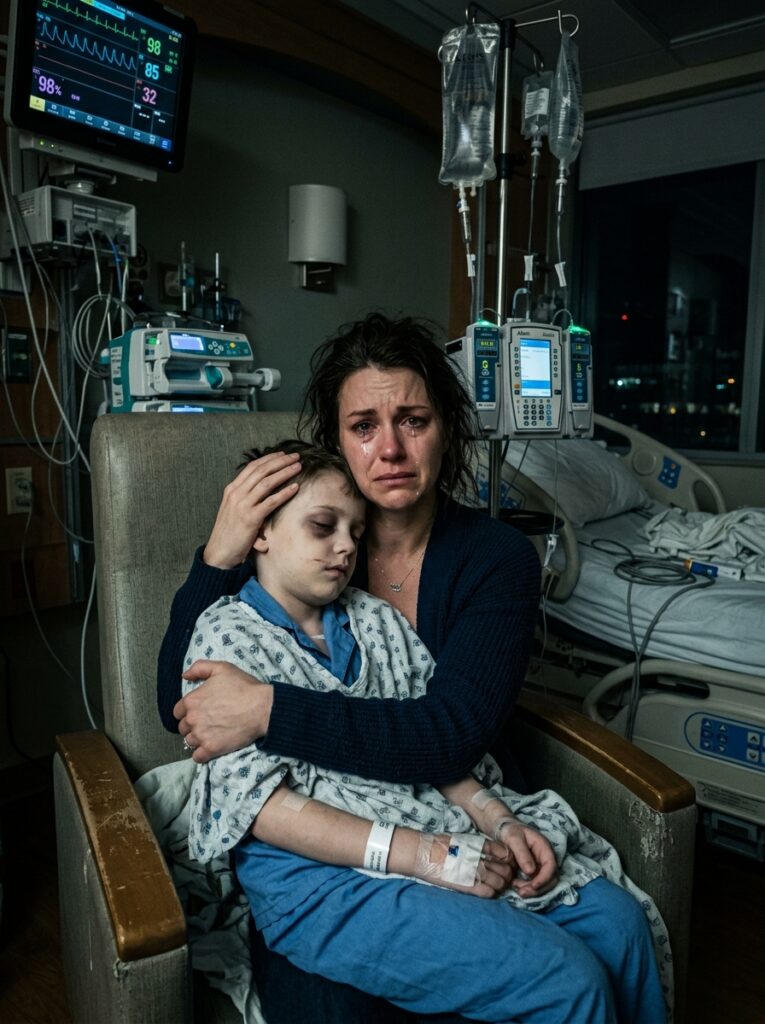
Daniel’s treatment was aggressive. Chemotherapy every three weeks. Surgery to remove as much of the tumor as possible. Radiation. Countless nights in the hospital where I slept in a recliner beside his bed, holding his hand while machines beeped around us.
The first round of chemo hit him hard. He lost his beautiful dark hair within two weeks. He threw up so much he could barely keep water down. His small body became frail, his eyes hollow, but his spirit — that stubborn, gentle spirit — refused to break.
One night, after a particularly brutal round, he looked at me with tears in his eyes and whispered, “Mom… I’m sorry I’m making you so tired.”
I climbed into the narrow hospital bed with him, ignoring the nurses’ rules, and held him close.
“Don’t you ever be sorry, baby. You are the reason I breathe. We’re in this fight together, and I’m never leaving your side.”
He cried himself to sleep in my arms that night. I stayed awake, staring at the ceiling, silently cursing Carlos for every time he had dismissed Daniel’s pain. The man who was supposed to be his father had abandoned him when he needed him most.
Carlos tried to show up twice. The first time, he brought a cheap toy and stood awkwardly in the doorway.
“How’s he doing?” he asked, not even coming close to the bed.
I stood up, blocking his view. “He’s fighting for his life. Something you should have helped with months ago. Get out.”
The second time, he came with flowers and a half-hearted apology.
“I was wrong,” he mumbled. “I should have listened.”
I looked at him with ice in my veins. “Your apology doesn’t erase the nights he cried in pain while you called him a liar. Leave. You lost the right to be his father the day you chose denial over him.”
He didn’t come back after that.
The hospital became our second home. The nurses became family. The other parents in the pediatric oncology ward became my support system. We shared stories, cried together, celebrated small victories like Daniel eating a full bowl of Jell-O or managing to walk down the hallway without getting dizzy.
Through it all, Daniel showed a strength that humbled me every single day.
One afternoon, after a particularly difficult round of chemo, he looked at me with tired but determined eyes.
“Mom… when I get better, can we go to the beach? Just you and me?”
I smiled through my tears. “Yes, baby. The moment you’re strong enough, we’re going to the beach. We’ll build the biggest sandcastle ever.”
He smiled back — that small, brave smile that reminded me why I kept fighting.
Six months into treatment, the doctors gave us the news we had been praying for.
“The tumor has shrunk significantly. The latest scans show no spread to the bones or organs. We believe we can operate and remove the rest.”
The surgery was long and risky, but Daniel came through it like the warrior he was. When he woke up in recovery, the first thing he asked for was me.
“Mom… did they get it all?”
I kissed his forehead. “They got it, baby. You’re going to be okay.”
Recovery was slow. Physical therapy. More chemo to make sure nothing was left. Countless follow-up appointments. But Daniel started gaining weight again. His hair began to grow back in soft curls. He laughed more. He asked to play soccer again.
One year after that terrifying diagnosis, Daniel ran onto the soccer field for his first game back. He wasn’t the fastest kid anymore, but when he scored his first goal, the entire sideline cheered louder than anyone.
I stood on the sidelines with tears streaming down my face, watching my boy run again — not just physically, but with joy in his heart.
That night, as I tucked him into bed, he hugged me tightly.
“Mom… thank you for believing me when Dad didn’t. Thank you for saving me.”
I held him close, my voice thick with emotion. “You saved me too, baby. Every single day you fought, you saved me.”
Some parents fail their children in silence.
Others fight like hell to make things right.
I chose the latter.
Carlos tried one last time to come back into our lives when Daniel was declared in remission. I met him at a coffee shop and looked him in the eyes.
“You don’t get to show up now that the hard part is over. You abandoned him when he needed you most. We don’t need you anymore.”
He didn’t argue. He just nodded and walked away.
Today, Daniel is thirteen. He runs, laughs, builds model spaceships again, and sometimes still crawls into my lap when the nightmares come. But he’s healing. We both are.
I learned the hardest lesson a parent can learn:
Your child’s pain is never an exaggeration.
Your instincts are never wrong.
And sometimes, the most loving thing you can do is walk away from the person who refuses to see the truth.
Daniel is the boy who stopped running for a while.
But now he’s running again — straight toward his future.
And I will be right beside him, every single step of the way.
THE END