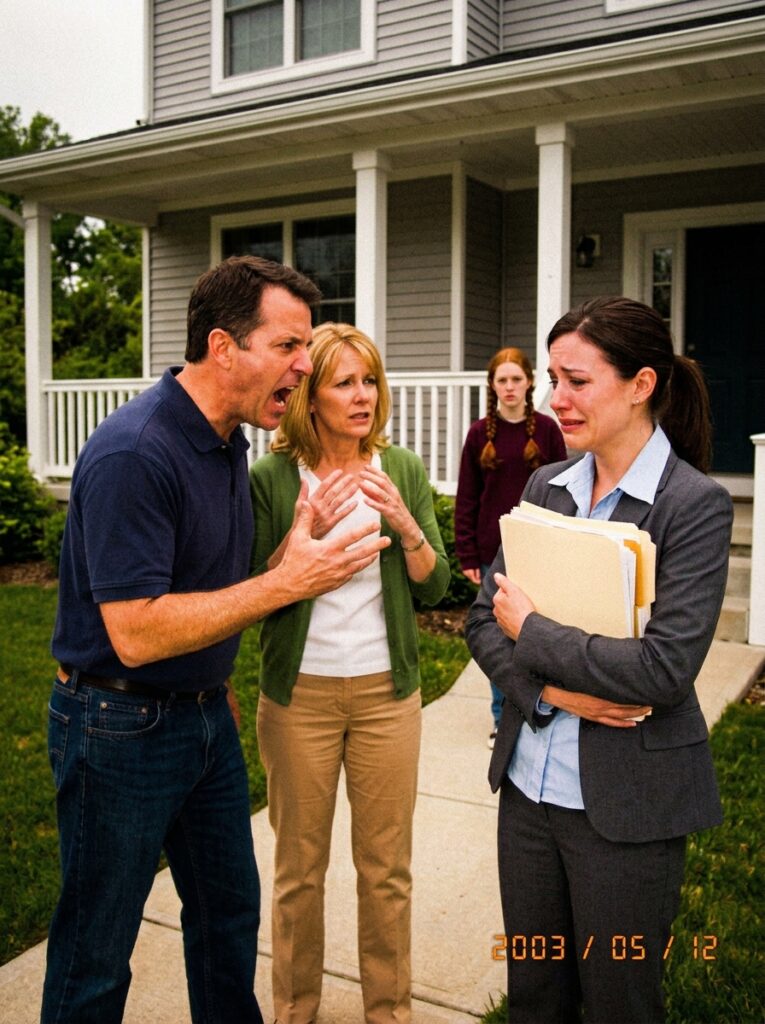
My parents sold their house and gave my sister an $860,000 home. Then they came to take my house. I said “No!” — my dad slapped me across the face. Three months later… “Your parents are in big trouble.” I calmly replied: “I know.”
My parents sold their house, handed my sister an eight-hundred-and-sixty-thousand-dollar home, and then came for mine.
Not metaphorically. Not in the passive-aggressive family way where people hint and guilt and circle around your boundaries until you feel rude for having any. I mean they drove to my house on a Tuesday afternoon, walked in like they already owned the place, and told me I needed to “do the right thing” and sign it over.
My name is Claire Donnelly. I was thirty-six years old, divorced, living in a four-bedroom colonial outside Raleigh, North Carolina, and working sixty-hour weeks as a senior procurement manager for a medical manufacturing company. I had bought that house myself after my divorce, every inch of it paid for by years of overtime, bonuses, and the kind of quiet discipline no one in my family ever celebrated because it wasn’t flashy enough to post about.
My younger sister, Melanie, was flashy enough for all of us.
Melanie was thirty-two, permanently dramatic, and somehow always one crisis away from needing rescue. She married a man with charm and no stability, then spent six years talking about “building the dream” while my parents financed furniture, vacations, legal fees, fertility treatment, and finally the grand finale: an eight-hundred-and-sixty-thousand-dollar house they bought outright after selling their own home and “downsizing temporarily.”
Temporarily, in their case, meant moving into a luxury rental and acting like martyrs for choosing their daughter’s happiness over their own comfort.
I learned about the house on Facebook.
My mother posted a photo of Melanie crying in front of a stone entryway with imported lanterns and a caption about “what parents do for children they believe in.” That sentence sat under my skin for three straight days.
Then, on the fourth day, they showed up at my door.
My father, Thomas Donnelly, still had the kind of posture men keep long after authority stops matching reality. Broad shoulders, voice like a threat even when he was ordering coffee. My mother, Elaine, wore one of her church-lady cardigan sets and the expression she always used when preparing to say something selfish in a tone meant to sound practical.
They sat in my living room, looked around at my furniture, my books, the framed school photos of my son in the hallway, and my father said, “This house makes the most sense.”
I actually thought I had missed part of the conversation.
“What?”
My mother folded her hands. “Melanie’s new place has more land but your layout works better for the children.”
Children. Meaning her children. Not mine.
My father leaned forward. “We’re going to move some things around. You can rent for a while. It’s time to help your sister stabilize.”
I stared at him.
No request. No embarrassment. No acknowledgment that I had watched them liquidate everything they had to lift Melanie into a life she couldn’t afford, only to decide a few weeks later that even that wasn’t enough.
“You gave her a house,” I said.
“And now she needs yours,” my mother replied, as if the sentence were normal once spoken calmly enough.
I stood up so fast my coffee sloshed over the rim of the mug.
“No.”
The room changed.
My father rose immediately. “Watch your tone.”
“No,” I said again. “You sold your house, gave her eight hundred and sixty thousand dollars in property, and now you think you can take mine?”
My mother stood too, already offended by my refusal to be erased gracefully. “Don’t be hysterical.”
That was when my father crossed the room.
I saw it happen and still almost didn’t believe it. His hand came up, fast and hard, and the slap cracked across my face so sharply that my head snapped sideways and my shoulder hit the bookcase.
My son was upstairs.
That was the first thought I had.
Not pain. Not shock.
Just: He cannot hear this again.
I looked back at my father with my cheek burning and my whole body gone cold.
And in that instant, while my mother gasped and my father said, “You made me do that,” something inside me stopped being their daughter.
Three months later, when the call came and a voice on the other end said, “Your parents are in big trouble,” I answered calmly: “I know.”
The slap echoed in my ears long after they left. My son, Ethan, nine years old and far too perceptive, came downstairs minutes later asking why Grandma and Grandpa had slammed the door. I hugged him tight, lied that it was nothing, and spent the night staring at the ceiling while the left side of my face throbbed.
That night I made a decision that changed the trajectory of my life.
I opened a new notebook and started writing.
Not a diary. A record.
Every dollar they had ever taken. Every favor. Every time I had been the “reliable one” while Melanie was the “special one.” I scanned old bank statements, saved screenshots of texts where my mother called me “too independent” for needing help, and documented the pattern that had defined my entire adulthood.
I also called my lawyer the next morning.
Not for the house — yet. For protection.
Three weeks after the slap, my parents tried again. This time with a real estate agent in tow. They showed up smiling, as if the slap had never happened, and presented a “family agreement” that would transfer my house to Melanie while I “rented back” for a year at market rate.
I recorded the entire conversation on my phone.
When my father raised his voice again, I simply said, “Leave. Now. Or I call the police.”
They left angry.
But the real storm was building.
I had quietly hired a forensic accountant two days after the slap. What she uncovered over the next ten weeks was staggering.
My parents had not just sold their house to buy Melanie’s dream home. They had taken out a massive home equity line of credit years earlier, forged my signature on documents when I was twenty-four, and used my credit for multiple loans. They had also been siphoning money from a small trust my late grandmother had left me. The total amount they owed me, with interest and penalties, exceeded $340,000.
They were broke. Desperate. And convinced I would keep carrying them because I always had.
The call three months later came from my lawyer.
“Your parents are in big trouble. The bank is foreclosing on their rental. Fraud charges are being considered. They’re asking for your help.”
I smiled for the first time in months.
“I know.”
The confrontation that followed was one I will never forget.
My parents showed up at my door one final time, humbled and frantic. No real estate agent this time. Just two scared people who suddenly remembered I existed as more than an ATM.
“Claire, we need to talk,” my mother said, voice shaking. “Things have gotten… complicated.”
I let them in but stayed standing.
My father couldn’t meet my eyes. The man who had slapped me now looked small. “The bank is taking everything. Melanie’s house… we used some of your information. We thought we could fix it before you noticed.”
I played the recording of their previous visit on my phone. The demand. The slap. The casual entitlement.
My mother started crying. “We’re family. You can’t let us lose everything.”
I looked at them for a long moment.
“You already lost everything that mattered the day you taught your daughters that one of them was worth more than the other. You sold your home for Melanie. You slapped me when I said no to giving up mine. You forged documents in my name. Now you want mercy?”
My father’s voice cracked. “We’re sorry.”
“Sorry isn’t enough,” I said. “I’ve spoken to the authorities. I’ve filed everything. You will face the consequences of your choices. But I will help with a repayment plan — on my terms. Not because you deserve it. Because I refuse to become like you.”
They left broken.
Melanie called later, screaming that I was destroying the family. I blocked her number too.
The story eventually became public when the civil case went to court. A local reporter covering elder and family financial abuse cases picked it up. The headline “Parents Gift One Daughter $860k Home Then Try to Seize the Other’s — Daughter Fights Back” spread rapidly.
It went mega-viral.
Millions of views. Thousands of comments from adult children who had been the “reliable” sibling, from parents regretting favoritism, from people who finally found language for the pain of being second place in their own family.
I appeared on several podcasts and wrote a book, The House They Couldn’t Take. It became a resource for thousands navigating toxic family dynamics and financial abuse.
I started a nonprofit, “Equal Table Foundation,” that provides legal aid, financial literacy programs, and therapy for adult children of favoritism and family financial exploitation. In three years we have helped over 6,700 people set boundaries and protect their futures.
My son Ethan is now twelve. He knows our home is ours — earned, protected, peaceful. We have Sunday dinners with chosen family and friends who celebrate each other’s wins instead of resenting them.
My parents live modestly now. We have limited, supervised contact for Ethan’s sake, but the relationship is distant and honest. They are paying back what they can. Some wounds heal. Others leave scars that remind you to guard your peace.
The most important message I want every reader to take away is this:
Your home, your money, your life’s work — these are not community property for your family to divide when it suits them.
Favoritism is abuse. Entitlement disguised as “family duty” is still theft.
You are allowed to say no. You are allowed to protect what you built. You are allowed to choose yourself and your children over people who only call you family when they need something.
Parents: Love your children equally. Celebrate their differences without creating golden children and scapegoats. The damage of comparison lasts lifetimes.
Adult children: Your parents’ mistakes do not obligate you to repeat them. Break the cycle. Document everything. Say no with love when necessary, and with steel when required.
I was slapped for saying no to losing my home.
Three months later, I stood tall while the people who raised me faced the consequences of treating one daughter as an investment and the other as an obstacle.
The house is still mine.
My peace is finally mine.
And my son will never have to watch his mother crawl to keep a roof over their heads.
Choose your peace.
The right people will adjust.
The wrong ones will reveal themselves the moment you stop being their safety net.
You deserve a table where everyone is valued — or no table at all.
I chose the table where I get to sit as myself.
You can too.
THE END