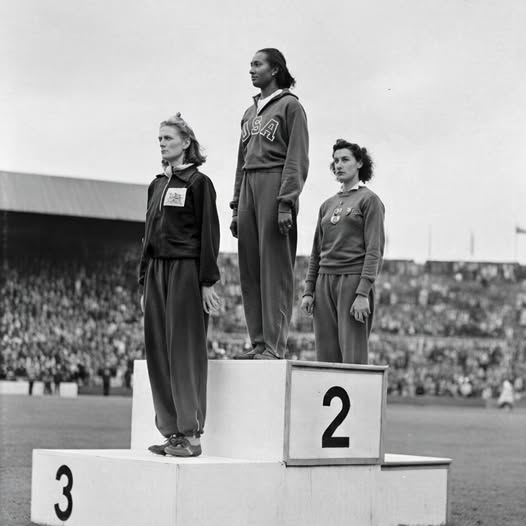
But before all of that, a king placed a gold medal around her neck.
August 1948. Wembley Stadium in London. Rain drifting across a crowd of 83,000. The track slick. The air cold.
Alice Coachman stood alone at the high jump bar.
Twenty four years old. Back aching. Doctors had already warned her that the injury should have ended her career. No American woman had won gold at these Games. Every eye in that stadium felt heavy.
The bar sat at 5 feet 6 and 1/8 inches.
She sprinted.
Planted.
Rose into the air like she had wings.
Clean. No touch.
Olympic record on the first attempt.
Gold medal. History.
King George VI stepped forward and placed the medal around her neck himself. In that moment she became the first Black woman, from any country, to win Olympic gold. The only American woman to win gold in 1948.
It looked graceful and easy.
Her life had been anything but.
Alice was born in 1923 in Albany, Georgia, the fifth of ten children in a family that counted every penny. She picked cotton. Sold plums and pecans on the street. Hauled corn to mills. Whatever helped put food on the table.
And whenever she could steal a few minutes, she ran.
She outran boys older than her. She jumped higher than anyone in sight.
But this was the Jim Crow South.
Public fields were for whites only. Girls’ sports barely existed. And at home, her father thought running made her look unladylike. He wanted her quiet and still on the porch.
When she kept training, he punished her.
She kept going anyway.
Barefoot on dirt roads.
She built her own high jump setup from rope and sticks in the yard because no one would let her use a real one.
A few people finally noticed. A teacher named Cora Bailey. Her aunt Carrie Spry. A coach, Harry Lash. They saw what others ignored.
Talent like that does not whisper. It roars.
Tuskegee Institute offered her a scholarship in 1939.
Before she even stepped into a college classroom, she had already broken national high school and college records. Still barefoot.
For nine straight years she ruled American track. Ten consecutive national high jump titles. Twenty six national championships across events. Basketball titles too. Reporters called her the Tuskegee Flash.
She should have filled a shelf with Olympic medals.
But World War II wiped out the 1940 and 1944 Games, the very years she was strongest.
By the time the Olympics returned, she was older, hurting, and down to one last shot.
London was it.
She made it count.
Back home, the country praised her. Count Basie threw her a party. President Truman congratulated her at the White House. Georgia organized a 175 mile motorcade in her honor.
Then reality set in.
At her own celebration in Albany, Black guests and white guests were separated. The white mayor sat near her on stage and would not even shake her hand.
After everything she had done, they told her to leave through a side door.
Imagine that.
You win gold for your country and still cannot walk out the front.
Years later she said it plainly. It did not feel good.
She retired soon after, finished her degree, and became a teacher. In 1952 Coca Cola signed her as a spokesperson, the first Black female athlete to represent a global brand. Hall of Fame after Hall of Fame followed. At the 1996 Atlanta Olympics she was honored as one of the greatest Olympic athletes ever.
She never bragged.
She talked about responsibility.
She said if she had gone to the Games and failed, there might not have been anyone behind her. Someone had to open the door.
So she did.
After her came Wilma Rudolph. Evelyn Ashford. Florence Griffith Joyner. Jackie Joyner Kersee. Serena Williams. Simone Biles. Generations of women who stepped onto world stages believing they belonged there.
Because a girl from Albany once built her own high jump bar from rope and sticks and refused to quit.
Alice Coachman did more than win a medal.
She proved that talent does not care about color lines or locked gates.
And sometimes one victory can change the path for millions.