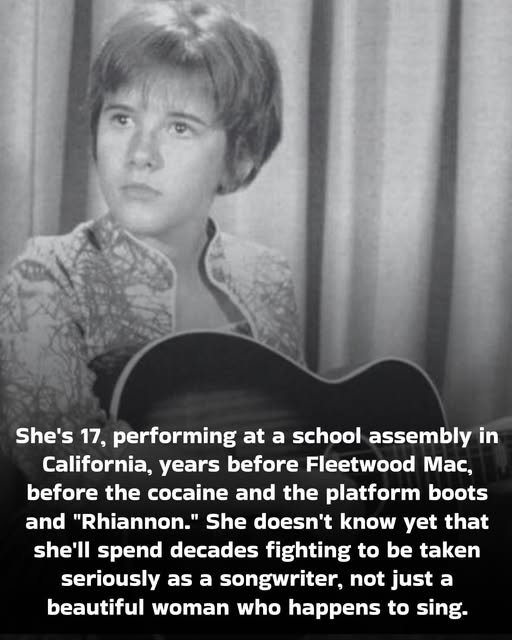
She’s 17, performing at a school assembly in California, years before Fleetwood Mac, before the cocaine and the platform boots and “Rhiannon.” She doesn’t know yet that she’ll spend decades fighting to be taken seriously as a songwriter, not just a beautiful woman who happens to sing.
Her name is Stevie Nicks. And in 1965, she’s just a high school student who loves music, has no idea she’ll become one of rock’s most iconic figures, and is about to learn that being a woman in rock means constantly proving you belong there.
Born Stephanie Lynn Nicks in 1948 in Phoenix, Arizona, Stevie was performing from childhood. Her grandfather was a country music singer who taught her harmonies. She started writing songs as a teenager, influenced by folk music, rock and roll, and the storytelling tradition she’d learned from family.
By 1965, when this photograph was taken, Stevie was performing at school events, local venues, anywhere she could. She was developing her stage presence, learning to command an audience, discovering the power of performance.
She looked like countless other teenage girls in 1965—dark hair, probably nervous, excited, not yet the mystical rock goddess in flowing chiffon that she’d later become.
The 1965 photograph is valuable precisely because it shows Stevie before the mythology, before the persona, when she was just a talented kid who loved music and had dreams of making it professionally.
In 1966, she met Lindsey Buckingham, a guitarist and songwriter. They began performing together, forming the folk-rock duo Buckingham Nicks. They dated, wrote songs together, struggled to make it in the music industry.
For years, they played small venues, recorded demos, got rejected by labels. Stevie worked as a waitress and cleaning woman to support herself while pursuing music. Lindsey worked odd jobs. They were broke, barely surviving, still believing they could make it.
In 1974, after Buckingham Nicks had released one unsuccessful album, Mick Fleetwood of Fleetwood Mac heard Lindsey’s guitar work and invited him to join the band.
Lindsey said yes—but only if Stevie came too. He wouldn’t join without her.
Fleetwood Mac agreed. And Stevie Nicks joined one of rock’s most legendary bands at age 26, after nearly a decade of struggling in obscurity.
The 1975 album “Fleetwood Mac” with the Buckingham-Nicks lineup was a massive success. Stevie’s song “Rhiannon” became a hit. Her mystical persona—flowing clothes, witchy imagery, intense stage presence—began to emerge.
But success didn’t mean acceptance. Stevie faced constant skepticism and dismissal as a female songwriter and performer in rock.
Rock critics treated her as a curiosity—interesting to look at, mysterious persona, but was she really a serious musician? Male bandmates got credit for musical vision and technical skill. Stevie was often discussed primarily in terms of appearance, mystique, relationships.
Her songwriting was sometimes attributed to male collaborators or dismissed as “feminine” and therefore less serious than male rockers’ work. Critics would praise Lindsey Buckingham’s guitar work and production skills extensively, then mention Stevie’s “ethereal” presence almost as an afterthought.
The 1977 album “Rumours” made Fleetwood Mac one of the biggest bands in the world. It sold over 40 million copies and remains one of the best-selling albums of all time.
Stevie wrote or co-wrote several of the album’s biggest hits, including “Dreams”—which became Fleetwood Mac’s only #1 single. She was a primary creative force on an album that defined 1970s rock.
But coverage still often focused on her appearance, her relationships (particularly the tumultuous breakup with Lindsey Buckingham that fueled many of the album’s songs), her mystical image—anything except her songwriting and musical contributions.
When Stevie asserted herself creatively, pushed for her songs to be included on albums, demanded recognition for her contributions, she was often labeled “difficult” or “demanding”—criticisms rarely applied to male artists who did the same things.
Male rockers who insisted on creative control were visionaries. Stevie Nicks doing the same was being a diva.
The double standard was exhausting. But Stevie persisted.
In 1981, while still in Fleetwood Mac, she released her first solo album, “Bella Donna.” It was a massive commercial success, debuting at #1 and eventually selling over 4 million copies.
Stevie proved she could succeed independently, that her creative vision and songwriting weren’t dependent on Fleetwood Mac or Lindsey Buckingham. She was a star in her own right.
But even solo success didn’t end the sexist treatment. Reviews of her solo work often focused on her persona and appearance rather than the music. Her mystical image—the shawls, the spinning on stage, the witchy aesthetic—was discussed more than her songwriting craft.
Male critics seemed unable to process a woman who was both visually striking and musically talented. They could handle one or the other, but the combination confused them into focusing on appearance and dismissing substance.
Through the 1980s and beyond, Stevie maintained dual careers—continuing with Fleetwood Mac while also releasing successful solo albums. She wrote prolifically, toured extensively, became one of rock’s most recognizable figures.
She also battled addiction—cocaine especially, which was endemic in the rock industry of the 1970s and 80s. She’s been open about how substance abuse nearly destroyed her, how the pressures of fame and the constant touring and the need to maintain her mystical persona while being dismissed as a serious artist took enormous tolls.
She got sober, got healthy, and kept working. She kept writing, kept performing, kept proving that she belonged in rock’s pantheon.
In 1998, Fleetwood Mac was inducted into the Rock and Roll Hall of Fame. Stevie became the first woman inducted twice when she was honored as a solo artist in 2019.
That second induction was significant—recognition that Stevie Nicks wasn’t just part of a great band, but was herself a legendary artist whose solo work deserved the highest honors.
By 2019, when she was inducted for the second time, Stevie was 70 years old. She’d been performing professionally for over 50 years. She’d sold over 140 million records. She’d written dozens of hit songs. She’d influenced generations of musicians.
And she was still, occasionally, being asked about her appearance and her relationships more than her music.
The sexism never entirely stopped. But Stevie’s response was to keep working, keep creating, keep proving her worth through decades of sustained excellence.
Looking back at the 1965 photograph of teenage Stevie performing at a school event, knowing everything that would come after, is both inspiring and sobering.
Inspiring because she made it. She achieved the dreams that seemed impossible. She became one of rock’s legends through talent, determination, and refusal to accept that rock was only for men.
Sobering because even after achieving legendary status, even after selling over 100 million records, even after being inducted into the Rock and Roll Hall of Fame twice, Stevie Nicks still faced dismissal and sexism that male artists of equivalent stature never encountered.
The 17-year-old in the 1965 photograph couldn’t have known what was coming. The struggle and the triumph. The addiction and the recovery. The constant fight to be taken seriously. The eventual legendary status that still didn’t fully protect her from sexist treatment.
If we could tell her—tell that teenage girl performing at a school event in California—what would we say?
That it will be harder than it should be. That she’ll have to prove herself repeatedly in ways male musicians never will. That her appearance will be discussed more than her songwriting. That she’ll be called difficult for asserting the same creative control that male artists are praised for.
But also: that she’ll make it. That she’ll write songs that millions of people will love. That she’ll become an icon. That she’ll influence generations of musicians. That she’ll be inducted into the Rock and Roll Hall of Fame twice.
That teenage Stevie in 1965 would probably say: I’ll take it. Even knowing all the sexism and the struggle, even knowing how hard it will be—I’ll take it. Because the music matters. Because the dream is worth fighting for.
And she did fight for it. For over 50 years. Through Fleetwood Mac’s triumphs and implosions. Through solo success and addiction and recovery. Through decades of sexist dismissal and hard-won recognition.
Stevie Nicks, 1965, performing at a school event. Just a teenage girl who loved music.
She became a rock legend. She wrote “Dreams” and “Rhiannon” and “Landslide” and dozens of other songs that defined generations. She sold over 140 million records. She was inducted into the Rock and Roll Hall of Fame twice.
And she did it all while fighting constant battles against sexism, while being told that rock was for men, while having to prove repeatedly that she was a serious musician and not just a mystical image.
The 1965 photograph shows where she started. A teenage performer, years before fame, just beginning the journey.
The rest is history. Hard-won, fought-for, often frustrating history. But legendary nonetheless.
Stevie Nicks. Born 1948. Still performing. Still writing. Still proving, even at 76, that women belong in rock.
That teenage girl in 1965 had no idea what was coming. But she had the talent, the determination, and the refusal to accept limitations.
And that was enough. Barely. After decades of fighting. But enough.
Remember her story. Not just the mystical rock goddess in flowing chiffon, but the 17-year-old at a school assembly, dreaming of making it in music, about to spend decades proving she deserved to be there.
She proved it. Over and over. For 50+ years.
And she’s still here. Still Stevie. Still writing, still performing, still refusing to fade away gracefully.
Because rock and roll is for everyone. Even when the industry says it isn’t. Even when you have to fight for recognition that should have been freely given.
Stevie Nicks knows this. She’s been proving it since 1965.
And she’s not done yet.