Talks between Iran and the US expose deep divisions, prolonging uncertainty during a two-week ceasefire.
High-stakes talks between the United States and Iran have ended without a deal, and Iran’s chief negotiator, Mohammad Bagher Ghalibaf, has blamed the US for the failure of talks held in Islamabad, Pakistan, during a two-week ceasefire in their war.
Ghalibaf, the speaker of Iran’s parliament, said on Sunday that his delegation raised “forward-looking” initiatives during the talks on Saturday but the US failed to gain the trust of the Iranian delegation.

US Vice President JD Vance, who led the US delegation, said earlier that the talks ended without a deal. “The bad news is that we have not reached an agreement, and I think that’s bad news for Iran much more than it’s bad news for the United States of America,” he said six weeks into the US-Israeli war on Iran.
The talks – the first direct engagement between the two countries at this level since the 1979 Iranian Revolution – exposed deep divisions on core issues, including Iran’s nuclear programme and the Strait of Hormuz, which in effect has been under Tehran’s control since the war began on February 28.
The de facto blockade of the waterway, through which one-fifth of global crude oil supplies pass, has caused a global energy crisis and rattled stock markets globally.
Al Jazeera’s Kamal Hyder, reporting from Islamabad, said the talks mediated by Pakistan, which went on for more than 21 hours, were “neither a breakthrough nor a breakdown”.
Here’s a look at what each side said and what the key sticking points between Tehran and Washington are:
What did the US say?
The US framed the lack of a breakthrough primarily around Iran’s alleged refusal to meet its core demand: a firm commitment not to develop nuclear weapons.
“We need to see an affirmative commitment that they will not seek a nuclear weapon and they will not seek the tools that would enable them to quickly achieve a nuclear weapon,” Vance told reporters at a news conference.
“That is the core goal of the president of the United States, and that’s what we’ve tried to achieve through these negotiations.”
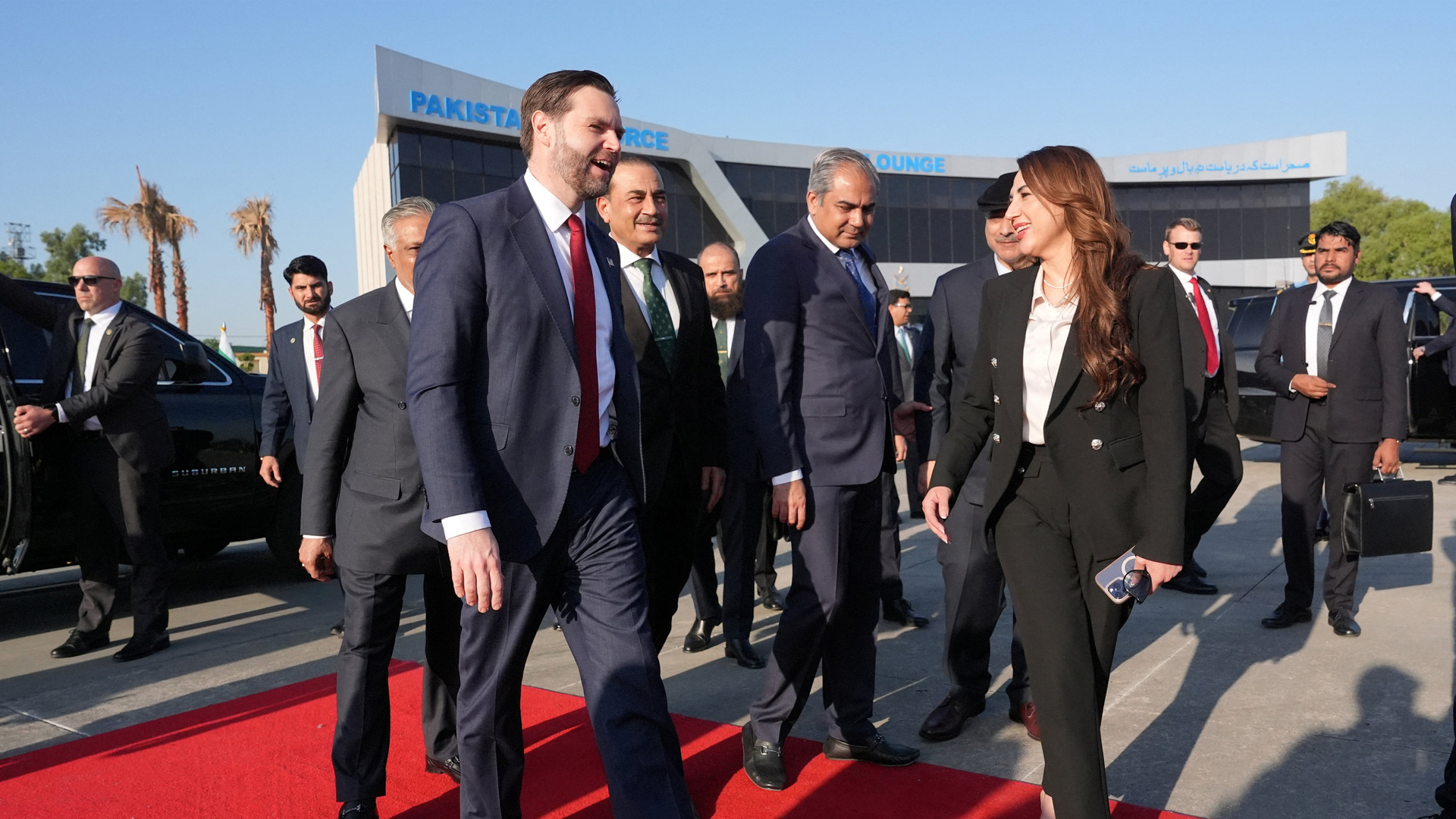
Vance said Washington had made its “red lines” clear and presented what he described as a “final and best offer”.
The vice president did not mention reopening the Strait of Hormuz.
During the negotiations, US President Donald Trump seemed to insert himself in the talks, saying a deal was not entirely necessary.
“We’re negotiating. Whether we make a deal or not makes no difference to me because we’ve won,” he told reporters in Washington, DC.
However, the fact that Trump sent Vance to Islamabad showed the US was taking these talks seriously, Al Jazeera’s John Hendren said, reporting from Washington, DC.
“The fact that Vance left [Islamabad] doesn’t necessarily mean that the talks are over,” he said, adding that the main sticking points seem to be the Strait of Hormuz and the gaps on Iran’s nuclear programme.
“The US has been negotiating with Iran over time. Those talks can continue remotely, and leaving those talks may simply be a hard stance,” the Al Jazeera correspondent added.
What did Iran say?
Iran downplayed expectations and blamed the US for making what it called unreasonable demands.
“The success of this diplomatic process depends on the seriousness and good faith of the opposing side, refraining from excessive demands and unlawful requests, and the acceptance of Iran’s legitimate rights and interests,” Iranian Ministry of Foreign Affairs spokesman Esmaeil Baghaei wrote on X.
He added that the two sides discussed a range of issues, including the “Strait of Hormuz, the nuclear issue, war reparations, the lifting of sanctions, and the complete end of the war against Iran”.
Baghaei emphasised that the lack of a deal should not be seen as a failure of the broader process, saying, “No one had such an expectation.”
According to the IRNA news agency, when asked whether diplomacy had ended, Baghaei said, “Diplomacy never ends.”
Ghalibaf posted on X: “The US has come to understand Iran’s logic and principles, and now it must decide whether it is capable of gaining our trust.”
Mohsen Farkhani from the University of Isfahan said Tehran entered the talks not for a breakthrough but to show the world that Washington was not serious.
“Iran was in these negotiations with a kind of totally realistic view and with distrust … to prove to the world that, for the third time, the US doesn’t have enough seriousness to solve the problems or the challenges in peace and negotiations,” he told Al Jazeera.
What did Pakistan say?
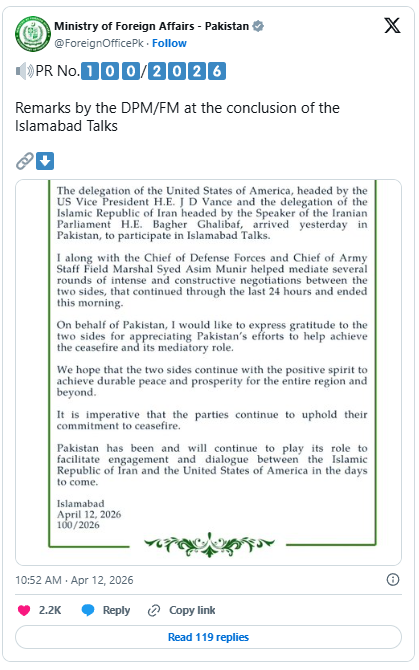
Pakistan called for the ceasefire to continue while keeping diplomacy alive.
Foreign Minister Ishaq Dar stressed that it is “imperative” for both sides to uphold their commitment to the ceasefire, warning implicitly of the risks of renewed conflict if it collapses.
“We hope that the two sides will continue with the positive spirit to achieve durable peace and prosperity for the entire region and beyond,” Dar said.
Pakistan will continue to “play its role to facilitate engagement and dialogue between” Iran and the US “in the days to come”, he added.
What are the main sticking points?
Iran’s nuclear programme
This remains the central dispute between Tehran and Washington.
The US wants a clear and enforceable commitment that Iran will not develop nuclear weapons – or even the capability to do so quickly.
Iran has consistently rejected accusations that it seeks to build nuclear weapons but said it is willing to negotiate limits on its nuclear activities if sanctions are removed.
Iran said its nuclear programme is for civilian purposes and it has no intention of making a nuclear weapon. Washington and Tehran signed a nuclear deal in 2015 under US President Barack Obama. The agreement put a limit on Iran’s uranium enrichment of 3.67 percent in return for sanctions relief. But Trump, who succeeded Obama, withdrew Washington from the deal three years later and slapped sanctions back on Iran. Since then, Iran has accelerated its uranium enrichment to 60 percent. To make an atomic bomb, 90 percent enrichment is required.
Trump has publicly called for enriched uranium to be removed from Iran. During Israel’s 12-day war on Iran in June, the US carried out air strikes on Iran’s three main nuclear sites, after which Trump claimed that Iran’s nuclear programme had been obliterated. But eight months later, he started a war against Iran by saying one of his main goals was to keep Iran from obtaining a nuclear weapon.
The war was launched while talks mediated by Oman were under way between Iran and the US. Oman had said a short time before the attacks began that a deal was “within reach”.
Strait of Hormuz
Who gets to control this strategic waterway, through which almost all of the oil and natural gas exports from the Gulf nations pass, has become a major flashpoint.
Iran has floated the idea of charging transit fees to allow ships to pass through the strait. Meanwhile, the US is adamant the strait is reopened free of any tolls.
The near shutdown of shipping through the strait has sent global energy prices soaring with many countries, especially in Asia, forced to implement unprecedented austerity measures to soften the impact of fuel shortages.
Experts said the near-closure of the strait has caused the worst economic shock since the 1973 oil embargo. That embargo removed 4.5 million barrels per day from the global supply. Today’s closure of the Strait of Hormuz has blocked 20 million.
Extending the ceasefire to Lebanon
Iran is pushing for a broader regional ceasefire, including an end to fighting involving its allies, such as Hezbollah in Lebanon.
While Israeli Prime Minister Benjamin Netanyahu has expressed support for Washington’s decision to suspend the strikes on Iran, he said the ceasefire will not extend to Israel’s ongoing military operations in Lebanon.
Hours into the ceasefire, which began on Wednesday, Israel carried out dozens of attacks across Lebanon, killing more than 300 people in one day.
However, Tehran insisted the ceasefire included Lebanon, citing Pakistani Prime Minister Shehbaz Sharif’s ceasefire announcement on X, which unequivocally stated this was the case.
Trump has backed Netanyahu’s comments, calling it “a separate skirmish”. Vance this week warned Iran that it would be “foolish” to jeopardise its ceasefire with Washington over Israel’s attacks in Lebanon.