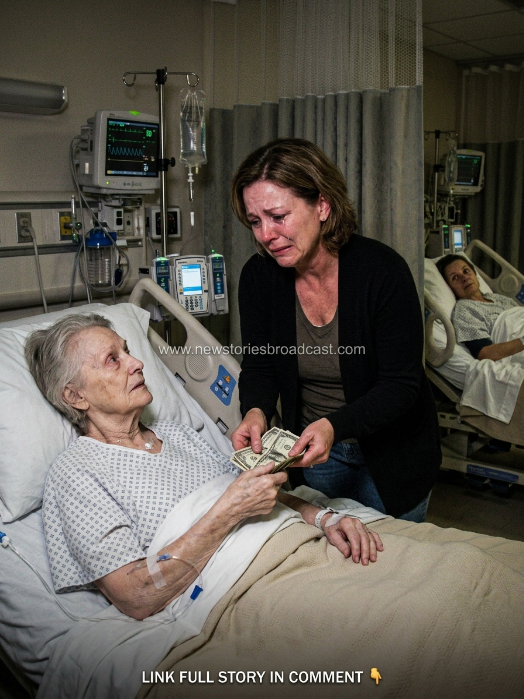
The $100 bill felt heavy, almost damp, in my palm. Evelyn’s grip was surprisingly strong—a desperate, skeletal strength that pinned my hand to the edge of her mattress. Her silver eyes, usually clouded with the fog of age and medication, were suddenly sharp, piercing through me with a terrifying clarity.
“Evelyn, you’re tired,” I whispered, my heart beginning a slow, heavy thud against my ribs. “The medication, it can make things seem… confusing.”
“I am old, Clara, not empty,” she hissed, her voice a dry rattle. “I was a bookkeeper. I spent forty years looking for the patterns people tried to hide in the margins. I know a ‘glitch’ when I see one. They think I’m a ghost because I’m quiet. But ghosts see everything.”
She let go of my hand, sinking back into her pillows as a nurse rounded the corner. I shoved the bill into my pocket, my skin crawling. I turned back to Mark. He was sleeping, his chest rising and falling in a rhythmic comfort that I suddenly found impossible to mirror.
I excused myself, walking with stiff legs to the end of the hallway, ducking into the cramped, fluorescent-lit sanctuary of the family waiting room. It was empty, save for the hum of a vending machine.
With trembling fingers, I pulled out the money.
It was an old $100 bill, the paper soft as cloth. I unfolded it carefully. On the back, in the white space surrounding Independence Hall, someone had used a fine-liner pen to cram rows of tiny, microscopic text. It wasn’t a message; it was a list of names and dates.
04/12 – L. MILLER – STAGED SLIP – $12k 06/18 – J. VANCE – BRAKE FAILURE – $25k 09/22 – M. TYSON – HIT & RUN – PENDING
My breath hitched. M. Tyson. Mark Tyson. My husband.
The date was exactly two weeks ago—the night of the accident. Next to his name, written in a different, more hurried ink, was a license plate number and a single word that made the room tilt on its axis: “INTERNAL.”
THE GHOST IN THE MARGINS
I didn’t go back to the room immediately. I couldn’t. I went to the hospital cafeteria and bought Evelyn the strongest black coffee they had. When I returned, the nurse was gone. I sat on the edge of her bed, the $100 bill hidden in my palm.
“Where did you get this, Evelyn?” I whispered, my voice shaking.
She didn’t look at me. She stared at the ceiling, her chest heaving slightly. “My son,” she said, her voice trembling. “My only son, Marcus. He’s a ‘claims adjuster’ for your husband’s insurance company. Or so I thought.”
She closed her eyes, a tear escaping the corner and disappearing into her hairline. “He visited me the night I was admitted. He thought I was asleep. He was agitated, pacing the room, talking on his burner phone. He dropped that bill. He didn’t even notice. He was talking about ‘quotas’ and ‘liquidating liabilities.’ He mentioned Mark’s name, Clara. He said the payout on Mark’s life insurance was too high, but a ‘disabling accident’ with a ‘contributory negligence’ clause would save the firm millions.”
I felt sick. “You’re saying… the insurance company hit my husband?”
“Not the company,” Evelyn whispered. “A cell. Within it. They engineer accidents for high-value policyholders to avoid massive future payouts or to trigger clauses that favor the firm. Marcus… my boy… he’s the one who identifies the targets. He’s the bookkeeper now.”
The betrayal was a physical weight. Mark wasn’t a victim of a random drunk driver. He was a line item on a balance sheet. He was a “liability” that needed to be “mitigated.”
THE TRAP IS SET
I knew I couldn’t go to the police—not yet. If Marcus worked for the insurance company, he had access to the police reports, the hospital records, and our home address. I had to be smarter.
I spent the next three days playing the grieving, distracted wife. I brought Evelyn her meals, but we spoke in whispers. She told me Marcus was coming back on Friday to “check on her.”
“He’ll want his money back,” she said. “He’s meticulous. He’ll realize it’s missing.”
“Let him come,” I said, a cold fire burning in my gut.
I contacted Sarah, my best friend, whose brother was a private investigator. We didn’t go to the precinct; we went to the source. Using the license plate number from the bill, Sarah’s brother tracked it to a shell corporation owned by a holding company—which was, in turn, a subsidiary of our insurance provider.
The car had been reported “stolen” three hours after Mark was hit. It was currently sitting in a private scrap yard in the industrial district, waiting to be crushed.
On Friday afternoon, the door to Room 412 pushed open. A man in a sharp charcoal suit walked in. He looked exactly like the kind of man you’d trust with your life savings—polished, empathetic, professional.
“Mother,” he said, leaning over Evelyn. “You’re looking better today.”
I stood by Mark’s bed, my back to them, heart hammering.
“Marcus,” Evelyn said, her voice feigning weakness. “I found something of yours. Under the pillow.”
I turned around just as Marcus took the $100 bill from her hand. I saw the exact moment his face changed. The professional mask didn’t just slip; it shattered. He saw the microscopic writing. He saw the list. He saw the names of the people whose lives he had helped dismantle.
He looked at his mother, then slowly, his gaze shifted to me.
“Clara, isn’t it?” he said, his voice dropping an octave, becoming smooth and lethal. “You’ve been very kind to my mother. It’s a shame you have such a habit of… overstepping.”
“I have the car, Marcus,” I said, my voice steady despite the roar of blood in my ears. “I have the plate. I have the ledger. And I have a digital recording of the conversation you just had with your mother about ‘liquidating liabilities’ in this very room.”
I held up my phone. I wasn’t actually recording, but he didn’t know that. I just needed him to blink.
Marcus stepped toward me, his hand reaching into his suit jacket. “You think a hospital is a safe place, Clara? People die here every day from ‘complications.'”
“Not today,” a voice boomed from the doorway.
Two plainclothes officers stepped in, followed by Sarah’s brother. The “internal” investigator from the insurance company—the one who actually cared about the law—had been tipped off by the private investigator. They had been standing in the hallway for the last five minutes, listening to every word through the cracked door.
THE COST OF TRUTH
Marcus was led out in silence, his head bowed, his charcoal suit suddenly looking like a funeral shroud. Evelyn watched him go with a look of profound, soul-crushing grief. She had sacrificed her only son to save a stranger’s husband.
Mark woke up fully two days later. The first “dad joke” he made was terrible—something about the hospital food being “to die for”—and I cried so hard the nurses thought he’d relapsed.
I told him everything. We moved states. We changed our names. We used the settlement from the resulting lawsuit against the insurance giant to move Evelyn into a high-end assisted living facility where she would never be lonely again. I visit her every Sunday.
The $100 bill is framed in a small safe in our home. Not because of the money, but because of the message.
We live in a world that tries to reduce us to numbers, to risks, and to liabilities. We are told that we are alone, that our accidents are random, and that our tragedies are just “bad luck.”
But the truth is, the margins of the world are filled with people like Evelyn—people who see the patterns, who remember the names, and who are willing to reach across the silence to save a soul they don’t even know.
Mark still walks with a slight limp, a permanent reminder of the night the world tried to erase him. But every time I see him play with our children, I remember the crumpled bill and the shaky hand of an old woman who decided that the truth was worth more than a legacy of lies.
Our world shattered that day, yes. But when we put the pieces back together, we realized they formed a picture far more beautiful than the one we had before. We weren’t just survivors; we were the ones who refused to be a line item.
THE END