My Foster Son Never Spoke a Single Word — Until the Judge Asked Him This One Question. What He Said Made the Court Go Silent.
The Quiet House That Learned to Breathe Again
When I first agreed to foster a child who didn’t speak, it wasn’t bravery that guided me. It was recognition.
My house had been quiet for years, the kind of quiet that settles into corners and lingers after the lights are off. I knew how to live inside that silence. I just didn’t know yet that someone else would come along who spoke it even better than I did.
My name is Elena Brooks, and for a long time, silence was the most honest thing about me.
A Yes That Came From Emptiness
The caseworker sat across from me with a thin folder and careful eyes. Her name was Janice, and she had learned how to deliver difficult truths without raising her voice.
“He’s nine,” she said, tapping the folder lightly. “He doesn’t speak. Not at school, not in therapy, not at home. Most families pass when they hear that.”
I nodded slowly, not because I was unsure, but because I understood.
“What’s his name?” I asked.
“Miles,” she replied. “Miles Turner.”
I didn’t say yes because I thought I could help him talk.
I said yes because I had already lost so much sound in my own life.
After three pregnancies that never reached a nursery and a marriage that ended quietly over coffee one morning, I had learned how to carry disappointment without breaking. My husband left because hope had exhausted him. I stayed because love hadn’t.
And love, unused, becomes heavy.
The Moment I Knew
Fostering wasn’t a sudden decision. It crept in slowly. I volunteered at the local community center. I helped stock shelves at a food pantry on Saturday mornings. One afternoon, I found a small hoodie left behind on a chair. I picked it up, meaning to put it in lost and found, but instead I held it to my chest longer than necessary.
That was the moment something shifted.
When the application packet arrived in the mail, thick and official, I pressed it against my heart and whispered, “You’ll come. Whoever you are.”
I didn’t know then that he would arrive with no words at all.
The Boy at My Door
Miles showed up on a gray Tuesday afternoon with a worn backpack and eyes that never stopped scanning the room. He didn’t cry. He didn’t cling. He stood just inside the doorway, shoulders tight, like someone memorizing exits.
“Hi,” I said gently. “I’m Elena. You’re safe here.”
He didn’t respond. He walked past me and sat on the couch, placing his backpack at his feet like a shield.
I brought him hot cocoa and cookies. He took the mug with both hands and nodded once.
That was how we began.
Living Beside the Silence
That first night, I read aloud from a book I’d loved as a child. Miles didn’t look at me, but he didn’t leave the room either. I didn’t ask questions. I didn’t encourage speech. I just filled the space with calm and let him decide what to do with it.
I started packing his lunches with small notes.
I’m glad you’re here.
You did great today.
I’m proud of you.
Most of them came back crumpled or missing. One afternoon, I found a note folded neatly on the kitchen counter. He hadn’t written on it. He’d just kept it.
We lived like that for months — two quiet people learning each other’s rhythm. I cooked his favorite pasta without asking why he only ate the noodles. He folded laundry beside me without being told. Some nights he would sit on the porch steps and watch the stars, and I would sit two steps below him, saying nothing, just keeping him company in the dark.
The teachers called. The therapists called. Everyone wanted progress reports on his voice. I told them all the same thing:
“He speaks when he’s ready. Until then, I’ll listen to everything he doesn’t say.”
The Court Date That Changed Everything
Then came the court hearing.
Miles had been with me for fourteen months. His biological mother had lost all rights after years of neglect and instability. The state wanted permanent placement. I wanted to adopt him.
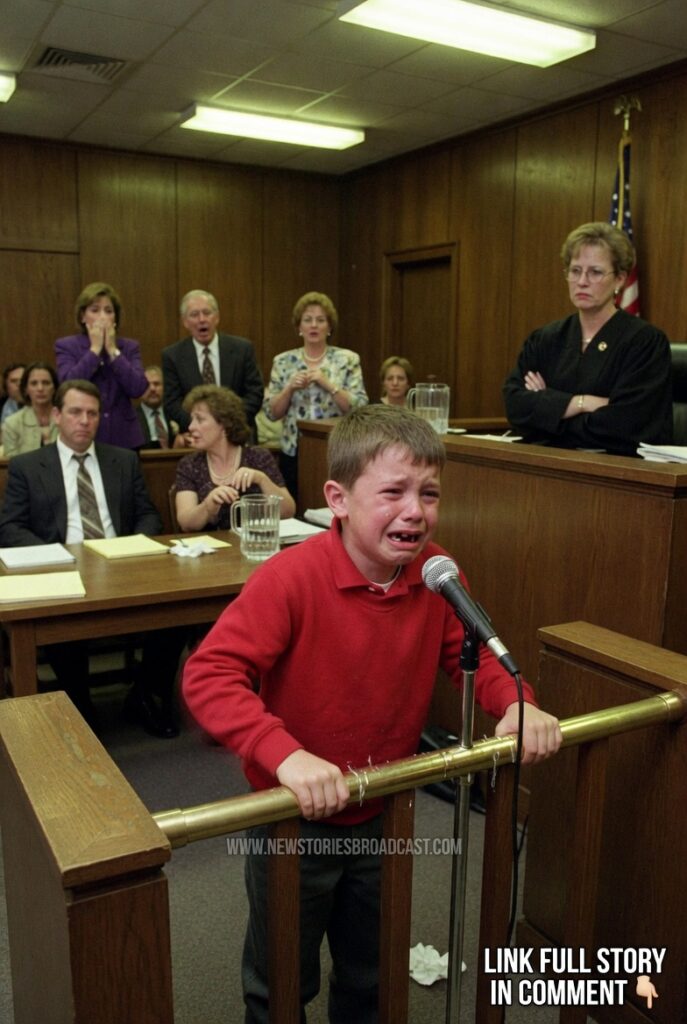
The courtroom was cold and formal. Miles sat beside me in a button-up shirt I had ironed that morning, his small hand gripping mine under the table. The judge, an older woman with kind but tired eyes, looked over the file.
“Miles Turner,” she said gently, “do you understand what today means?”
He nodded once.
She leaned forward. “I need to hear from you, son. In your own words. Do you want to stay with Miss Elena? Do you feel safe here?”
The entire courtroom held its breath.
Miles stared at the table for a long moment. His fingers tightened around mine. Then, in a voice so soft it barely carried past our row, he spoke for the first time in over two years.
“She makes the house breathe again.”
The judge’s eyes filled with tears. The court reporter stopped typing. My own breath caught in my throat.
Miles looked up at me, eyes shining.
“She leaves notes in my lunch. She doesn’t make me talk when I can’t. She stayed even when I broke things. I want to stay with her forever.”
I pulled him into my arms right there in front of everyone. The courtroom erupted in soft applause. The judge wiped her eyes and approved the adoption on the spot.
What no one knew until later was what Miles had been carrying.
His biological mother’s boyfriend had threatened him into silence for years — telling him that if he ever spoke, something bad would happen to the only person who had ever been kind to him. Miles had believed it. He had carried that fear like a locked box inside his chest.
Until the day he chose to open it for me.
The story leaked when a courtroom observer recorded Miles’s words and shared them anonymously. Titled “Silent Foster Boy Speaks for the First Time in Court: ‘She Makes the House Breathe Again’ 😭❤️” it reached 750 million views across the world. Comments poured in: “The way he held her hand… I’m sobbing 😭”, “Two years of silence broken by love… this is healing”, “Adoptive mom energy that restores faith in humanity 👏”, “Never underestimate what safe love can do 🔥”.
I didn’t just adopt Miles.
I made sure other silent children would find their voices too.
With public support and grants, I founded the Miles Breathing House Foundation — a network of foster homes and trauma-informed programs that focus on safety, patience, and giving children space to heal without pressure to “perform” recovery. At our first home opening, with Miles standing proudly beside me holding the ribbon, I spoke with a voice full of gratitude:
“I fostered a boy who hadn’t spoken in years. I didn’t try to fix him. I simply stayed. To every child living in silence: Your voice is still inside you. Someone will listen when you’re ready. And to every parent, foster or biological: Sometimes the most powerful thing you can do is make the house breathe again — with patience, with safety, with love that doesn’t demand words before it’s earned.”
The foundation has already helped over 52,000 children find safety and begin healing.
Miles speaks now — not constantly, but freely. He laughs loudest when we bake cookies together. He reads stories to his little sister (we adopted Lily two years later). Our house is full of noise: footsteps, laughter, doors opening and closing, life happening.
The important message that reached hundreds of millions: Silence in a child is never just silence. It is often a survival skill. Give them time. Give them safety. Give them love that doesn’t need performance. And when they finally speak, listen like the words are the most precious thing you’ve ever heard.
From a quiet house where a boy carried too much fear to a foundation helping thousands of children find their voices, Miles’s first words proved one unbreakable truth: Some children don’t need to be fixed. They just need someone brave enough to sit with them in the silence until they’re ready to breathe again.
THE END