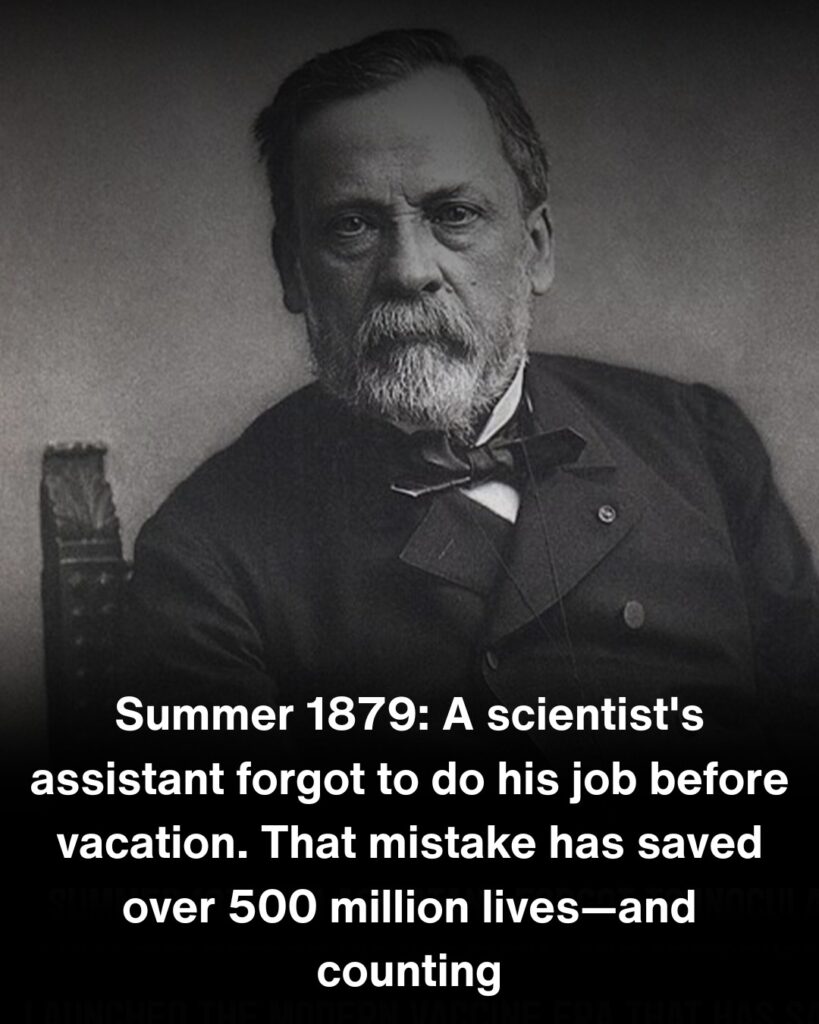
Louis Pasteur was stuck. For two years, he’d been obsessed with chicken cholera—a devastating disease that swept through French poultry farms, killing entire flocks within days. By 1878, Pasteur had successfully cultured the deadly bacteria in his laboratory. He could grow it, study it, inject it into chickens—and watch helplessly as they died within 48 hours. Every single time.
But understanding how the disease killed wasn’t the same as stopping it.
Pasteur, already famous for his work on fermentation and germ theory, was desperate for a breakthrough. He had no idea it was about to arrive through the most unlikely source: human forgetfulness.
In summer 1879, Pasteur prepared to leave his Paris laboratory briefly. His daughter was getting married, and he wasn’t feeling well. Before leaving, he gave clear instructions to his assistant—either Émile Roux or Charles Chamberland, both brilliant young doctors working alongside him.
“Inject the next batch of chickens with fresh bacterial cultures.”
Then he left.
His assistant had every intention of following through. But life intervened. Perhaps it was the allure of vacation. Perhaps simple distraction. Whatever the reason, the assistant forgot.
He left the bacterial cultures sitting on the laboratory shelf—stoppered only with cotton plugs—and went on holiday himself.
For an entire month, those cultures sat untouched, exposed to air, slowly aging.
When the assistant returned in October, he realized his mistake. The cultures had been sitting there since July. But rather than discard them and start fresh, he decided to use them anyway—perhaps hoping Pasteur wouldn’t notice, perhaps assuming it didn’t matter.
He injected the chickens with the old, month-old bacterial culture.
Then he waited for them to die, as they always did.
But they didn’t.
The chickens became mildly ill—ruffled feathers, some lethargy—but within days, they recovered completely. They were perfectly healthy.
When Pasteur returned and learned what had happened, another scientist might have been furious at the incompetence. Another might have dismissed the results as contaminated or dead bacteria.
But Pasteur was intrigued.
Why had the chickens survived? The bacteria should have killed them. What had changed?
Then Pasteur had an idea that would change medical history forever.
“Inject them again,” he ordered. “But this time, use fresh, virulent cultures.”
His assistants thought he was mad. Why inject already-sick chickens with deadly bacteria? But Pasteur insisted.
They prepared two groups:
Group 1: The birds that had survived the old culture
Group 2: Fresh chickens that had never been exposed
Both groups were injected with freshly cultured, fully virulent chicken cholera bacteria—the kind that always killed within 48 hours.
Pasteur and his team watched and waited.
Group 2—the fresh chickens—died quickly, just as expected.
Group 1—the chickens that had survived the old culture—remained perfectly healthy.
They were immune.
Pasteur was electrified. He understood immediately what had happened: the month-old culture had weakened. Exposure to oxygen over time had attenuated the bacteria—made it less deadly but still capable of teaching the chickens’ bodies to recognize and fight the disease.
The immune system had been trained to fight an enemy without being killed by it.
This was revolutionary.
Edward Jenner had discovered vaccination in 1796 by using cowpox to protect against smallpox—but that required finding a naturally occurring weak version of the disease. Pasteur had just discovered that you could create weakened versions of deadly diseases in the laboratory.
You could manufacture immunity.
“Chance favors the prepared mind,” Pasteur famously said. And his mind was prepared. He immediately understood the implications: if chicken cholera could be weakened and turned into a vaccine, so could other diseases.
Pasteur threw himself into systematic testing. He discovered how to weaken different bacteria—how long to expose them to air, at what temperature, under what conditions. Different diseases required different attenuation methods.
In 1881, just two years after the chicken cholera discovery, Pasteur developed an anthrax vaccine using similar principles. In May, he staged one of the most dramatic scientific demonstrations in history at Pouilly-le-Fort.
He vaccinated 24 sheep, 1 goat, and 6 cows with his experimental anthrax vaccine. Another 24 sheep, 1 goat, and 4 cows remained unvaccinated as controls.
On May 31, all the animals were injected with virulent, deadly anthrax bacteria.
On June 2, over 200 spectators gathered to see the results.
Every single vaccinated animal was alive and healthy.
Every single unvaccinated animal was dead or dying.
The crowd erupted. Pasteur had proven that laboratory-created vaccines could prevent deadly diseases. The age of modern immunization had begun.
In 1885, Pasteur used his attenuation method to create the first rabies vaccine, saving the life of nine-year-old Joseph Meister who had been bitten by a rabid dog. Over the next year, Pasteur saved nearly 350 more people from rabies—people who would have faced agonizing, certain death.
His work laid the foundation for every vaccine that followed: diphtheria, tetanus, polio, measles, mumps, rubella, COVID-19. Vaccines have saved an estimated 500 million lives since Pasteur’s discovery—more than any other medical intervention in human history.
And it all started because an assistant forgot to do his job before going on vacation.
That month-old bacterial culture, left sitting on a laboratory shelf by accident, revealed one of nature’s most profound secrets: that immunity could be taught, that diseases could be defeated not by chance but by design.
Pasteur’s forgotten assistant—whoever he was, Roux or Chamberland—never received credit for his mistake. History remembers Pasteur, the genius who recognized the significance of what others would have dismissed as contamination or failure.
But perhaps we should also remember the power of accidents. Of mistakes. Of the unexpected moments when human error collides with scientific curiosity.
Because sometimes the greatest discoveries don’t come from doing everything right.
They come from doing something wrong—and being smart enough to notice.
A forgotten experiment. A month-old culture. A curious mind willing to ask “why?” instead of discarding the unexpected result.
And the birth of vaccines that would save hundreds of millions of lives across generations.
Every person alive today who received a polio vaccine, a measles vaccine, a COVID vaccine—every parent whose child survived diphtheria, every community protected from deadly outbreaks—owes a debt to that forgetful assistant in summer 1879.
He forgot to do his job. And in doing so, he accidentally helped change the world.