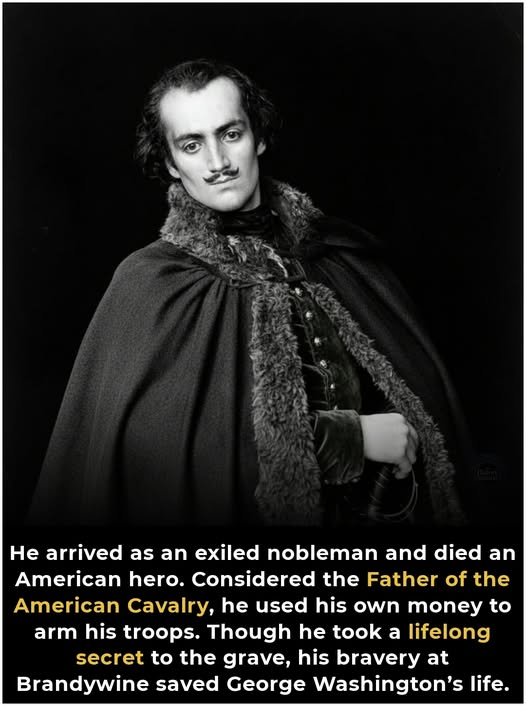
In 1777, a foreigner arrived on American shores with little more than a horse and a sword. By 1779, he was dead. Yet in those two years, this man changed the course of our history forever.
General George Washington’s fledgling army was in trouble. They were being chased across the colonies by the finest military in the world. They had brave men, but they lacked a professional cavalry. They were fighting on foot against the greatest empire on earth.
But a Polish nobleman named Casimir Pulaski arrived to stand in the gap. He was a man who had already lost everything. He was an exile, a warrior for the Catholic faith, and a soldier who had spent years fighting Russian tyranny in his homeland.
Casimir Pulaski didn’t just join the fight. He transformed it. He saw the potential in the American soldier. He saw the need for speed. He saw the path to victory.
When he first met Washington, he didn’t ask for a safe desk job. He famously told the General that he came to live or die for American liberty. He was a man of his word.
At the Battle of Brandywine, he led a daring charge that saved Washington’s life. Without his quick thinking and courage, the American Revolution might have ended that very day. He fought with a ferocity that stunned the British.
But the struggle was not just on the battlefield. Pulaski was often penniless. He spent his own money to equip his troops. He fought through language barriers and the skepticism of American officers who didn’t trust a foreigner.
He built the American cavalry from the ground up. He taught men how to ride, how to charge, and how to strike fear into the hearts of redcoats. He gave us the mobility we needed to survive.
He saw the chaos. He saw the sacrifice. He saw the vision of a free nation. His dedication was total, right up until the end at the Siege of Savannah in 1779.
During that brutal battle, he charged into the fray to rally French and American troops. A grapeshot hit him, and he fell from his horse. He died days later, a long way from his home in Poland, but a hero in his adopted land.
Today, we remember him as the Father of American Cavalry. His legacy lives on in every tank and armored unit that bears the crossed sabers. He proved that freedom is a cause worth any price.
Sources: National Archives / Smithsonian History / Catholic Encyclopedia