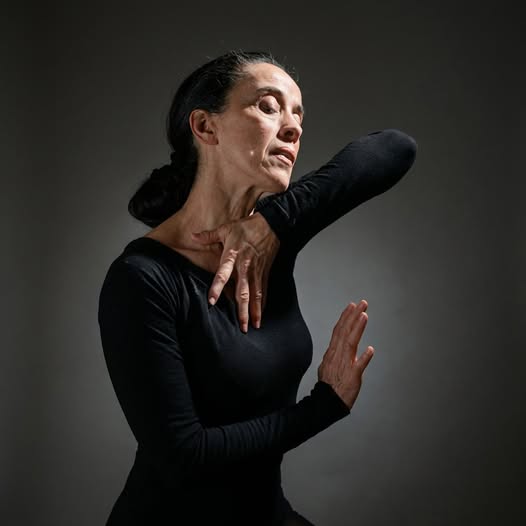
Martha Graham was born in 1894 into a culture that believed beauty in movement meant escape from the body. Classical ballet prized lightness, elevation, illusion. Dancers were meant to look as if they barely touched the earth, as if effort were an embarrassment best concealed behind silk and smiles. Emotion existed, but it was ornamental, contained within shapes that never truly broke.
Martha Graham broke them anyway.
She arrived in dance later than most and with a mind already sharpened by observation. She watched people breathe when they were afraid. She noticed how the torso tightened with grief, how anger compressed the belly before it exploded outward, how desire pulled inward before it reached. She understood something no one else was willing to say aloud.
The body does not lie.
Instead of denying gravity, she listened to it. Instead of hiding effort, she exposed it. She began building a language of movement that started at the core, not the extremities. Contraction and release. The tightening of the abdomen like a held breath. The sudden expansion as if the soul itself were pushing outward through muscle and bone.
This was not decorative.
It was anatomical truth.
When she performed, audiences were unsettled. Her dancers were grounded. Barefoot. Angular. They fell. They struck the floor. They curved inward as if protecting something essential and then unfurled with force that felt dangerous. Critics accused her of ugliness, hysteria, excessive emotion. She took it as confirmation.
She was not interested in prettiness.
She was interested in necessity.
Graham believed that movement came from an inner landscape and that technique existed only to serve expression. Her choreography did not ask what looks good. It asked what must be said. Grief was not lifted into elegance. It was allowed to bend the spine. Rage did not get smoothed into symmetry. It twisted. Desire was not coy. It pulled the body forward like gravity reversed.
In works like Lamentation she wrapped the dancer in fabric not to beautify but to restrict, forcing emotion to press against boundaries until it became visible. The body became architecture under pressure. The audience did not watch a story unfold. They watched feeling take shape.
She built an American language of dance not by rejecting tradition outright but by refusing to be governed by it. She drew from myth psychology and the rhythms of breath. Her dancers did not disappear into roles. They inhabited states of being. Fear. Defiance. Ecstasy. Despair. Strength was no longer about lightness. It was about endurance.
This mattered because the female body had been taught to apologize for weight.
Graham made weight the point.
She showed that power could be inward, coiled, deliberate. That authority did not require extension into space but command of center. Her technique trained dancers to initiate movement from the pelvis and spine, from places long considered improper or invisible. She reclaimed the torso as a site of intelligence.
That reclamation was political even when she did not name it as such.
At a time when women were expected to soften themselves to be accepted, she insisted on intensity. She did not ask permission to be severe. She demanded discipline, precision, and absolute commitment from her dancers. She led with authority that did not mimic men and did not need to.
Her company became a crucible.
Dancers trained in her technique carried it into the world, spreading a way of moving that changed everything it touched. Modern dance as we understand it grew directly from her work. Even those who rebelled against her were responding to the vocabulary she had made unavoidable.
She aged in public. She continued performing into her seventies, her body no longer capable of the feats of youth but still carrying presence that silenced rooms. She refused the idea that artistry belonged only to the young. Experience altered movement. It did not diminish it.
Her influence extended beyond dance.
Actors learned from her that gesture could hold meaning. Choreographers learned that structure could arise from emotion rather than impose it. Audiences learned that beauty could include tension and discomfort and that witnessing was sometimes meant to be challenging rather than soothing.
Martha Graham did not create a style meant to be copied.
She created a technique meant to be inhabited.
One that insisted the body was not an ornament but an instrument of truth. One that treated emotion as a source of rigor rather than excess. One that proved that grounding could be as transcendent as flight.
Her legacy lives every time a dancer breathes into movement rather than skating over it. Every time a body contracts in recognition of something real before releasing it into space. Every time strength is defined not as weightlessness but as presence.
She taught the world that dance did not need to escape the body to be art.
It needed to go deeper into it.
And by doing so, she changed not only how we move, but what we believe the body is allowed to say.