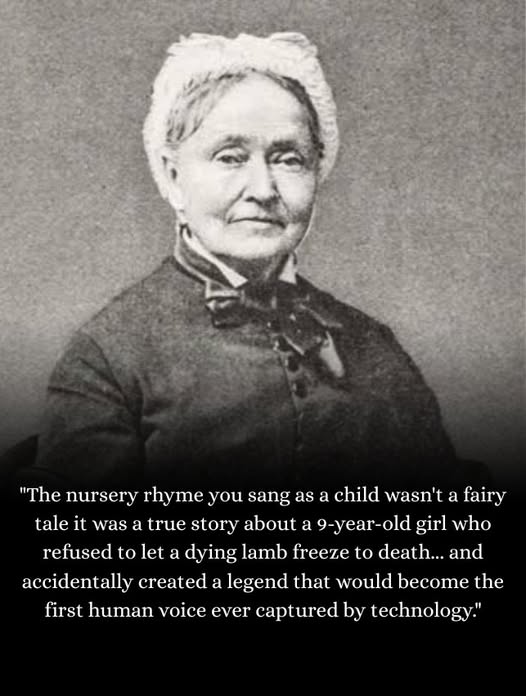
“The nursery rhyme you sang as a child wasn’t a fairy tale—it was a true story about a 9-year-old girl who refused to let a dying lamb freeze to death… and accidentally created a legend that would become the first human voice ever captured and played back by technology.”
It was a cold March morning in 1815 in Sterling, Massachusetts.
Nine-year-old Mary Sawyer walked into her family’s barn with her father to do the morning chores. In the sheep pen, they found two newborn lambs—twins, born overnight.
One was healthy, nursing contentedly from its mother.
The other lay motionless in the straw—rejected, freezing, barely breathing. Too weak even to stand.
Mary’s heart broke.
“Can I take it inside?” she begged.
Her father shook his head. “No, Mary. It’s as good as dead. Even if we try, it won’t survive.”
But Mary couldn’t bear to watch the tiny creature die.
She pleaded. She begged. She refused to give up.
Finally, her father relented—though he made it clear he thought it was hopeless.
Mary carried the limp lamb into the house. Her mother helped her wrap it in old cloth. And there, beside the fireplace, nine-year-old Mary Sawyer began the fight of her life.
All night, she held the lamb. Fed it milk drop by drop. Kept it warm. Refused to let it slip away.
“In the morning, much to my girlish delight, it could stand,” Mary would write decades later. “And from that time it improved rapidly. It soon learned to drink milk; and from the time it would walk about, it would follow me anywhere if I only called it.”
The lamb—white as snow—became utterly devoted to Mary.
It followed her to the yard. To the fields. Everywhere she went, the lamb was sure to go.
And one morning, with a little encouragement from her mischievous older brother Nat, Mary decided to take the lamb to school.
She tried to hide it. Tucked it in a basket under her desk, hoping it would stay quiet during lessons.
For a while, it worked.
But when the teacher called Mary to the front of the room to recite, the lamb burst out—bleating loudly, running straight to her side.
The classroom erupted in laughter. Even the teacher, Polly Kimball, couldn’t help but smile.
The lamb waited outside in a shed until Mary brought it home at lunch.
But someone else was in the classroom that day.
John Roulstone—a local boy preparing for college, visiting the school—was charmed by the scene. That night, he went home and wrote a poem.
The next day, he returned on horseback and handed Mary a slip of paper with three simple verses:
“Mary had a little lamb,
Its fleece was white as snow,
And everywhere that Mary went,
The lamb was sure to go.”
Mary kept that piece of paper for years.
Life went on. The lamb lived on the Sawyer farm, had three lambs of her own, and died at age four—gored by a family cow.
Mary’s mother made two pairs of stockings from the lamb’s wool. Mary treasured them.
John Roulstone went off to Harvard. Tragically, he died of tuberculosis at age 17.
And Mary? She grew up, married, raised a family, and rarely spoke about the lamb or the poem.
Until 1830.
That year, a renowned writer and editor named Sarah Josepha Hale—the same woman who would later help make Thanksgiving a national holiday—published a collection called Poems for Our Children.
In it was a poem called “Mary’s Lamb.”
It had six verses. The first three were identical to what John Roulstone had written. The last three were new—moral lessons about kindness to animals.
Mary had no idea how Hale had gotten Roulstone’s poem. When asked, Hale claimed she’d made it up entirely from her imagination.
The controversy would rage for decades. Two towns—Sterling, Massachusetts and Newport, New Hampshire—would argue over the poem’s origins for a century.
But the poem itself? It took on a life of its own.
It was set to music (the melody borrowed from a minstrel song called “Goodnight Ladies”). It became wildly popular in the mid-1800s. Children across America sang it.
And then, in 1877, something extraordinary happened.
Thomas Edison had just invented the phonograph—a machine that could, for the first time in human history, record sound and play it back.
He needed something to recite to test it.
He chose “Mary Had a Little Lamb.”
On December 6, 1877, Edison wrapped tinfoil around a cylinder, turned a crank, and spoke into the mouthpiece:
“Mary had a little lamb. Its fleece was white as snow. And everywhere that Mary went, the lamb was sure to go.”
When he played it back, he was astonished. His mechanic couldn’t believe it. The words—recorded, preserved, played back—were clear.
Those words, born from a nine-year-old girl’s compassion in a Massachusetts barn, became the first successful recording and playback of the human voice.
The first time a voice could be captured, preserved, and heard again.
Mary Sawyer lived a long, quiet life. She married Reuben Tyler, had children, and rarely mentioned the famous poem.
Until 1876.
At age 70, Mary finally came forward.
Boston’s Old South Meeting House—where colonists had met before the Boston Tea Party—was in danger of being torn down. A fundraising campaign was launched to save it.
Mary still had those two pairs of stockings her mother had made from her lamb’s wool, decades earlier.
She unraveled them. Cut the wool into small pieces. Attached them to cards with her autograph.
And she sold them, telling the world:
“I am the Mary. This is my lamb’s wool.”
People were astonished.
The woman behind the nursery rhyme was real. And she was still alive.
Mary Sawyer died in 1889 at age 83.
Today, a statue of her little lamb stands in Sterling, Massachusetts—honoring the girl who refused to let a helpless creature die, and whose kindness echoed through time in ways she never could have imagined.
The nursery rhyme didn’t make Mary famous.
Her compassion did.
Because she didn’t just save a lamb that cold March morning.
She showed that one small act of kindness—one refusal to give up on a dying creature—can ripple across centuries.
Can become a poem children sing.
Can become the first voice technology ever captured.
Can become a legend that reminds us: compassion matters. Determination matters. And sometimes, the gentlest hearts change the world in ways they never see coming.
Fun Fact: Thomas Edison’s phonograph test recording of “Mary Had a Little Lamb” in 1877 became the first successful recording and playback of the human voice—making the words born from a nine-year-old’s compassion the first sound humanity ever captured and heard back.