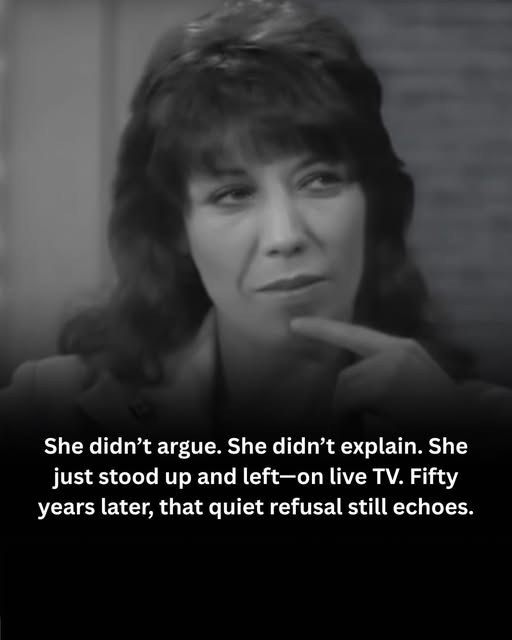
It took less than a minute.
But fifty years later, people still talk about it.
March 1972.
A late-night studio. Bright lights. Easy laughter.
Another episode of The Dick Cavett Show, drifting along like any other.
Lily Tomlin sat calmly in her chair.
So did Chad Everett—handsome, relaxed, certain of himself.
Cavett asked Everett about his life.
Everett answered with a grin, ticking off his world like a checklist.
Three horses.
Three dogs.
A wife.
The audience laughed—half reflex, half discomfort.
Cavett tried to rescue the moment. Gently.
“Want to change the order of that?”
Everett didn’t hesitate.
“No,” he said.
“She’s the most beautiful animal I own.”
The room stalled.
Some people laughed because they didn’t know what else to do.
Some stayed silent.
The cameras waited.
And Lily Tomlin understood exactly what was expected of her.
Smile.
Stay seated.
Let it pass.
That’s what women had been trained to do—especially on television.
Instead, she stood up.
“I have to leave,” she said.
No lecture.
No outrage.
No performance.
She simply walked off the stage.
For a split second, no one knew how to react.
Then the audience began to clap.
Not because they’d been told to.
Because they recognized something rare: a refusal.
Later, Tomlin said it wasn’t bravery. It wasn’t strategy.
“It was instinct,” she explained.
“I felt like angels walked me off.”
That moment didn’t make her famous—but it revealed who she already was.
A woman who used humor as a scalpel.
Who created characters that exposed power by pretending to play along.
Who never mistook silence for grace.
She went on to star in 9 to 5, a comedy that landed because she’d already shown she wouldn’t laugh at being diminished.
She built a life and career with Jane Wagner long before it was safe to be public about it.
She kept working past the age women were told to disappear.
And in her seventies, she became the co-lead of Grace and Frankie, proving relevance has nothing to do with youth—and everything to do with refusal.
Lily Tomlin never raised her voice that night.
She didn’t argue.
She didn’t demand an apology.
She simply declined to remain seated next to disrespect.
And sometimes that’s all courage is—
standing up, walking away, and letting the silence say the rest.