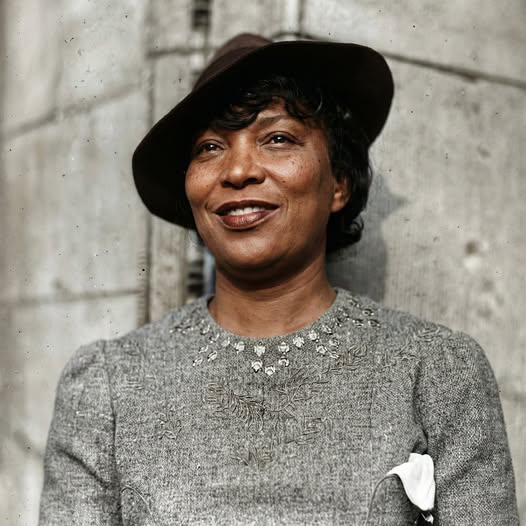
She did not chase headlines.
She bent close enough to hear what history was whispering.
Zora Neale Hurston is remembered by many as a novelist. A Harlem Renaissance voice. The woman who wrote Their Eyes Were Watching God. But before she was canonized, before she was debated, before she was rediscovered after years of neglect, she was something rarer and more dangerous.
She was a listener.
In the early twentieth century, America was on the move. Millions of Black families were leaving the rural South in what would later be called the Great Migration. Sociologists counted bodies. Economists measured labor shifts. Newspapers turned human motion into numbers and trends. Progress was charted in charts.
Zora Neale Hurston heard something else.
She heard songs breaking apart. Stories losing their homes. Proverbs with no one left to repeat them. She understood that when people move under pressure, culture moves with them, and much of it does not survive the journey unless someone insists it matters.
So she trained herself to record it.
Hurston studied anthropology under Franz Boas, one of the few scholars of the time who believed culture should be understood on its own terms rather than ranked against European standards. She took that belief seriously. Too seriously for some. While others analyzed Black life from a distance, Zora went home.
She went to porches and kitchens.
To juke joints and work camps.
To back roads and front stoops.
She traveled through Florida, Alabama, Louisiana, and the Caribbean, not with questionnaires designed to extract data, but with patience. She sat quietly. She laughed. She waited. She understood that folklore does not perform on command. It emerges when trust has settled into the room.
What she collected were not curiosities.
They were cosmologies.
Hoodoo practices. Creation stories. Work songs. Sermons. Lies told for pleasure. Jokes layered with pain and brilliance. The language itself, bent and braided into forms that did not exist in books. She wrote it down phonetically, refusing to “correct” grammar into something more respectable. She knew that respectability was often just another form of erasure.
This choice made her controversial.
White scholars were uncomfortable with the intimacy of her work. Some Black intellectuals worried that she was preserving material that would be used to mock rather than honor. Hurston understood the risk. She took it anyway. Because she knew what happened when a people were told they had no history.
History does not vanish quietly.
It bleeds out through forgetting.
Zora Neale Hurston treated oral tradition as archival truth. Not raw material to be refined, but finished art. She believed that stories told in kitchens carried as much weight as stories bound in leather. That laughter was evidence. That spirituality practiced outside churches still mapped a moral universe.
While the world looked at migration and saw displacement, she heard rhythm. She heard the way language shifted but carried its past inside it. She heard Africa echoing through the American South, not as nostalgia, but as continuity.
Her recordings preserved something no statistic could.
Voice.
And yet, the cost was high.
Hurston did not fit neatly anywhere. She resisted political dogma. She refused to flatten her people into symbols. She would not trade complexity for approval. As literary tastes shifted and movements hardened, she found herself increasingly isolated. Her books fell out of print. Her anthropological work was sidelined. She died in 1960 in poverty, buried in an unmarked grave.
The whispers she saved outlived the silence imposed on her.
Decades later, her work was reclaimed. Scholars recognized what she had done. That she had not merely written stories. She had built an archive where none had been allowed to exist. She preserved Black interior life at a moment when the nation was determined to define Black existence only through struggle or pathology.
Zora Neale Hurston proved something quietly radical.
That survival is not only physical.
It is narrative.
That when a people are told they have no history, recording their laughter is an act of resistance. That folklore is not quaint. It is philosophy spoken sideways. That listening can be as revolutionary as protest when what is being listened for is dignity.
She was the anthropologist of the soul because she understood that culture does not announce itself as important. It hides in cadence. In timing. In who pauses before a sentence and why. She leaned in close enough to hear it before it was drowned out by progress.
She did not save relics.
She saved motion.
Because of her, the songs did not vanish when the trains left. The jokes did not die when the fields emptied. The spiritual logic of a people was written down not by an outsider peering in, but by a woman who knew exactly when to speak and when to stay silent.
Zora Neale Hurston recorded what power never thinks to destroy first.
The everyday.
The intimate.
The spoken.
And because she did, a people who were told they had no history can still hear themselves answering back.
Not as a statistic.
As a song.