The sun beat down on Camp Pendleton like it had a personal grudge. I stood at attention in my civilian clothes, heart hammering against my ribs, while my father’s voice echoed across the open field.
“That fake tattoo is a disgrace to this uniform and this family!” he bellowed, loud enough for every Marine within fifty yards to hear. “You have no right to be here. Get off my base!”
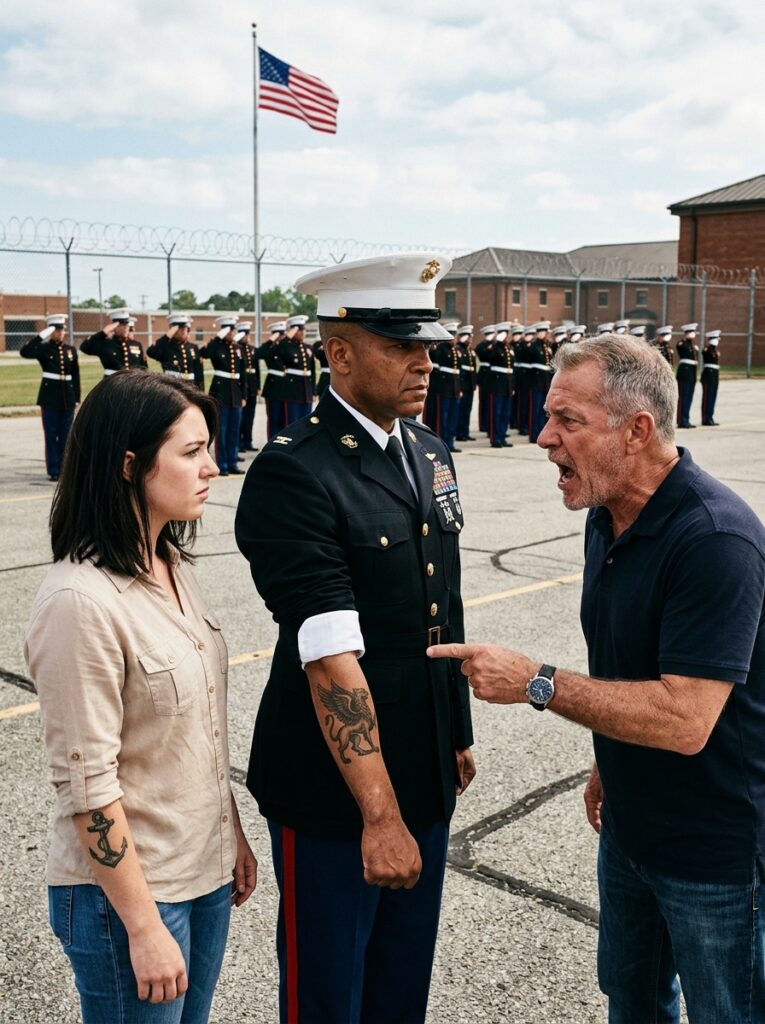
Colonel Robert Ellis — my father — pointed toward the main gate, his face red with rage. Two MPs took a step closer, waiting for his order.
I didn’t move.
On my left forearm, clearly visible under the rolled-up sleeve of my black shirt, was a tattoo: a stylized eagle clutching a sword, with the words “Death Before Dishonor” woven through the feathers. It looked exactly like the one many Marines in this unit had.
But according to my father, it was fake.
Because I was his daughter. Because I was a woman. Because I had left the Marine Corps four years ago after two combat tours in Afghanistan. Because, in his eyes, I would always be just “the girl who couldn’t handle it.”
The crowd of Marines around us had gone silent. Some looked uncomfortable. Others stared at the ground. No one dared speak against Colonel Ellis.
Until Captain Marcus Reyes stepped forward.
He was the current commander of the unit I once led. Tall, broad-shouldered, with the quiet confidence of a man who had seen real war. He stopped beside me, looked my father dead in the eyes, and slowly rolled up his own sleeve.
There it was — the exact same tattoo.
Same eagle. Same sword. Same words.
Captain Reyes spoke, his voice low but carrying across the entire formation:
“Sir… this isn’t a fake tattoo.”
He paused, letting the words sink in.
“And she wasn’t just any Marine. She was our Commander.”
A ripple went through the crowd of over 100 Marines. Then, as if on command, every single one of them snapped to attention and saluted me in perfect unison.
The sound of boots hitting the ground was deafening.
My father’s face went from red to ghost white. His extended arm dropped slowly to his side like it had lost all strength. For the first time in my life, I saw genuine shock — and shame — in his eyes.
How did we get here?
My name is Captain (Ret.) Elena Ellis. At twenty-nine years old, I became one of the youngest female platoon commanders in my battalion. I led my Marines through some of the toughest fighting in Helmand Province. We lost brothers. We saved lives. We came home changed.
But to my father — a career Marine Colonel — I was still just his daughter. The one who was supposed to marry a nice officer, have babies, and stay out of “real” combat roles.
When I got the tattoo with my platoon after our last deployment, my father called it “a childish stunt.” When I left the Corps to take care of my mother during her cancer battle, he called it “quitting.” When I started my own security consulting firm and began training young Marines, he called it “playing dress-up.”
Today was supposed to be a simple family visit. My father was retiring in two weeks, and the base was hosting a farewell ceremony. I came to pay my respects.
Instead, he decided to humiliate me in front of the entire unit I once commanded.
Captain Reyes continued, his voice steady and respectful:
“Colonel Ellis, sir… your daughter led us through Operation Steel Dawn. She dragged two wounded Marines out of a kill zone while under heavy fire. She refused evacuation until every one of her people was safe. That tattoo isn’t fake. It’s earned. Every Marine standing here today would follow her into hell again without hesitation.”
One by one, Marines began stepping forward.
A Gunnery Sergeant spoke up: “She saved my life in 2018, sir.”
A young Lance Corporal added: “She’s the reason I’m still alive to meet my daughter.”
The salutes never dropped.
My father stood frozen, staring at me like he was seeing me for the first time. The man who had spent my entire life telling me I wasn’t strong enough, wasn’t tough enough, wasn’t worthy enough… was now facing the truth.
I finally spoke, my voice calm but clear:
“I didn’t come here to embarrass you, Dad. I came to say goodbye and thank you for teaching me what duty means. Even if you never believed I could live up to it.”
Tears welled in my father’s eyes. For the first time in thirty-two years, Colonel Robert Ellis saluted his daughter first.
The entire formation held their salute as I walked past them toward the gate — not in shame, but with my head high.
Behind me, I heard my father’s broken voice:
“Elena… wait.”
But I kept walking.
Some lessons hurt the most when they come too late.
THE END