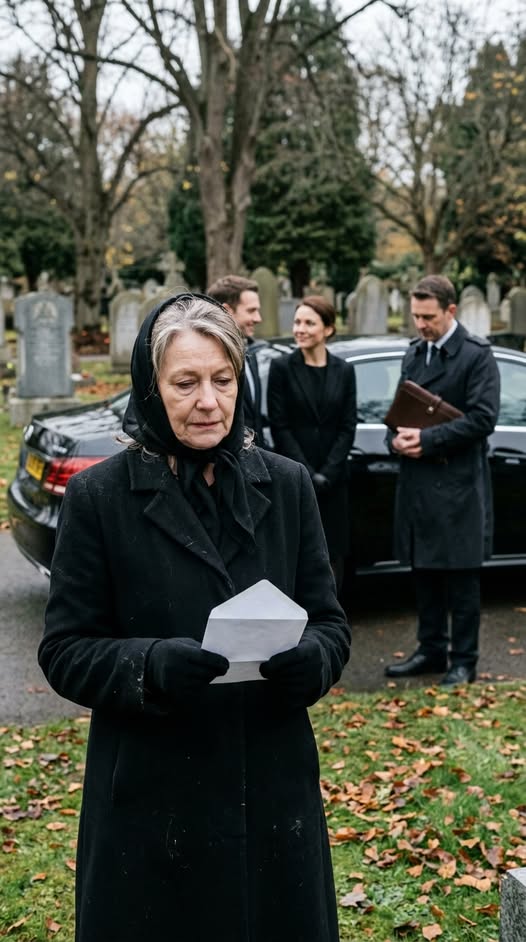
At my husband’s funeral, my children inherited the estate, the apartments, the cars, and a fortune I never even knew existed… while I was handed a folded envelope and told, “Costa Rica is perfect for someone your age.”
My children did not cry when the lawyer read Roberto’s will.
They smiled.
I had already cried enough for everyone in that room.
For eight years, I watched my husband disappear one fragile piece at a time. I fed him. Bathed him. Lifted him when he could no longer turn himself in bed. I stitched clothes late into the night until my fingers cramped, just to help cover medicines nobody else seemed willing to pay for.
And still, when it was time to divide what he left behind, everyone suddenly remembered who his children were.
No one seemed to remember who his wife had been.
My daughter, Rebecca, inherited the apartments.
My son, Diego, got the cars.
Together, they took the estate, the land, and an amount of money so large the whole air in that office shifted.
And me?
I was given one small folded envelope.
No explanation.
No kindness.
No apology.
No human warmth.
Just paper.
I still remember the sound it made when Rebecca snatched it from my hands and opened it in front of everyone, like she was unveiling a joke that had been written especially to embarrass me.
Inside was a one-way plane ticket to Costa Rica.
That was all.
No letter.
No key.
No note.
No message in Roberto’s handwriting.
Not one line explaining why the man I had cared for until his final breath was leaving millions to them…
and sending me alone to another country.
That was when the smiles began.
Rebecca’s thin, satisfied smile.
Diego’s little half-laugh.
And Elvira, my daughter-in-law, who did not even bother lowering her eyes.
“Costa Rica is quiet,” Diego said, looking down at his inheritance papers again. “Perfect for someone your age.”
He used that soft, careful tone cruel people love most, the kind that pretends to be concern while it is really just a hand on your back pushing you toward the door.
I was seventy-two years old.
And for the first time in years, I did not just feel widowed.
I felt discarded.
The cruelest part was not the money.
The cruelest part was watching my children look more alive over what they had gained than heartbroken over the man they had lost.
Because Roberto did not leave this world suddenly.
He faded slowly.
And while I was the one holding his body together, his medications together, his house together, his dignity together, they came and went like distant guests. Short visits. Fast embraces. Expensive perfume. Polished shoes. Sympathy that never stayed long enough to feel real.
Rebecca lived in comfort.
Diego lived far away.
And Elvira always looked at our home as if hardship might stain her clothes if she stood in it too long.
I was the one who kept sewing.
Sewing for groceries.
Sewing for pills.
Sewing for electricity.
Sewing for the small humiliations that old age and illness bring into a house.
At night, while Roberto drifted in and out of shallow sleep, he would reach for my hand as if he wanted to say something and never quite found the courage.
The night before he died, he did say one thing.
At the time, it sounded strange. Almost meaningless.
“Don’t judge by appearances, Teresa. The most valuable things sometimes come in the smallest packages.”
READ PART 2 (Final Epilogue) Click Here :AT MY HUSBAND’S FUNERAL, MY CHILDREN INHERITED EVERYTHING Part 2
At the funeral, standing there with that airline ticket in my hand and those smiles around me, I told myself it was probably just the confused comfort of a dying man.
But that night, alone in the house, I looked at the ticket again.
Departure in three days.
Costa Rica.
Roberto and I hardly ever spoke about Costa Rica. It was not where we honeymooned. Not where we had family. Not some old dream we used to whisper about and never reached.
It made no sense.
And still, something in me would not tear it up.
Maybe it was grief.
Maybe it was pride.
Maybe it was the last stubborn piece of my heart that still refused to believe a man could spend forty-five years beside me only to humiliate me at the very end.
So I packed one small suitcase.
Three dresses.
My rosary.
A photograph from our wedding.
And the little money I had left.
Just before leaving, I opened the drawer in Roberto’s nightstand out of habit more than intention.
And that was when I found the photograph.
I had never seen it before.
In it, Roberto was decades younger, standing beside a man who looked so much like him that my chest went tight. They were smiling in front of green mountains and low clouds.
On the back, written by hand, were only a few words:
Roberto and Tadeo.
Costa Rica, 1978.
I stared at that name as if it might crack open and explain forty-five years of marriage all at once.
Who was Tadeo?
Why had my husband never once spoken that name to me?
The flight was long, uncomfortable, and quieter than I imagined a plane full of strangers could be. I wore black the entire way. Grief sat on my chest like wet cloth. By the time I landed in San José, the air met me warm and heavy, and for one honest second, fear moved through me so sharply I almost turned around.
I was alone.
I was seventy-two.
I had a ticket I did not understand.
And a photograph with a name that would not let me breathe.
Then I saw him.
A well-dressed man in a perfectly cut gray suit stood near arrivals, watching me as if he had been expecting me for a very long time.
He did not hesitate.
He did not look uncertain.
He did not search the crowd twice.
He walked straight toward me.
“Mrs. Teresa Morales?” he asked.
I nodded, though my throat had gone dry.
“My name is Moisés Vargas,” he said. “I’m an attorney. I’ve been waiting for you.”
Not waiting for someone.
Waiting for me.
As if whatever this was had started long before I understood I belonged to it.
During the drive, I could barely speak.
He did.
He told me he had known Roberto well.
He told me my husband had planned everything carefully.
He told me my children had received exactly what they were meant to receive.
And then he looked at me through the rearview mirror and said I was about to understand something that had been hidden for years.