The first thing people ever noticed about my nephew Keller was his size.
At ten, he looked twelve. At twelve, he looked fifteen. By sixteen, he had shoulders like a door frame, hands the size of catcher’s mitts, and a neck that made every T-shirt collar look too tight. My brother Dwight talked about that boy the way men talk about classic cars and winning lottery tickets. Keller had been wrestling since he was seven. He had state titles. He had trophies with little gold figures twisting on top. He had coaches shaking his hand and college scouts sniffing around early.
He also had a mean streak wide enough to drive a truck through.
Everybody in the family knew it. Nobody said it plain.
They called it intensity. Competitiveness. High energy. A strong personality. That was the language people used when a kid like Keller pinned smaller cousins to the grass until they cried, or swiped food off a younger kid’s paper plate because he could, or stood too close on purpose so children backed up like he was weather moving in.
My son Eli was the opposite of all that.
He was twelve, narrow-shouldered, soft-spoken, and always half a thought away from wherever he really wanted to be, which was usually inside a book or bent over his desk fitting tiny plastic wings onto model airplanes. He was the kind of kid who apologized if he bumped into a chair. Keller noticed that the way dogs notice limps.
The bullying had been going on for about two years by then.
At Thanksgiving, I’d seen Eli come back from the side yard with dirt on his sweater and that tight, shut-down look around his mouth that meant he’d decided silence was safer than honesty. At Christmas, a wheel from one of his model landing gears went missing after Keller had spent ten minutes “just checking out the nerd plane stuff.” At my parents’ place in March, I caught Keller shoulder-checking Eli hard enough to send him into the hallway table, then grinning when I looked over.
I talked to Dwight once. Only once.
We were standing beside his grill while hamburgers hissed and spat grease into the flames. I remember the smell of lighter fluid and overdone onions, Dwight’s apron tied too tight around his belly, his face already pink from beer and heat.
“Keller’s getting rough with Eli,” I said. “It needs to stop.”
Dwight snorted like I’d told him a joke too small to bother laughing at.
“They’re boys,” he said. “They mess around.”
“He’s not messing around.”
“He’s bigger, sure. Eli’s gotta toughen up a little. Put him in a sport. All that reading’s not doing him any favors.”
Karen, his wife, was arranging burger buns on a tray nearby. She didn’t even look up. “Keller doesn’t mean anything by it,” she said. “He just plays hard.”
That was the conversation. That was the whole thing. The first adult warning I gave and the first time I understood I was talking to people who had mistaken excuses for parenting.
After that, I stopped expecting help and started doing what a lot of people do when they don’t want to admit how bad something is: I managed. I hovered. I redirected. I kept Eli close. I timed bathroom breaks. I made sure we left early.
Then came the barbecue at my parents’ house in July.
The air that afternoon smelled like charcoal smoke, cut grass, citronella candles, and hot dog buns going stale in their plastic bag. The patio was crowded with folding chairs and red cups sweating onto every flat surface. My mother had made potato salad in the big yellow bowl she brought out every summer. My father was in one of his old straw hats pretending he was in charge of the grill while everyone quietly worked around him.
Dwight showed up late, loud, and already bragging.
He clapped Keller on the back and announced to anybody within twenty feet that college scouts had been watching him again. Full rides. D1 interest. First real athlete in the family, he said, as if the rest of us had spent our lives crocheting in a cellar.
Eli stayed close to me most of the afternoon. He helped carry plates, refilled drinks, and tried to stay out of Keller’s line of sight. But Keller always found him.
It started small. A “playful” shove. A mocking comment about Eli’s glasses. Then Keller “accidentally” stepped on Eli’s new sneakers, grinding his heel down until Eli winced.
I was about to step in when it happened.
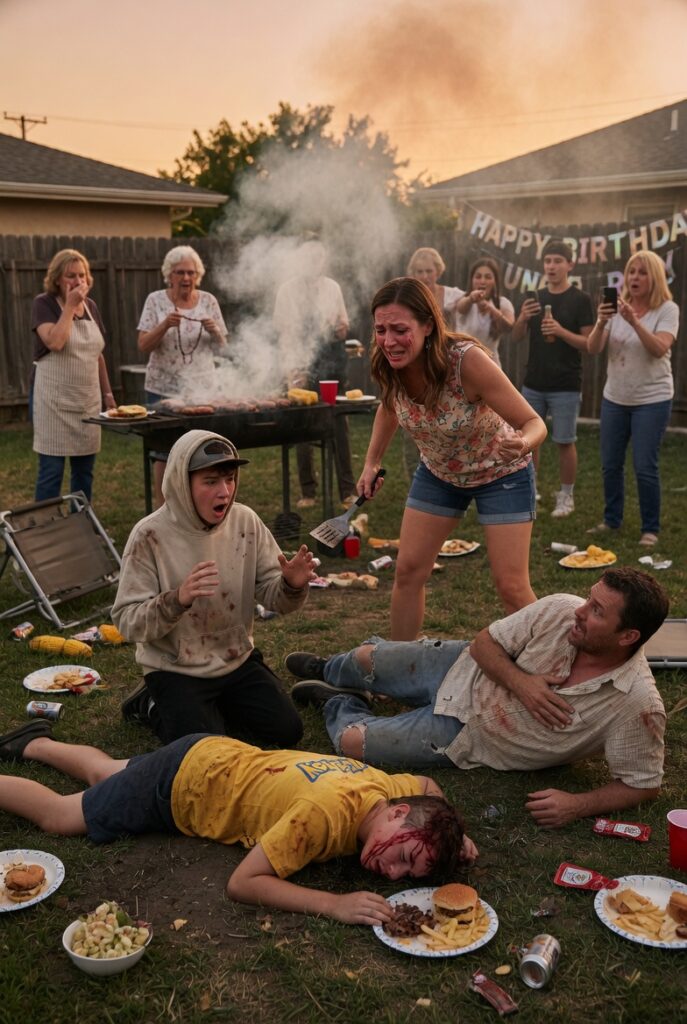
Keller grabbed Eli by the shirt, spun him around, and slammed him backward into the wooden picnic table. Eli’s head hit the corner with a sickening crack.
The sound was sharp. Final.
Eli crumpled to the grass like a rag doll. He didn’t move.
For one horrible second, the entire backyard went silent except for the sizzle of meat on the grill.
Then chaos.
I ran. I dropped to my knees beside my son, my hands shaking as I checked for a pulse. “Eli! Eli, baby, wake up!”
He was unconscious. Blood trickled from the back of his head.
I looked up. Keller stood there, breathing hard, a smirk still half-formed on his face like he thought this was still a game.
Dwight was already laughing nervously. “Boys will be boys, right? He’ll be fine.”
That was the moment something inside me snapped.
I stood up slowly. My vision narrowed until all I could see was Dwight’s smug face.
I walked straight up to him, planted both hands on his chest, and shoved with every ounce of rage and fear I had.
Dwight hit the ground hard right next to his son.
The backyard exploded again — this time with shouts, gasps, and people rushing forward.
But I didn’t care.
I stood over both of them — the bully and the man who had enabled him — and spoke loud enough for everyone to hear.
“Touch my son again, and next time I won’t stop at one punch.”
(Continued in Part 2)