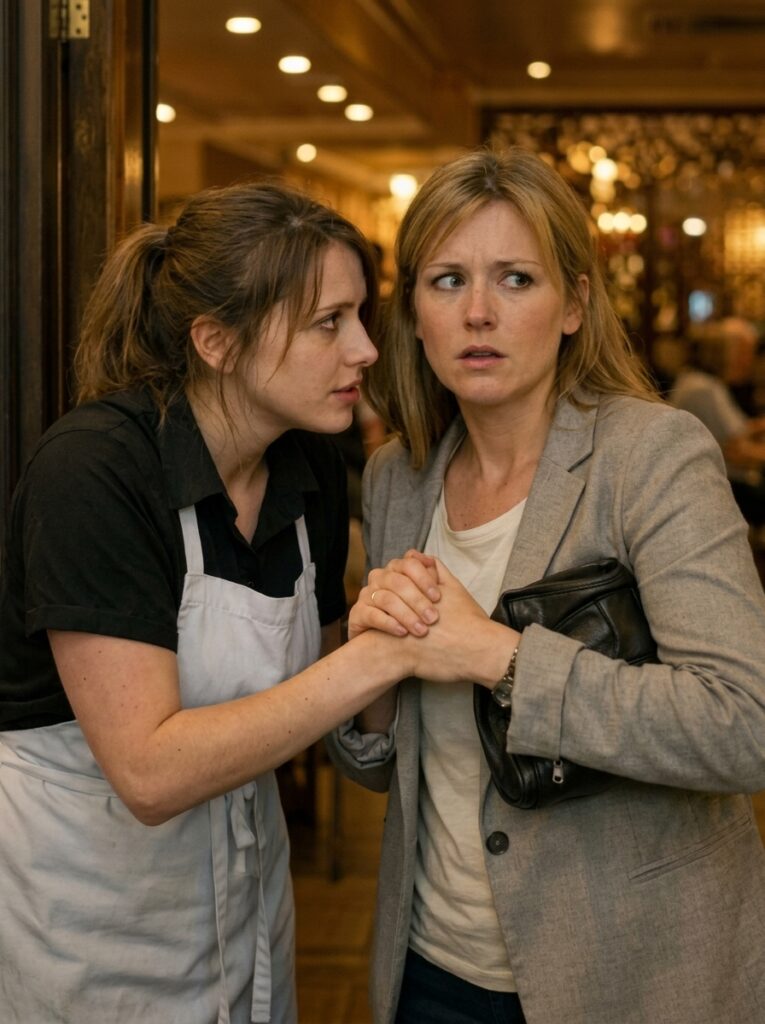
The waitress caught my wrist one week before my wedding and whispered, “Hide now if you want to keep your name, your condo, and your future from the man who says he loves you.”
“Don’t look at me like that,” she said, already scanning the front door. “Please. There’s a folding screen in the back corner. Go behind it. Right now.”
I stared at her.
I had driven straight from work to the restaurant with my wedding binder on the passenger seat, a pen clipped to my blouse, and a head full of seating charts, cake flavors, and centerpieces. I was supposed to be meeting the event manager at seven. I was supposed to be talking about shrimp skewers and place cards.
Instead, a waitress I had never seen before was gripping my arm so hard I could feel the shape of her fingers through my sleeve.
“I’m here to finalize the reception,” I said. “Are you sure you have the right person?”
“You’re Nina Carter.”
It was not a question.
“Yes.”
Her throat moved as she swallowed. “Then I have the right person. Listen to me. In about two minutes, two people are going to walk in here. You cannot let them see you. If you trust me for five minutes, I can save you.”
The word “save” hit me wrong. My first instinct was to pull away, ask for the manager, and leave. My second instinct came from somewhere deeper and colder. I looked into her face and saw panic. Not the sloppy kind. Not the kind people fake for attention. This was old panic. The kind that had lived somewhere for years.
“Please,” she whispered. “I’m begging you.”
I don’t know why I listened. Maybe because my fiancé’s mother had insisted I come alone tonight. Maybe because the waitress already knew my name. Maybe because every woman knows the sound of another woman speaking from experience she never wanted.
I nodded once.
She released my arm and exhaled like she had been holding her breath all day. “Back corner,” she said. “Behind the carved screen. There’s a little alcove. You’ll be hidden, but you’ll hear everything.”
I moved through the half-empty dining room in a fog. Rosewood House was the kind of place older families loved for anniversaries and rehearsal dinners. White tablecloths. Polished wood floors. Warm lamps. A piano in the corner no one ever seemed to play. I had fallen in love with it the first night Mason’s mother brought me there. She had smiled across the table and said, “This place is classic. A marriage should begin somewhere classic.”
Now I slipped behind a tall walnut screen near the back wall and found a small cushioned nook tucked behind it. A sofa. A side table. A view of nothing unless you leaned just right through the narrow carved openings. I sat down and clutched my purse so tightly my knuckles ached. My heart was pounding so hard it felt embarrassing, like surely someone out there could hear it.
I counted my breaths. One. Two. Three.
The front door opened.
I heard heels first. Then a voice I knew as well as my own name.
“Window table,” Lorraine Hale said. “Like always.”
My stomach dropped.
Then Mason answered, low and uneasy. “Mom, maybe we shouldn’t do this here.”
My body went cold.
I leaned toward the carved gap and saw them take their seats exactly where the waitress must have known they would. Lorraine in a cream blazer, pearls at her throat, posture straight as a ruler. Mason across from her, navy button-down, sleeves rolled, jaw tight. If someone had taken a picture of them right then, they would have looked like any close family sharing dinner before a wedding.
My future husband. My future mother-in-law. My future, sitting under warm lights with menus in their hands.
“Stop fidgeting,” Lorraine said. “You look guilty before anything’s even happened.”
Mason rubbed his palms on his pants. “I just don’t understand why this has to be this complicated.”
“Because your little fiancée has assets and clean credit. That is why.”
She opened her leather folder and spread papers across the table. Even from a distance, I knew those weren’t catering papers. They were the kind of documents that could strip me of everything before I ever made it to the altar.
I pressed my hand over my mouth to keep from making a sound. The waitress appeared at their table with water glasses, her face blank, professional. She didn’t glance toward my hiding spot once.
Lorraine waited until the waitress left. “The prenup is ready. You sign it tomorrow. She signs it at the rehearsal dinner. We make it look like a formality. Then, after the wedding, we trigger the clauses. Her condo goes into the family trust. Her savings become joint. And when the inevitable happens…”
Mason’s voice cracked. “Mom, I do love her. In my own way.”
Lorraine laughed, a cold, elegant sound. “Love doesn’t pay the Hale debts, darling. Her software company is worth eight figures on paper. Her parents left her that inheritance last year. We need it. The company is bleeding. Your gambling problem didn’t help.”
I felt the room spin. Mason’s gambling? He had told me he stopped years ago. He had cried in my arms about it on our third date.
Mason leaned forward. “She trusts me. She loves me. This feels… dirty.”
“Dirty is losing everything we built,” Lorraine hissed. “Your father’s legacy. My reputation. You will marry her, you will control the assets, and in eighteen months we file for divorce on grounds she can’t fight. Irreconcilable differences. She walks away broken, we walk away rich. Simple.”
I wanted to vomit. The woman who had taken me shopping for wedding dresses, who had called me “daughter” with tears in her eyes, was planning to destroy me like a business transaction.
The waitress returned with appetizers. As she set them down, she angled her body so her back was to me and whispered something so softly only I could catch it through the screen: “Stay. There’s more.”
I stayed.
For the next forty minutes I listened to them discuss timelines, lawyers on retainer, how to isolate me from my friends after the honeymoon, how to make sure my name stayed on the mortgage so the debt would ruin me. Mason sounded reluctant at first, then resigned, then almost excited when they talked about the new yacht they could buy with my money.
When they finally left, I couldn’t move. My legs felt like water.
The waitress came behind the screen. Her name tag said “Elena.” She was maybe thirty-five, dark hair pulled back, eyes that had seen too much.
“I’m sorry,” she said quietly. “I worked here for six months. I overheard them planning this exact thing with the last girl Mason was engaged to. She didn’t listen. She married him anyway. She lost everything. I tried to warn her too. She called me crazy.”
I looked up at her, tears streaming down my face. “Why are you helping me?”
Elena sat on the edge of the sofa. “Because seven years ago, I was you. Different man. Same mother. Same restaurant, actually. I lost my house, my business, my dignity. I’ve been waiting for the chance to stop it from happening again. When I saw you come in with that binder, looking so happy… I couldn’t stay quiet this time.”
She handed me a USB drive. “Everything. Recordings from the last engagement. Bank records I shouldn’t have. Screenshots of texts. Take it. Run. Cancel everything tonight.”
I took the drive with shaking hands. “I loved him.”
“I know,” Elena said gently. “Love makes us blind. But truth opens our eyes. You’re not the first. You can be the last.”
That night I drove home in a daze. I canceled the wedding through tears and rage. I called my best friend at 2 a.m. and asked her to come stay with me. I changed every password, moved money, consulted a lawyer before sunrise.
Mason showed up at my door the next morning with flowers and confusion. “Baby, what’s going on? Mom said the restaurant called and said you never showed up for the meeting.”
I stood in the doorway, no longer the woman who trusted him. “I did show up. I heard everything.”
His face went pale. “Nina, whatever you think you heard—”
“I heard your mother call me an asset. I heard you agree to destroy me for money. I heard you say you loved me ‘in your own way.’”
He tried to push inside. I slammed the door and locked it. Through the wood I heard him begging, then threatening, then crying. None of it touched me anymore.
The next week was hell. Lorraine called my friends, spread rumors that I was unstable. Mason showed up at my office. I had already filed a police report for harassment. The USB drive gave my lawyer everything needed to protect my assets. The wedding was called off publicly. My name trended for a day on social media as “the runaway bride who dodged a bullet.”
But the real story started after that.
I sold the condo. I moved to a small house by the sea, two hours from the city. I needed quiet to rebuild. Elena came to visit two months later. We sat on my porch watching the waves.
“You saved my life,” I told her.
She smiled. “You saved your own. I just gave you the map.”
We became friends. Real friends. She told me her full story — how she had been a successful graphic designer before her own nightmare marriage. How she had rebuilt slowly, working nights as a waitress while starting over. How helping me had healed something in her.
I started writing. Not just code for my software company, but my story. I posted it anonymously on a blog first. Then on social media. The response was overwhelming. Thousands of women wrote to me saying they had lived the same story. Mothers-in-law who saw dollar signs instead of daughters. Men who smiled while sharpening knives. I turned the blog into a book. The book became a movement.
Three years later I stood on a stage in front of two thousand people at a women’s empowerment conference. Elena sat in the front row, proud tears in her eyes.
I looked out at the audience and said, “I almost married a lie. A beautiful, charming, well-dressed lie. But one woman who had nothing to gain and everything to lose chose to speak. That choice changed everything. Never underestimate the power of one voice. Never ignore the whisper that says ‘something is wrong.’ Your instincts are not crazy. They are your ancestors screaming through your bones to protect you.”
The audience rose in a standing ovation. I stepped down and hugged Elena so tightly we both cried.
Life after the almost-wedding wasn’t easy. I lost friends who believed Lorraine’s version. I lost sleep. I questioned my own judgment for a long time. But I also gained something priceless: myself.
I rebuilt my company stronger. I met a man two years later — quiet, kind, a teacher who loved books and Saturday morning pancakes. His name was Daniel. He had no wealthy mother, no hidden debts, just a gentle heart and honest eyes. When he proposed, there was no grand show, just us on the beach at sunset with Elena as witness.
“I don’t want your money,” he said. “I want your mornings and your bad jokes and the way you fight for people. That’s all.”
We married simply. No Rosewood House. No seating charts. Just love that felt like truth.
Years passed. I had a daughter. I named her Elena.
When she was old enough, I told her the story. Not to scare her, but to arm her.
“Sweetheart,” I said one evening as we sat on the same porch, “one day someone might try to dim your light because they see value in what you have instead of who you are. When that happens, listen to the quiet voices. Listen to the women who have walked before you. And most importantly, listen to yourself.”
She nodded solemnly, her small hand in mine.
Elena — my friend — passed away last spring. Cancer. I held her hand at the end. She smiled at me and whispered, “Worth it.”
I still run the foundation we started together — a safe house and legal fund for women escaping financial abuse. We’ve helped over three thousand women reclaim their lives. Every story I hear reminds me how close I came to losing everything.
Mason and Lorraine? They eventually lost the family company. Last I heard they were living in a small apartment, still blaming everyone but themselves. I feel no joy in their fall, only sadness that they chose greed over love.
Looking back now, fifteen years later, I realize the waitress didn’t just save me from a bad marriage. She saved me from a small life. A life where I would have measured my worth by someone else’s approval. Instead, I learned my worth is mine to define.
To every woman reading this who feels that cold instinct in her gut right now — trust it. Hide if you need to. Run if you must. Speak your truth even when your voice shakes. There are other women waiting in the shadows who will catch you when you leap.
You are not alone. You never were.
The greatest wedding gift I never received was the truth. And truth, my friends, is the only thing that truly sets us free.
THE END