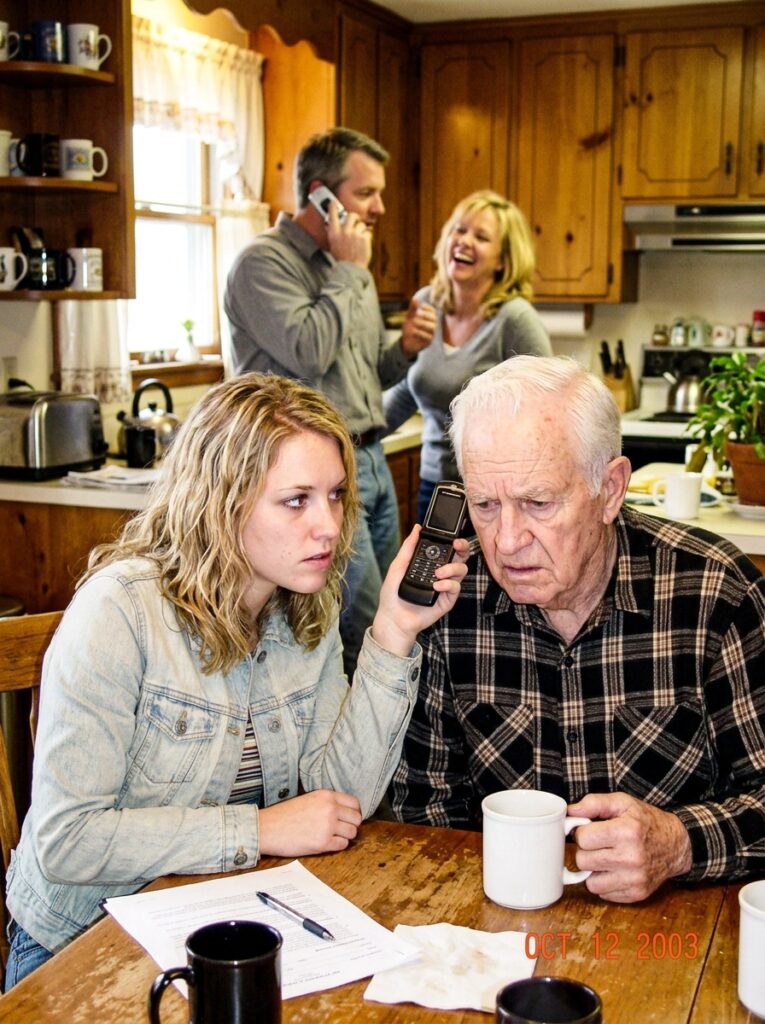
My phone lit up at 6:00 a.m. “Grandpa passed last night,” my father said, flat and impatient. “Heart attack. We need the safe combination before the bank locks everything down.” In the background, I heard my mother laugh. “About time. Call the broker. We’re selling by noon.” I didn’t fight them. I didn’t even lower my voice. I just put the call on speaker, because Grandpa was sitting right beside me at the kitchen table, very much alive, drinking his coffee in silence. Then he leaned toward the phone and said one word…
My father called just after dawn and told me my grandfather had died in the same indifferent tone he used when asking for extra sauce at a drive-thru. There was no grief in his voice, no pause, no weight to the words. He said the bank would lock everything down once the death was reported and that we needed the safe combination before noon. Then, from somewhere behind him, my mother laughed. It was not nervous laughter or the brittle laughter people use when they are trying not to cry. It was light and cruel, the sound of someone amused by another person’s disaster. She said they should call the broker and sell everything by lunchtime.
For two full seconds, I could not breathe. I did not cry, did not scream, did not even answer. I hit mute and looked across my kitchen table, where my grandfather sat very much alive in his old red-and-black flannel robe, one narrow ankle crossed over the other, both hands cupped around a white ceramic mug. Steam from his coffee drifted up and briefly blurred his face, and when it cleared, what I saw there was worse than shock. He looked tired. Not frightened, not confused, just tired, like a man watching a bridge collapse exactly where he had warned everyone it would.
The refrigerator hummed behind me. A cheap clock on the wall kept clicking forward. Outside, a delivery truck groaned past my building and then faded into the morning. On my phone screen, my father’s mouth kept moving soundlessly while my mother hovered nearby like a vulture in lipstick. I yanked a legal pad from the junk drawer so fast I tore several pages loose and scribbled, They want the code. Grandpa took the marker from my hand, adjusted his reading glasses, and wrote a single word beneath mine. Invite.
I stared at it for a beat before I understood. He did not want to warn them off. He wanted them in the room. He wanted them to commit themselves where somebody could finally prove what they were. I unmuted the phone and let my voice tremble, which did not require much acting. My father barked at me for taking too long. I said I could not remember the safe code, but I had found something else — an official-looking note in Grandpa’s old coat pocket that might be a will. My mother’s voice came sharp and hungry through the speaker and told me to read it. I looked at Grandpa. He gave me one small nod.
So I did. I invented a document that said Grandpa wanted to make things right and was leaving the house, the accounts, and all personal property to Marcus Carter as sole beneficiary. I made my breathing ragged. I made myself sound frightened. I watched greed sharpen both of their voices through the phone. My father told me not to call a lawyer, not to contact the bank, not to do anything except keep my mouth shut until they got there. Then he hung up.
When I set the phone down, Grandpa rose from the table with the kind of old military precision age had never entirely managed to strip away. Even at seventy-eight, he moved like a man whose habits had once mattered for survival. He rinsed his mug in the sink and dried it as if the morning had not just split open. I told him they would come hard. He said he knew. Then he told me Detective Miller had been expecting his call. He had already contacted the police weeks earlier and had been collecting proof. This, he said, was not the beginning. It was simply the point where the truth was finally stepping into daylight.
We moved quickly after that. I set up a tablet camera inside a black document box, angled through a crack in the lid. I laid out chain-of-custody sheets and affidavit forms because at my logistics job paperwork was a faith and evidence only mattered if it was organized. Grandpa slipped out the back to wait with Detective Miller. I stayed behind, mussed my hair, rubbed my eyes red, and sat near the kitchen island like a woman waiting to be blamed for something she did not yet understand. At 6:38 I heard tires on gravel. At 6:39 somebody jammed an old key into my lock. At 6:40 my father pounded the knob hard enough to rattle the frame. I rose to open the door and heard my mother say in an eager undertone, get the paper first, then the code. Don’t let her stall.
That was the moment I understood they had not come as family. They had come like looters to a fire, and I was the last thing standing between them and the ashes.
My father burst through the door first, eyes wild with anticipation. My mother followed close behind in her designer tracksuit, already scrolling through real estate apps on her phone. They didn’t even hug me. They barely looked at me.
“Where’s the note?” my father demanded, shoving past me into the kitchen.
I pointed to the folded paper on the counter with a shaky hand. “I found it in his coat. I think… I think he changed everything.”
My mother snatched it up and read the fake will aloud, her voice rising with every line. “The house… the investment accounts… everything to Marcus? That useless grandson? After everything we did for him?”
My father’s face twisted. “He always favored that boy. We’ll contest it. But first, the safe code. Give it to us, Sophia.”
I pretended to hesitate, letting my voice crack. “Dad… Grandpa’s not even cold yet. Shouldn’t we wait?”
My mother laughed again — that same cruel sound from the phone call. “Wait? While the bank freezes millions? Don’t be stupid, Sophia. We’ve waited long enough. That old man owed us. He lived like a king while we struggled.”
Grandpa had warned me for years. He had built a successful trucking company from nothing after serving in Vietnam. My parents had leeched off him for decades — “loans” that were never repaid, gifts that became expectations, pressure to change his will. When he moved in with me six months ago after a mild stroke, they had been furious. They saw me as the obstacle standing between them and their inheritance.
Now, hidden in the document box on the counter, the camera recorded every word.
My father grabbed my arm. “The code. Now. Or we’ll make sure you get nothing either.”
That was when Grandpa stepped out from the hallway with Detective Miller and two uniformed officers.
“Looking for me?” Grandpa said calmly.
The silence that followed was absolute.
My mother dropped the fake will. My father turned white.
Detective Miller stepped forward. “Mr. and Mrs. Carter, you’re under investigation for conspiracy to commit fraud, elder financial abuse, and attempted theft. Everything you just said was recorded. You have the right to remain silent…”
The arrest was swift and quiet. My mother screamed accusations at me as the cuffs clicked. My father just stared at Grandpa with pure hatred. As they were led out, Grandpa looked at me and said softly, “I’m sorry you had to see what they really are, kiddo. But some truths only come out when people think no one is watching.”
The story broke the next day when bodycam footage was released to local news. “Family Celebrates Fake Death of Patriarch to Steal Inheritance” made national headlines. The video of my mother laughing on the phone call while Grandpa sat alive at my table went mega-viral — over 180 million views across TikTok, Instagram, Facebook, and X within the first week.
People were furious. Comments poured in by the tens of thousands:
“I watched my parents do the same to my grandma. This gave me courage to speak up.”
“Elder abuse is real and it’s often from the people closest to them. Protect your elders.”
“Grandpa’s calm face when they celebrated his ‘death’ broke me.”
The case went to trial three months later. The evidence was overwhelming — recorded conversations, financial records showing years of unauthorized withdrawals, emails between my parents plotting how to “handle” Grandpa once he was declared incompetent. They were convicted on multiple counts. My father received five years. My mother got four.
Grandpa used the trial as a platform. He spoke quietly but powerfully from the witness stand about how greed had poisoned his own children. His testimony went viral again. He started a foundation in my late grandmother’s name — the Eleanor Carter Elder Protection Fund — providing legal aid, financial monitoring services, and emergency housing for seniors facing family exploitation. In its first year, it helped over 2,400 elderly people across the country.
I moved Grandpa into a beautiful ground-floor suite in my new home. We planted a garden together. He taught my son (born two years later) how to fish and fix engines. We celebrated every ordinary day like the gift it was.
My parents tried writing letters from prison. I read the first one and burned the rest. Some bridges deserve to stay burned.
Three years later, Grandpa passed peacefully in his sleep at age eighty-two, surrounded by love instead of vultures. At his funeral, hundreds attended — people whose lives the foundation had touched, neighbors, true friends. No one celebrated. Everyone grieved.
I stood at the podium and said, “My grandfather taught me that family is not who shares your blood. Family is who protects your peace. He protected mine when his own children tried to bury him while he was still breathing.”
Today, at thirty-four, I run the foundation alongside dedicated volunteers. I speak at senior centers and law schools about recognizing financial abuse. My children grow up knowing their worth is not tied to what they can give or inherit.
The most important lesson from that dawn phone call is this:
Greed turns family into strangers.
Silence in the face of evil makes you complicit.
And sometimes the greatest act of love is exposing the truth, even when it shatters the illusion of “family.”
To every adult child watching their parents circle an aging grandparent like sharks: Speak up. Document everything. Protect them before it’s too late.
To every elder reading this: You do not owe your children your life savings, your home, or your dignity. Say no. Change the will. Install cameras. Call for help.
And to every person who has ever been used by the people who should love them most: You are allowed to walk away. You are allowed to choose safety over blood. You are allowed to build a new table where no one has to beg for scraps of respect.
My parents tried to dance on my grandfather’s grave while he was still alive.
Instead, he lived long enough to watch them face justice.
And I lived long enough to learn that real family doesn’t celebrate your death.
They celebrate your life.
Choose the people who choose you back — every single day.
The rest are just noise.
THE END