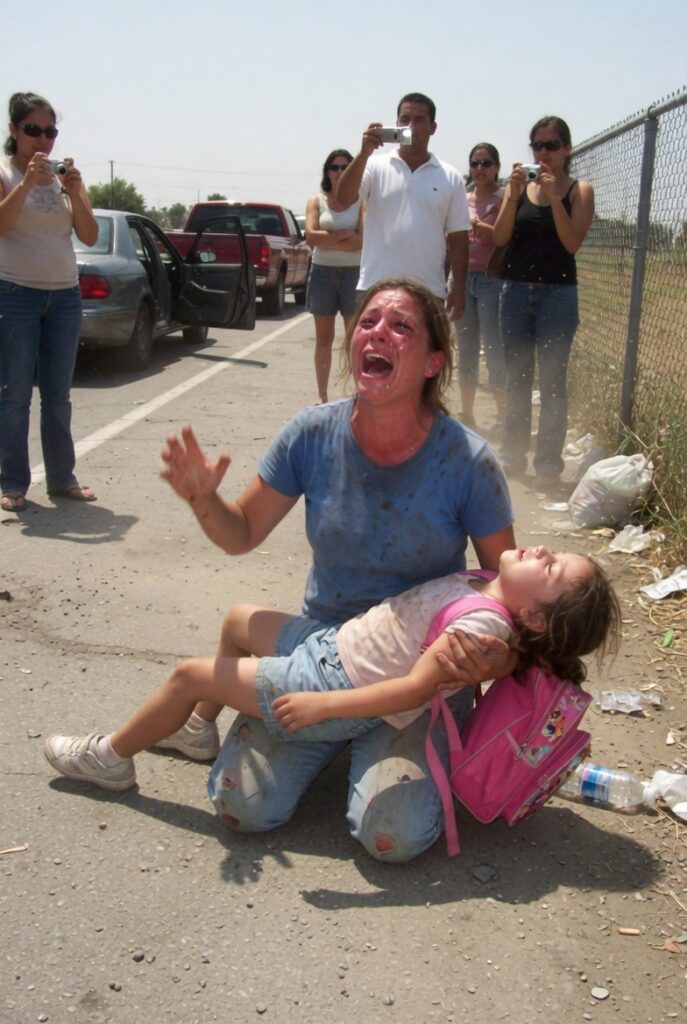
My daughter collapsed on a blistering bridge, and strangers didn’t reach for help—they reached for their phones, hunting a better angle while I begged for someone to call 911. Then nine veterans stepped out of the heat like a trained unit, and everything got worse before it got better.
The bus never came, or maybe it came and we missed it because the stop sign was half-hidden behind a construction fence. All I knew was the sun kept climbing, and the sidewalk on the overpass felt like it was breathing fire through our shoes.
Maya’s hand was in mine, small and sweaty, her backpack bumping her spine with each step. She was nine and stubborn in that quiet way, the way kids get when they don’t want you to see they’re tired. “I’m fine,” she kept saying, even as her voice got thinner.
Halfway across, she stopped answering my questions. Her fingers loosened around mine like she’d forgotten what they were for, and her eyes drifted past me to the traffic below. I turned to ask if she needed water—and that’s when her knees folded.
She didn’t scream or cry. She just dropped, like a puppet whose strings had been cut, her shoulder catching the concrete with a dull sound that felt louder than the cars. I went down with her, my palms scraping, my heart yanking hard against my ribs.
“Maya, hey—look at me.” I brushed hair off her forehead and tried to make my voice steady. Her skin was hot, and her breathing sounded wrong, like she couldn’t decide between a gasp and a sigh.
I shouted for help, but the bridge swallowed my words. A car horn blared, long and angry, and a voice yelled, “Move!” as if my child were a piece of trash in the lane.
I waved my arms anyway. “Please! Somebody call 911! She’s not okay!” A few cars slowed at the end of the bridge, not close enough to help, just close enough to stare.
The first phone appeared over a dashboard, held up like a periscope. Then another person stepped onto the sidewalk from a parked sedan, their camera already aimed. A teenager in a bright shirt said, “This is going crazy,” and turned his screen toward his friend.
“Stop recording,” I snapped, surprised by how sharp my own voice sounded. “Please—just call for help.” The teenager kept filming, his thumb tapping the screen like he was ordering lunch.
An older man leaned out of a pickup and shouted, “You can’t sit there! You’re gonna cause an accident!” Another horn answered him, and the bridge filled with that impatient chorus, as if noise could push sickness back into my daughter’s body.
I tried to lift Maya, but her limbs felt heavy in a way that scared me. I couldn’t get her upright without losing her head, and I couldn’t protect her from the edge of the sidewalk without moving her again. My hands shook so badly I almost dropped my own phone.
Then I heard voices behind me—real voices, not horns. “Ma’am,” someone said, calm and close. “We’ve got her. Stay with me.”
I turned and saw them: nine adults in plain clothes, sun-faded caps, a few wearing simple service pins on their shirts. They moved fast but not frantic, like people who’d learned how to borrow time in emergencies.
One man knelt at Maya’s side and didn’t waste words. “I’m Cal,” he said, already checking her breathing with practiced care. “I was a medic. How long has she been down?”
“I—I don’t know. A minute? Two?” My throat burned. “She just fell. She was walking and then—” I couldn’t finish the sentence without falling apart.
A woman with close-cropped hair crouched beside me, her hand firm on my shoulder. “I’m Renee,” she said, steady as an anchor. “You did the right thing. Keep talking to her. She can hear you.”
Two of the veterans stepped into the roadway at the bridge entrance, hands raised, directing cars to slow without touching anyone. A third stood between us and the nearest onlookers, not threatening, just present—like a door you couldn’t push through.
“That’s not legal!” a man shouted, phone held high. “They’re blocking traffic!” His camera swung from Maya to the veterans as if he’d found a better story.
Cal looked up once, his eyes hard but controlled. “Call 911,” he told the onlookers. “Not your followers. Not your friends. Call 911.”
A woman in an SUV rolled her window down. “Is she on something?” she asked, voice full of suspicion dressed up as concern. Renee didn’t flinch.
“She’s a child in distress,” Renee said. “That’s all you need to know. Please keep the lane open for emergency responders.”
I finally got 911 to connect, my thumb slipping across the screen. The dispatcher’s voice was professional and distant, asking for cross streets and landmarks while my daughter lay too still at my feet. When I said “bridge,” the dispatcher paused, then said, “Units are responding, but traffic is heavy.”
“Please,” I whispered, my voice breaking in the one place I’d been trying to keep it whole. “She’s getting worse.”
Cal touched Maya’s wrist and checked the color in her face, then met my eyes. “Stay with her,” he said quietly. “Keep saying her name.”
I did. I said “Maya” like it was a rope I could throw across a river. I told her about her drawings taped to our fridge, about the way she laughed when our upstairs neighbor’s dog sneezed, about anything that might pull her back to me.
A siren wailed somewhere far off, but it didn’t get closer. Cars had bunched at the end of the bridge, and people had started stepping out to film, turning the sidewalk into an audience.
Then a patrol car arrived from the opposite side, lights flashing in the heat shimmer. The officer’s door opened, and his voice cut through everything, sharp and commanding.
“Step away from the child,” he ordered, eyes on the veterans. “Now.”
Cal didn’t move. He leaned closer to me instead, his voice low enough that only I could hear it.
“If we do this wrong,” he said, “we don’t just lose the video’s opinion—we lose her.”
The officer’s hand moved toward his holster. “I said step back.”
Renee stood slowly, hands visible. “We’re veterans. We’re rendering aid. The child is in medical distress. We have a former medic here. Let us stabilize her until EMS arrives.”
The officer’s eyes flicked to Maya’s pale face, then to the growing crowd filming from cars. “I need everyone to clear the roadway. Now.”
Cal stayed on his knees, one hand gently on Maya’s shoulder. “Officer, she’s tachycardic and hypotensive. Heat exhaustion or worse. We move her wrong and she crashes. Give us two minutes.”
The officer hesitated, then nodded once. “Two minutes. Then we move her.”
The veterans worked like a unit that had done this before. Cal directed compressions on her legs to improve circulation. Renee cooled her with water from a bottle one of them had. Another veteran kept the crowd back with calm authority, reminding people that filming a child in distress wasn’t help.
I kept talking to Maya, my voice cracking. “Stay with me, baby. Mommy’s here. Help is coming.”
The ambulance finally broke through the traffic. Paramedics took over with professional speed. Maya was loaded onto a stretcher, IV started, oxygen mask placed. I climbed into the ambulance with her, holding her hand as the doors closed.
Behind us, the veterans stood on the bridge like sentinels, watching us go.
At the hospital, Maya was diagnosed with severe heat exhaustion bordering on heat stroke. She had been dehydrated for hours, her body temperature dangerously high. The doctor said another ten minutes on that bridge and the outcome could have been different.
The veterans arrived in the waiting room an hour later, still in the same clothes, still carrying the quiet competence that had saved my daughter. Cal introduced them one by one — Renee (Army nurse), Marcus (Marine corpsman), Lena (Air Force pararescueman), and the others, each with their own service and their own reasons for stopping.
“We couldn’t drive past,” Cal said simply. “Not when a kid was down.”
I hugged every one of them, sobbing into their shoulders, thanking them for doing what strangers with phones refused to do.
The video of the veterans helping while others filmed had already gone viral. The contrast was stark — civilians recording for likes while nine veterans stepped in without hesitation. The story made national news. “Nine Veterans Stop Traffic to Save Collapsing Child on Bridge” became a rallying cry for humanity, service, and the bystander effect.
Donations poured in to veteran organizations. Maya received cards and gifts from people across the country. I started a foundation called “Bridge Guardians” to train civilians in basic emergency response and encourage intervention over recording.
Maya recovered fully. She still talks about “the soldiers who saved me.” She wants to be a doctor now, like Uncle Caleb (my brother, who flew in the next day and hasn’t left her side since).
My family — the one I was born into — remains distant. They saw the news and called once, offering “thoughts and prayers.” I thanked them and hung up. Some relationships are better left on the bridge.
The nine veterans became family. They come for barbecues. They teach Maya first aid. They remind me that heroes don’t always wear capes — sometimes they wear faded caps and service pins and the quiet knowledge that one person’s action can change everything.
The most important message I want every person reading this to carry is this:
When someone is down, put the phone down.
Help first. Record later.
The life you save might be a child who only wanted to see the beach with her mom.
To every veteran reading this: Thank you. Your service didn’t end when you took off the uniform. It lives in the way you still show up.
To every parent: Teach your children that kindness is not optional. Teach them that a person in distress is not content.
And to every bystander who has ever filmed instead of helped: The next time you see someone collapse, be the person who steps forward, not the one who steps back to get a better angle.
Maya is ten now. She is healthy, strong, and kind. She still has the little blue suitcase she packed for Bali that day we never took. She keeps it in her closet as a reminder that sometimes the best adventures are the ones you take after the worst days.
The bridge could have been the end.
Instead, it became the place where nine veterans reminded me that humanity still exists — and that one mother’s scream for help can still be answered by people who choose to listen.
Thank you, Cal. Thank you, Renee. Thank you to all nine of you.
You didn’t just save my daughter.
You restored my faith in strangers.
And in a world that sometimes feels like it’s only watching, that is everything.
THE END