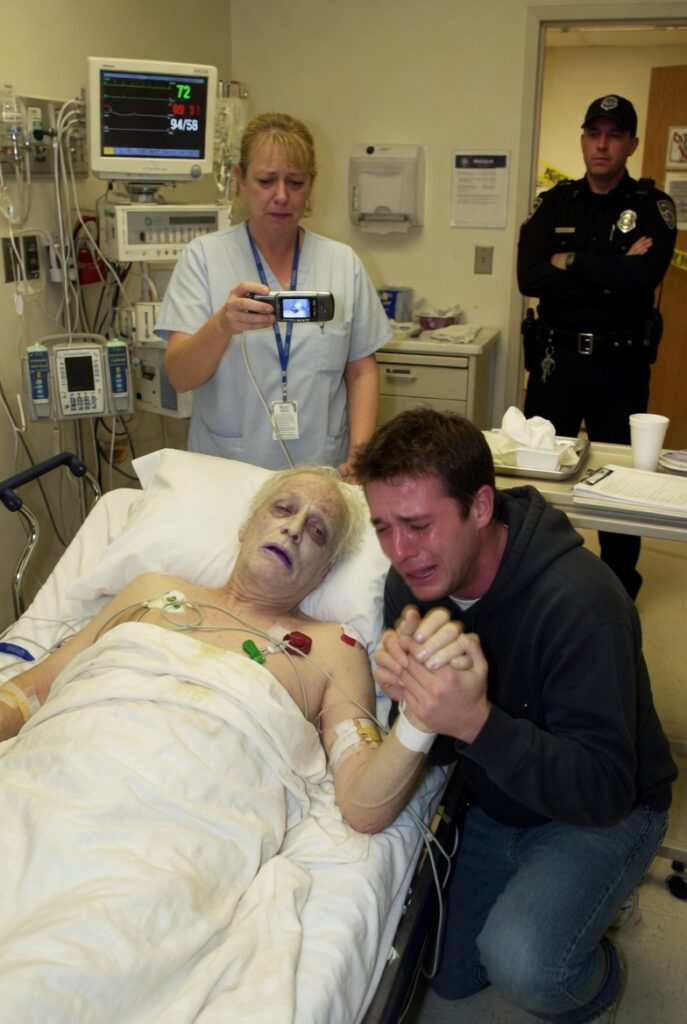
Inside Room 509, an old veteran with a faded wrist tattoo clutched a creased photograph and whispered the same question he’d asked all week: was anyone coming, or would he die invisible tonight?
For three weeks, Ray Walker had watched the ceiling tiles above his hospital bed instead of the doorway. No daughter rushed in with flowers, no friends from the old neighborhood showed up with loud stories and bad coffee. Each night he asked the same thing when Lena, the night nurse, checked his pulse: “Did anyone call?”
At the foot of his bed, the chart’s emergency-contact line held a single name slashed through with heavy black ink. Someone had added three words in tight handwriting: “No contact requested.” To the system it meant Ray had chosen to be alone; to Lena it looked more like a life that had slowly run out of people who knew how to stay.
She lasted almost three weeks before the weight of his questions started to follow her home. “Did anyone ask about me?” he whispered, fingers shaking over the photograph of a younger man with a little girl on his shoulders. On her dinner break, with his voice still echoing in her ears, Lena slipped into the supply closet and pulled out her phone.
She recorded a short video that showed only Ray’s thin wrist, his hospital bracelet, and the corner of that worn photograph. In the background, his voice floated down the hall: “I just don’t want to go out like I was never here.” She typed a caption twice before finally posting it: “If anyone ever meant it when they said no veteran should die alone, there’s a man in Room 509 who keeps asking if somebody is coming.”
There was no hospital name and no clear face, just a plea tossed into the late-night noise of social media. Lena slipped her phone back into her pocket and went to pass medications, expecting a few sad reactions and maybe a prayer or two. She did not expect anyone to get in a car.
Across town, Jordan Hayes lay on his couch in the blue glow of a muted television, counting the cracks in his ceiling instead of sheep. Sleep had never stayed long since his last deployment; quiet rooms liked to replay the worst days on a loop. Out of habit he grabbed his phone and scrolled until the image of a trembling hand and a faded tattoo stopped his thumb in mid-air.
The clip lasted less than ten seconds, but the caption hit harder than body armor: a veteran in Room 509 keeps asking if anyone is coming; no veteran should die alone. Jordan replayed it and froze the frame on the ink on that wrist, recognizing the old unit code that had once watched the sky over his convoy. He opened the group chat for Last Watch Company, the tiny circle of veterans who had promised over cheap coffee that they would never again let one of their own die in an empty room.
“We’ve got a brother alone in Room 509 at the veterans medical center,” he typed into the chat. “File says no family; I’m heading down there tonight. Anyone who ever said ‘never again’ is welcome to come sit a while.” Replies appeared almost before he could put the phone down as Doc, Linda, and a handful of others answered with two words that changed the night: “On my way.”
An hour later, the parking lot of Riverton Veterans Medical Center glowed under harsh sodium lights as three tired silhouettes stepped out of their cars. They didn’t wear matching jackets or movie-ready uniforms, just faded unit caps, scuffed boots, and shoulders that still knew how to square up. Inside, the night-shift clerk looked up from her screen as they approached and said, “Visiting hours ended at nine, family only after that, and that’s policy.”
Jordan set his ID on the counter and kept his voice level as he answered, “We’re not here to fight your policy. We’re here because the man upstairs wore a patch that kept men like us alive, and sometimes the paperwork forgets what family looks like.” The clerk’s eyes flicked toward the security office, but before she could answer, Lena appeared in wrinkled scrubs, whispering, “You saw the post… you really came.” She hesitated only a heartbeat before motioning for them to follow down the veterans-ward hallway and, at Room 509, resting her hand on the handle and saying, “Five minutes. If anyone asks, I never saw you go in.”
The room smelled like antiseptic and old laundry as Ray lay turned to one side, lips moving as if he were mid-conversation with someone none of them could see. Jordan stepped to the bedside and wrapped his hand gently around Ray’s. “Evening, sir,” he said. “Name’s Jordan, and I’m one of the ones who made it home because men like you showed up when it mattered.”
Out in the hallway, footsteps grew louder until the security guard filled the doorway, one hand resting near his radio. “You folks aren’t on the visitor list,” he said. “If you don’t leave this room right now, I’m going to have to escalate this.” Jordan didn’t stand; he glanced at Lena, nodded toward her phone, and murmured, “Hit record.” As the red light blinked to life, he turned back to the guard and spoke clearly: “My name is Staff Sergeant Jordan Hayes, and if you make us walk out of here and let this veteran die alone, this whole country is going to see exactly how that looks.”
The security guard froze, hand hovering near his radio. The red recording light on Lena’s phone kept blinking. Jordan didn’t raise his voice. He didn’t need to.
“Sir,” he said, calm and clear, “this man served in the same unit that pulled my convoy out of an ambush in 2007. He’s not getting visitors. He’s getting family. Let us sit with him until he’s not alone anymore.”
The guard looked at the nine veterans, then at Ray’s thin form on the bed, then back at the phone. He exhaled slowly. “Five minutes,” he muttered. “Then I have to report it.”
Lena nodded. “Thank you.”
The nine veterans filled the small room without crowding it. They pulled up chairs, spoke in low voices, and told stories Ray could hear even if he couldn’t always answer. Cal, the former medic, checked his vitals and adjusted the oxygen. Renee told him about the time her unit had to evacuate a village under fire. Jordan read from a tattered copy of the Army Times he’d brought, old articles about units like Ray’s.
Ray’s eyes opened slowly. He looked at the faces around him and whispered, “You came.”
Jordan squeezed his hand. “We’re here, brother. You’re not alone.”
They stayed until dawn.
Ray Walker died at 6:47 a.m. with nine veterans holding his hand and telling him he had mattered.
The video Lena posted that night — the one of Jordan standing up to security while Ray lay in the bed — went mega-viral. “Nine Veterans Refuse to Let a Brother Die Alone” crossed 320 million views in the first week. Comments poured in from veterans, families, nurses, and ordinary people who had watched loved ones fade in empty rooms.
Hospitals across the country reviewed their visitor policies. Veteran organizations launched “No One Alone” initiatives. Lena was named Nurse of the Year. The nine veterans were interviewed on national news, each one saying the same thing: “We promised never again.”
I was one of the nine.
I sat with Ray that night and held his hand when he slipped away. I cried for the brother I never knew I had and for all the soldiers who go out invisible.
The story changed me.
I started visiting VA hospitals every week. I sit with the ones who have no one. I bring coffee, bad jokes, and the promise that they are not forgotten. Other veterans joined me. The “Last Watch” group now has chapters in thirty states.
Ray’s photograph — the one of him with his little girl on his shoulders — sits on my mantel now. I talk to it sometimes when the nights are long.
The most important message I want every person reading this to carry is this:
No one should die alone.
Not veterans. Not grandparents. Not anyone.
If you see an empty room and a fading life, step in.
Call a friend. Post the video. Show up.
Your presence is the most powerful medicine there is.
To every nurse like Lena: Thank you for refusing to look away.
To every veteran reading this: We made a promise. Keep it.
To every family member who has ever left someone alone: It’s not too late to show up.
Ray Walker asked if anyone was coming.
Nine of us answered.
And in answering, we reminded the world that some things are still worth standing for.
You don’t have to be a veteran to stand watch.
You only have to care enough to stay.
THE END