Her first thought wasn’t “I’ve won the Nobel Prize.” It was “What could be happening at this hour?”
She picked up the phone. A voice told her she’d been awarded the 2019 Nobel Memorial Prize in Economic Sciences. Her immediate response? “With whom?”
When they told her “Abhijit Banerjee and Michael Kremer,” she said, “Oh, you want to talk to him?” and handed the phone to her husband, who was also just waking up.
Then they told her: “You need to be ready for a press conference in 45 minutes.”
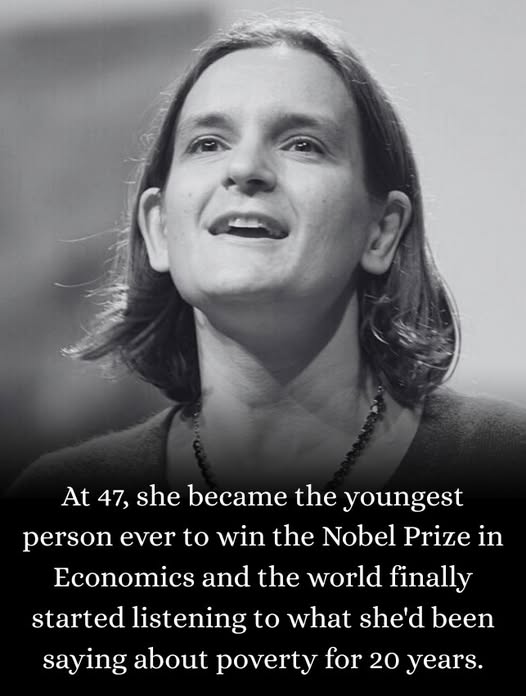
At age 47, Esther Duflo had just become the youngest person ever to win the Nobel Prize in Economics. She was also only the second woman to receive the honor—and the first female economist (the previous woman winner, Elinor Ostrom in 2009, was a political scientist).
But the truly revolutionary part wasn’t just who won. It was why.
For two decades, Duflo, her husband Banerjee, and colleague Michael Kremer had been quietly transforming how the world fights poverty. And the Nobel Committee was finally recognizing it.
The problem they faced was enormous: global poverty affects billions of people. For decades, economists and policymakers had approached it with sweeping theories and massive programs. Some worked. Many didn’t. But nobody knew exactly why.
Duflo, Banerjee, and Kremer asked a simple question: What if we stopped trying to solve all of poverty at once?
What if, instead, we broke this massive problem into smaller, specific questions that could actually be answered scientifically?
Questions like: Do smaller class sizes improve education outcomes? Does providing free school uniforms increase attendance? Does giving farmers access to fertilizer actually help them? What’s the most effective way to increase vaccination rates?
Their innovation was adapting randomized controlled trials—the gold standard in medical research—to economics. They would test one specific intervention at a time in real communities, measuring actual results with scientific rigor.
It sounds obvious now. But in the 1990s, when they started, it was revolutionary.
Starting in the mid-1990s, Michael Kremer began conducting field experiments in Kenya, testing specific policies to improve school outcomes. Duflo and Banerjee joined this work, and together they expanded it across multiple countries and issues—education, health, financial inclusion, agriculture.
They weren’t sitting in offices theorizing about poverty. They were in villages in Kenya, India, Indonesia, and dozens of other countries, testing real interventions with real people.
And they discovered something crucial: the poor weren’t making irrational decisions. They were making completely logical choices based on the constraints and information they had.
“Our goal is to make sure that the fight against poverty is based on scientific evidence,” Duflo explained after winning the prize. “It starts from the idea that often the poor are reduced to caricatures and often, even people who try to help them do not actually understand the roots of the problem.”
Her work revealed uncomfortable truths. For instance, microcredit loans—once hailed as the solution to poverty—didn’t significantly boost small-business growth or improve health and education outcomes the way everyone assumed. Her research in India proved it.
Other studies showed that simply giving parents information about their children’s learning levels dramatically improved outcomes. That free deworming medication in schools increased attendance more cost-effectively than many expensive interventions. That small incentives could boost vaccination rates significantly.
These weren’t grand theories. They were specific, tested, proven solutions.
In 2003, Duflo co-founded the Abdul Latif Jameel Poverty Action Lab (J-PAL) at MIT to expand this work. By 2019, J-PAL had been involved in nearly 1,000 projects across 84 countries. Policies developed from their research had impacted more than 450 million people.
The Royal Swedish Academy of Sciences noted in their announcement: “The research conducted by this year’s Laureates has considerably improved our ability to fight global poverty. In just two decades, their new experiment-based approach has transformed development economics, which is now a flourishing field of research.”
When Duflo spoke at the Nobel Banquet in Stockholm, she said something powerful: “I speak on behalf of many more. For we represent a movement that is much broader than any one of us.”
She also addressed what it meant to be only the second woman to win the prize:
“Today, I am also proud to represent women, and in particular women in economics… I cannot help but hope that this prize, with its emphasis on the essential question of how to improve the lives of others, and with one woman among the laureates, will encourage many others to come join us.”
The reality is sobering. Women remain dramatically underrepresented in economics at every level—from undergraduate students to PhD candidates to prize winners. Duflo acknowledged this openly, pointing to the “aggressive and macho” culture of the economics profession.
But her win represented something important: a reminder that economics isn’t just about interest rates and stock markets. It’s about understanding how people actually live their lives and finding evidence-based ways to improve them.
Esther Duflo didn’t solve global poverty. She would be the first to say that’s impossible for any one person or even one generation.
But she proved something equally valuable: that we don’t have to rely on guesswork or ideology. We can use science to figure out what actually works, one specific question at a time.
A woman from Paris who got her PhD from MIT in 1999 showed the world that the fight against poverty doesn’t require grand theories. It requires listening to the poor, understanding their actual constraints, testing specific solutions, and building evidence piece by piece.
At 47, she became the youngest Nobel laureate in economics not by having all the answers, but by asking the right questions.
And by proving that sometimes the most revolutionary act is breaking an impossible problem into solvable pieces.